


Association of anemia with poor housing quality among older Indian adults: Multilevel modeling analysis of nationally representative cross-sectional study in India
- PMID: 39790765
- PMCID: PMC11709077
- DOI: 10.4103/jfmpc.jfmpc_556_24
Association of anemia with poor housing quality among older Indian adults: Multilevel modeling analysis of nationally representative cross-sectional study in India
Abstract
Introduction: Anemia is an important public health disorder. There is a significant chunk of India's population residing in poor housing quality with inadequate sanitation and hygiene, which might lead to higher anemia prevalence. The objective was to determine the association between anemia with poor housing quality among the older Indian adult population (≥45 years) as per residence.
Methods: This study analyzed the nationally representative dataset of the Longitudinal Ageing Study in India (LASI 2017-18, Wave-1). Bivariate analysis and logistic regression were conducted to show the association of anemia (outcome variable) with poor housing quality (explanatory variable). Multivariable logistic regression was conducted by adjusting for covariates as per their models. P value <0.05 was considered statistically significant. STATA version 17 was used for analysis.
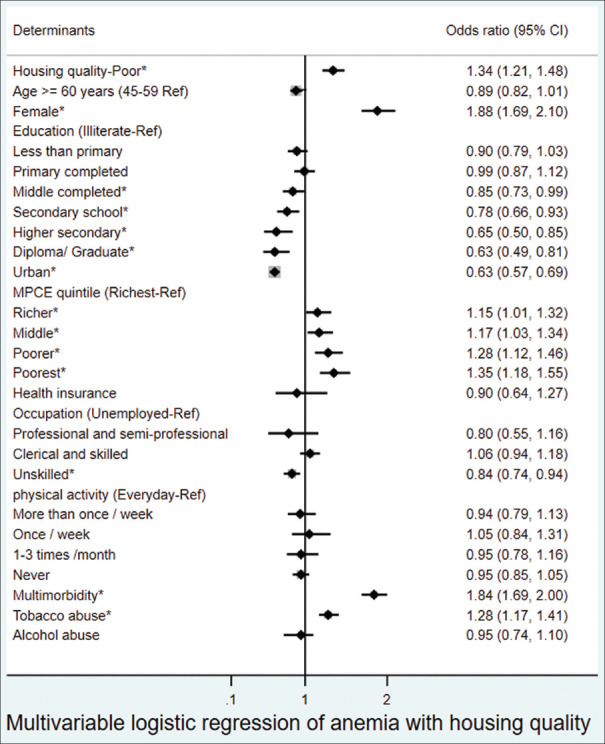
Results: Our study found that higher adjusted odds of having anemia among older Indian adults were observed among participants with overcrowding (AOR 1.30, 95%CI 1.19-1.42), having access to open/nonsanitary toilet facility (AOR 1.56, 95%CI 1.41-1.72), no electric supply (AOR 1.31, 95%CI 1.12-1.53), and overall poor housing quality (AOR 1.34, 95%CI 1.21-1.48). All of these associations were even higher in urban areas except for having access to open/nonsanitary toilet facilities, which was much higher in rural areas (AOR 1.61, 95%CI 1.45-1.79).
Conclusion: Through a nationally representative large dataset, this study generated compelling evidence despite several obstacles indicating a positive association between anemia and poor housing quality among older Indian adults. It might raise awareness and assist individuals in steering clear of the negative effects of overcrowding, using open/nonsanitary toilet facilities, lack of electric supply, and overall housing quality on anemia status. It is advised to conduct additional research to determine temporality and causation.
Keywords: Anemia; LASI; housing; housing quality; modeling; sanitation.
Copyright: © 2024 Journal of Family Medicine and Primary Care.
Conflict of interest statement
There are no conflicts of interest.
Figures
References
-
- Government of India. Anemia Mukt Bharat Training Tool Kit. New Delhi. 2018. [[Last accessed on 2024 Feb 13]]. Available from: https://www.i4n.in/wp-content/uploads/2023/05/Anemia-Mukt-Bharat-Trainin... .
-
- Bagla P, Bagla P. World Health Organization. Anaemia Policy Brief. 2014. Available from: http://thousanddays.org/tdayscontent/uploads/Anameia-Policy-Brief.pdf .
-
- Stevens GA, Finucane MM, De-Regil LM, Paciorek CJ, Flaxman SR, Branca F, et al. Global, regional, and national trends in haemoglobin concentration and prevalence of total and severe anaemia in children and pregnant and non-pregnant women for 1995-2011: A systematic analysis of population-representative data. Lancet Glob Health. 2013;1:e16–25. - PMC - PubMed
LinkOut - more resources
Full Text Sources