Review
. 2025;6(1):5.
doi: 10.1038/s43246-024-00721-y. Epub 2025 Jan 7.

Device-assisted strategies for drug delivery across the blood-brain barrier to treat glioblastoma

Affiliations
Review

Device-assisted strategies for drug delivery across the blood-brain barrier to treat glioblastoma

Nassir Mokarram et al. Commun Mater. 2025.

Abstract

The blood-brain barrier, essential for protecting the central nervous system, also restricts drug delivery to this region. Thus, delivering drugs across the blood-brain barrier is an active research area in immunology, oncology, and neurology; moreover, novel methods are urgently needed to expand therapeutic options for central nervous system pathologies. While previous strategies have focused on small molecules that modulate blood-brain barrier permeability or penetrate the barrier, there is an increased focus on biomedical devices-external or implanted-for improving drug delivery. Here, we review device-assisted drug delivery across the blood-brain barrier, emphasizing its application in glioblastoma, an aggressively malignant primary brain cancer in which the blood-brain barrier plays a central role. We examine the blood-brain barrier and its features in glioblastoma, emerging models for studying the blood-brain barrier, and device-assisted methods for crossing the blood-brain barrier. We conclude by presenting methods to monitor the blood-brain barrier and paradigms for combined cross-BBB drug delivery.

Keywords: Biomaterials; Blood-brain barrier; CNS cancer; Translational research.


Conflict of interest statement

Competing interestsThe authors declare no competing interests.

Figures
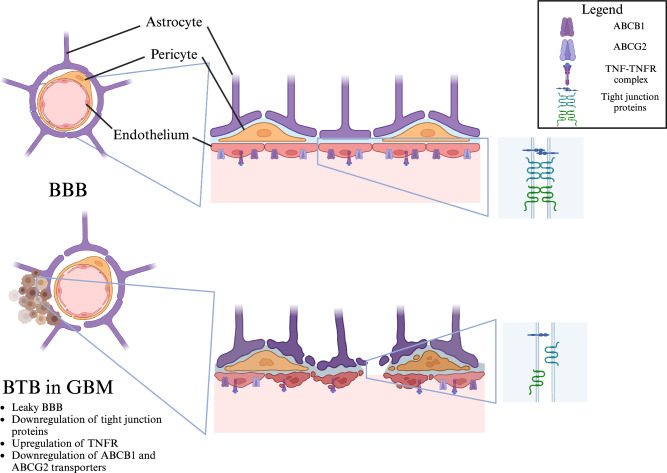
Fig. 1
Fig. 1. Comparison of the BBB and BTB.
The BBB is composed of endothelial cells, astrocytes, and pericytes, with tight junctions forming between endothelial cells. The BTB in GBM is leakier than normal BBB in part due to lower expression of tight junction proteins and active efflux transporters (ABCB1 and ABCG2). BBB, blood-brain barrier; BTB, blood-tumor barrier; GBM, glioblastoma. Figure created in BioRender. Lab, B. (2024) https://BioRender.com/b97c299.
Fig. 2
Fig. 2. BBB and BTB Models.
BBB and BTB can be modeled in vivo, in vitro, and in silico. Each model has limitations, and no model can completely recapitulate human conditions. in vitro models vary in their ability to replicate key aspects of the BBB, such as cell-cell interactions, 3D characteristics, and mechanical forces like sheer stress. Some of the greatest challenges of in vitro models include their inability to accurately mimic mechanical forces and the variations observed in the different areas of the BBB and BTB. The most used in vivo models are rodents, but rodents have significantly different BBB structures and functions than humans, including with the efflux transporters; hence, the application of other preclinical validation models such as canines, non-human primates, and porcine is necessary. Nevertheless, all in vivo models have the burden of ethical concerns, high cost, and maintenance, rendering them unsuitable for high-throughput assays. BBB, blood-brain barrier; BTB, blood-tumor barrier. Figure created in BioRender. Lab, B. (2024) https://BioRender.com/y94i838.
Fig. 3
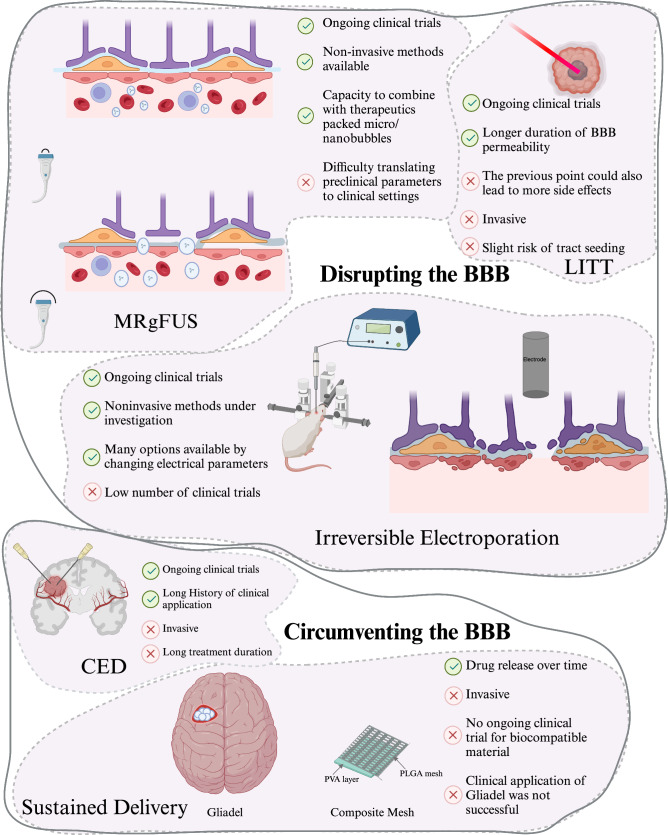
Fig. 3. Device-assisted drug delivery methods applicable to GBM.
Promising device-assisted methods to deliver drugs across the BBB include MRgFUS, LITT, electroporation, CED, and sustained delivery. These methods either disrupt or circumvent the BBB. Device-assisted methods that disrupt the BBB include MRgFUS, LITT, electroporation, and electrical fields. Methods that circumvent the BBB include CED and sustained delivery methods (e.g., Gliadel wafers and composite meshes). Each of these technologies presents opportunities and challenges for translation to clinical application. GBM, glioblastoma; BBB, blood-brain barrier; MRgFUS, magnetic resonance-guided focused ultrasound; LITT, laser interstitial thermal therapy; CED, convection-enhanced delivery; PVA, polyvinyl alcohol; PLGA, poly(lactic-co-glycolic acid). Figure created in BioRender. Lab, B. (2024) https://BioRender.com/a63u637.
Fig. 4
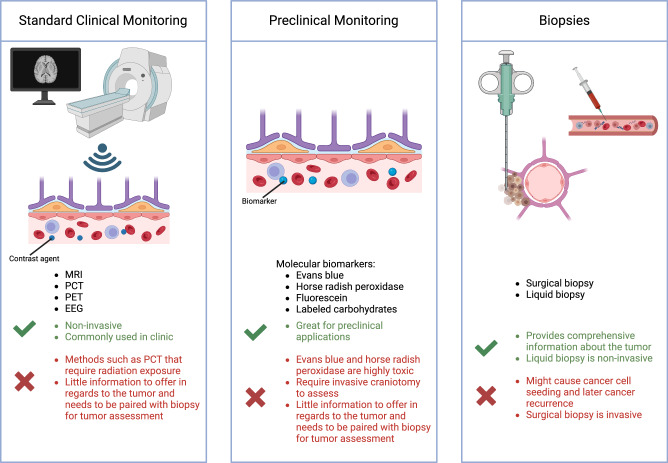
Fig. 4. BBB and tumor monitoring and assessment methods.
BBB monitoring methods can be categorized by application and invasion into clinical and preclinical monitoring methods. These monitoring methods can also be used to provide some data on the tumor and BTB conditions; however, BBB monitoring methods are not sufficient to assess the tumor and taking biopsies is necessary. BBB, blood-brain barrier; BTB, blood-tumor barrier; MRI, magnetic resonance imaging; PCT, perfusion computed tomography; PET, positron emission tomography; EEG, electroencephalography. Figure created in BioRender. Lab, B. (2024) https://BioRender.com/o56x349.
Fig. 5
Fig. 5. Continuous sampling.
Continuous sampling can encompass the benefits of other BBB crossing and tumor-monitoring strategies in a single platform with reduced risks to patients. On-demand biopsy facilitates continuous tumor phenotyping and assessment of drug concentration at the tumor site. Relatedly, the sampling conduit also enables targeted drug delivery via assisted BBB crossing. Finally, clinical imaging techniques such as MRI can be used in conjunction with an implanted device to evaluate tumor movement into the device as well as BBB disruption at the interface with the implant. BBB, blood-brain barrier; MRI, magnetic resonance imaging. Figure created in BioRender. Case, A. (2024) https://BioRender.com/o69z127.

References

    1. Daneman, R. & Prat, A. The blood–brain barrier. Cold Spring Harb. Perspect. Biol.7, a020412 (2015). - PMC - PubMed
    1. Terstappen, G. C., Meyer, A. H., Bell, R. D. & Zhang, W. Strategies for delivering therapeutics across the blood–brain barrier. Nat. Rev. Drug Discov.20, 362–383 (2021). This article provides a comprehensive review of the non-invasive and pharmacological-based methods for drug delivery to the CNS. - PubMed
    1. Watkins, S. et al. Disruption of astrocyte–vascular coupling and the blood–brain barrier by invading glioma cells. Nat. Commun.5, 4196 (2014). - PMC - PubMed
    1. Lyon, J. G., Mokarram, N., Saxena, T., Carroll, S. L. & Bellamkonda, R. V. Engineering challenges for brain tumor immunotherapy. Adv. Drug Deliv. Rev.114, 19–32 (2017). - PMC - PubMed
    1. van Tellingen, O. et al. Overcoming the blood–brain tumor barrier for effective glioblastoma treatment. Drug Resist. Updat.19, 1–12 (2015). - PubMed

LinkOut - more resources