


Efficacy of bolus injections of landiolol hydrochloride as premedication in coronary artery CT angiography
- PMID: 39792205
- PMCID: PMC11723858
- DOI: 10.1186/s13244-024-01892-5
Efficacy of bolus injections of landiolol hydrochloride as premedication in coronary artery CT angiography
Abstract
Purpose: To assess the efficacy of bolus injections of landiolol hydrochloride as premedication in coronary artery CT angiography (CCTA).
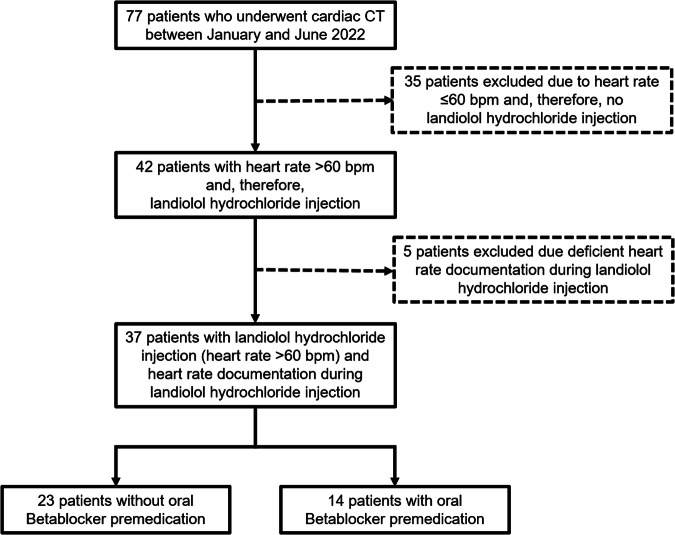
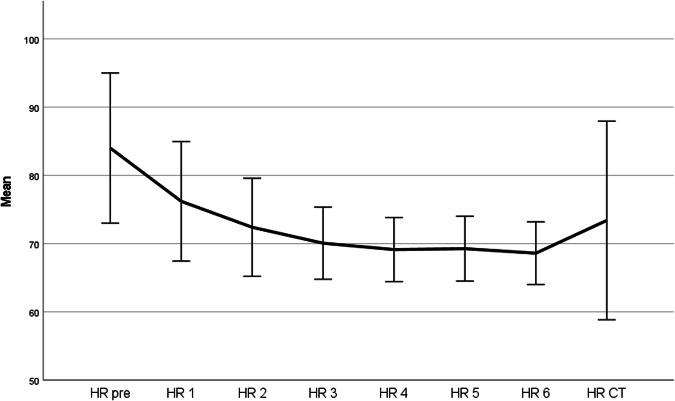
Methods: The study population consisted of 37 patients (17 female; median age, 56 years; IQR, 19 years; range, 19-88 years) who underwent CCTA after intravenous injection of landiolol hydrochloride due to a heart rate > 60 bpm. Landiolol hydrochloride was administered in a stepwise manner until a heart rate of ≤ 60 bpm was achieved or a maximum dose of 60 mg was reached after six injections. Heart rates routinely displayed continuously on the CT scanner before the start of the landiolol hydrochloride injection (HRPRE), after each partial dose (HR1-6), during the CT scan (HRCT), and after the examination before moving from the CT table (HRPOST) were recorded. Furthermore, the blood pressure routinely measured before (BPPRE) and after the examination before moving from the CT table (BPPOST) was recorded.
Results: A HRCT of ≤ 60 bpm was achieved in 13 patients (35%) and a HRCT ≤ 65 bpm was achieved in 25 patients (68%). The mean difference (± SD) between HRPRE and HRCT was -11 ± 9 bpm in total, -14 ± 10 bpm in patients without oral beta-blocker premedication and -6 ± 5 bpm in patients with oral Beta-blocker premedication.
Conclusions: Landiolol hydrochloride enables a reduction of the heart rate in patients with and without oral beta-blocker premedication, whereby the use of serial partial doses is a simple and effective approach in clinical routine.
Critical relevance statement: In cardiac CT, weight-independent, stepwise landiolol hydrochloride injection up to 40 mg reduces heart rate by -14 bpm without and -5 bpm with oral beta-blocker premedication, and achieves heart rates of ≤ 65 bpm in a significant proportion of patients.
Key points: The ideal heart rate for cardiac CT is ≤ 60-65 bpm, which improves image quality and reduces radiation dose. In cardiac CT, landiolol hydrochloride intravenously reduces heart rate by -14 bpm. Heart rate of ≤ 65 bpm can be achieved in a significant proportion of patients.
Keywords: Beta-adrenergic blocker; Cardiac imaging techniques; Heart rate; Heart–drug effects; Multidetector computed tomography.
© 2025. The Author(s).
Conflict of interest statement
Declarations. Ethics approval and consent to participate: This retrospective study was approved by the Ethics Committee of the Medical University of Graz, Austria (Reference Number: 34-483 ex 21/22). Informed consent was waived. Consent for publication: Not applicable. Competing interests: The authors declare that they have no competing interests.
Figures
References
-
- Stocker TJ, Leipsic J, Chen MY et al (2021) Influence of heart rate on image quality and radiation dose exposure in coronary CT angiography. Radiology 300:701–703 - PubMed
-
- Ablad B, Borg KO, Carlsson E et al (1975) A survey of the pharmacological properties of metoprolol in animals and man. Acta Pharmacol Toxicol 36:7–23 - PubMed
-
- Murakami M, Furuie H, Matsuguma K, Wanibuchi A, Kikawa S, Irie S (2005) Pharmacokinetics and pharmacodynamics of landiolol hydrochloride, an ultra short-acting β1-selective blocker, in a dose escalation regimen in healthy male volunteers. Drug Metab Pharmacokinet 20:337–344 - PubMed
-
- Nasrollahi-Shirazi S, Sucic S, Yang Q, Freissmuth M, Nanoff C (2016) Comparison of the β-adrenergic receptor antagonists landiolol and esmolol: receptor selectivity, partial agonism, and pharmacochaperoning actions. J Pharmacol Exp Ther 359:73–81 - PubMed
LinkOut - more resources
Full Text Sources
