


A systematic review of salivary gland hypofunction and/or xerostomia induced by non-surgical cancer therapies: prevention strategies
- PMID: 39792256
- PMCID: PMC11723892
- DOI: 10.1007/s00520-024-09113-x
A systematic review of salivary gland hypofunction and/or xerostomia induced by non-surgical cancer therapies: prevention strategies
Erratum in
-
Correction to: A systematic review of salivary gland hypofunction and/or xerostomia induced by non‑surgical cancer therapies: prevention strategies.Support Care Cancer. 2025 Mar 20;33(4):305. doi: 10.1007/s00520-025-09327-7. Support Care Cancer. 2025. PMID: 40111560 Free PMC article. No abstract available.
Abstract
Purpose: This systematic review aimed to assess the updated literature for the prevention of salivary gland hypofunction and xerostomia induced by non-surgical cancer therapies.
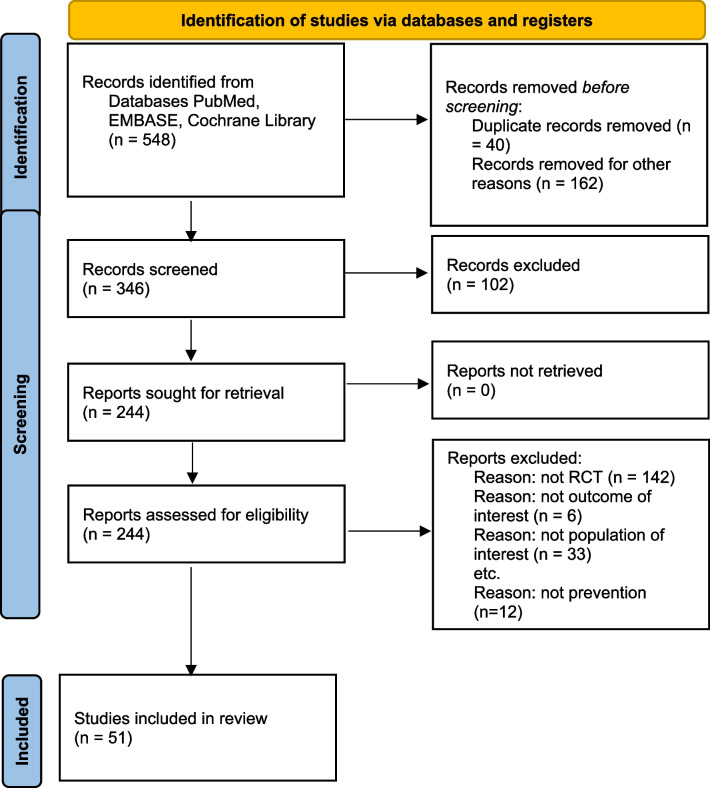
Methods: Electronic databases of MEDLINE/PubMed, EMBASE, and Cochrane Library were searched for randomized controlled trials (RCT) that investigated interventions to prevent salivary gland hypofunction and/or xerostomia. Literature search began from the 2010 systematic review publications from the Multinational Association of Supportive Care in Cancer/International Society of Oral Oncology (MASCC/ISOO) up to February 2024. Two independent reviewers extracted information regarding study design, study population, cancer treatment modality, interventions, outcome measures, methods, results, risk of bias (RoB version 2), and conclusions for each article.
Results: A total of 51 publications addressing preventive interventions were included. Eight RCTs on tissue-sparing radiation modalities were included showing significant lower prevalence of xerostomia, with unclear effect on salivary gland hypofunction. Three RCTs on preventive acupuncture showed reduced prevalence of xerostomia but not of salivary gland hypofunction. Two RCTs on muscarinic agonist stimulation with bethanechol suggested a preventive effect on saliva flow rate and xerostomia in patients undergoing head and neck radiation or radioactive iodine therapy. Two studies on submandibular gland transfer showed higher salivary flow rates compared to pilocarpine and lower prevalence of xerostomia compared to no active intervention. There is insufficient evidence on the effectiveness of vitamin E, amifostine, photobiomodulation, and miscellaneous preventive interventions.
Conclusion: This systematic review continues to support the potential of tissue-sparing tecniques and intensity-modulated radiation therapy (IMRT) to preserve salivary gland function in patients with head and neck cancer, with limited evidence on other preventive strategies, including acupuncture and bethanecol. Preventive focus should be on optimized and new approaches developed to further reduce radiation dose to the parotid, the submandibular, and minor salivary glands. As these glands are major contributors to moistening of the oral cavity, limiting the radiation dose to the salivary glands through various modalities has demonstrated reduction in prevalence and severity of salivary gland hypofunction and xerostomia. There remains no evidence on preventive approaches for checkpoint inhibitors and other biologicals due to the lack of RCTs.
Keywords: Checkpoint inhibitors; Chemotherapy; Radiotherapy; Salivary gland hypofunction; Xerostomia.
© 2025. The Author(s).
Conflict of interest statement
Declarations. Competing interests: The authors declare no competing interests.
Figures
References
-
- Ang KK, Zhang Q, Rosenthal DI, Nguyen-Tan PF, Sherman EJ, Weber RS, Galvin JM, Bonner JA, Harris J, El-Naggar AK, Gillison ML, Jordan RC, Konski AA, Thorstad WL, Trotti A, Beitler JJ, Garden AS, Spanos WJ, Yom SS, Axelrod RS (2014) Randomised phase III trial of concurrent accelerated radiation plus cisplatin with or without cetuximab for stage III to IV head and neck carcinoma: RTOG 0522. J Clin Oncol 32:2940–2950 - PMC - PubMed
-
- Arbabi-kalati F, Arbabi-kalati F, Deghatipour M, Moghaddam AA (2012) Evaluation of the efficacy of zinc sulfate in the prevention of chemotherapy-induced mucositis: a double-blind randomised clinical trial. Arch Iran Med 15:413–417 - PubMed
-
- Bardet E, Martin L, Calais G, Alfonsi M, Feham NE, Tuchais C, Boisselier P, Dessard-Diana B, Seng SH, Garaud P, Aupérin A, Bourhis J (2011) Subcutaneous compared with intravenous administration of amifostine in patients with head and neck cancer receiving radiotherapy: final results of the GORTEC 2000–02 phase III randomised trial. J Clin Oncol 29:127–133 - PubMed
-
- Javadzadeh Bolouri A, Pakfetrat A, Tonkaboni A, Aledavood SA, Fathi Najafi M, Delavarian Z, Shakeri MT, Mohtashami A (2015) Preventing and therapeutic effect of propolis in radiotherapy induced mucositis of head and neck cancers: a triple-blind, randomized, placebo-controlled trial. Iran J Cancer Prev 8(5):e4019 - PMC - PubMed
-
- Burlage FR, Coppes RP, Meertens H, Stokman MA, Vissink A (2001) Parotid and submandibular/sublingual salivary flow during high dose radiotherapy. Radiother Oncol 61:271–274 - PubMed
Publication types
MeSH terms
Substances
LinkOut - more resources
Full Text Sources
Medical
Research Materials
