. 2025 Jan 10;9(1):9.
doi: 10.1038/s41698-024-00788-3.

Translational and clinical comparison of whole genome and transcriptome to panel sequencing in precision oncology

Affiliations

Translational and clinical comparison of whole genome and transcriptome to panel sequencing in precision oncology

Irina A Kerle et al. NPJ Precis Oncol. .

Abstract

Precision oncology offers new cancer treatment options, yet sequencing methods vary in type and scope. In this study, we compared whole-exome/whole-genome (WES/WGS) and transcriptome sequencing (TS) with broad panel sequencing by resequencing the same tumor DNA and RNA as well as normal tissue DNA for germline assessment, from 20 patients with rare or advanced tumors, who were originally sequenced by WES/WGS ± TS within the DKFZ/NCT/DKTK MASTER program from 2015 to 2020. Molecular analyses resulted in a median number of 2.5 (gene panel) to 3.5 (WES/WGS ± TS) treatment recommendations per patient. Our results showed that approximately half of the therapy recommendations (TRs) of both sequencing programs were identical, while approximately one-third of the TRs in WES/WGS ± TS relied on biomarkers not covered by the panel. Eight of 10 molecularly informed therapy implementations were supported by the panel, the remaining two were based on biomarkers absent from the panel, highlighting the potential additional clinical benefit of WGS and TS.


Conflict of interest statement

Competing interests: I.A.K. reports personal fees from Bayer and stock ownerships in BioNTech, CureVac, Valneva, and Novavax, but declares no non-financial competing interests. C.H. reports honoraria from Novartis and Roche, research funding from Boehringer Ingelheim, and advisory board activities for Boehringer Ingelheim, but declares no non-financial competing interests. L.M. reports financial support from Else Kröner Research College Dresden, a Clinician Scientist Program led by Professor A. El-Armouche, and that his wife is an employee of Pfizer Pharma GmbH, but declares no non-financial competing interests. E.E.M. reports that she became an employee of Pfizer Pharma GmbH after participating in this research project, but declares no non-financial competing interests. M.H. reports personal fees from MSD and stock ownerships in AbbVie, Astellas Pharma, AstraZeneca, Bayer, BridgeBio Pharma, Bristol-Myers Squibb, Daiichi Sankyo, Eisai, Exelixis, Gilead, GSK, Illumina, Incyte, Johnson & Johnson, Merck, MSD, Novartis, Pfizer, PharmaMar, and Roche, but declares no nonfinancial competing interests. The remaining authors declare no competing interests.

Figures

Fig. 1
Fig. 1. Study flow chart.
Extracted tumor DNA and RNA, as well as normal tissue DNA from 20 patients with one hematologic and 18 different advanced solid cancer diagnoses, were originally sequenced as participants in the MASTER program and discussed in the molecular tumor board (MTB) from 10/2015 to 12/2020 (MASTER 1). Aliquots of the same tumor DNA and RNA, as well as normal tissue DNA were then used for panel sequencing (annotation 06–10/2022). To harmonize and update WES/WGS ± TS data, MASTER 1 sequencing data was reanalyzed with the current bioinformatics pipeline of the MASTER program in 06/2023 (MASTER 2). Both panel sequencing and MASTER 2 data were evaluated by physicians trained in precision oncology with access to the patients’ medical history up to the MTB of MASTER 1 (evaluation panel: 06/2022–03/2023, evaluation MASTER 2: 06–08/2023). Therapy recommendations (TRs) and their underlying biomarkers (BMs) derived from the panel were then compared to TRs and underlying BMs from MASTER 1 (comparison 1) and MASTER 2 (comparison 2).
Fig. 2
Fig. 2. Oncoplot depicting biomarkers of different alteration types used for therapy recommendations (black frame) or their presence (no frame) in both whole-exome/whole-genome ± transcriptome sequencing (WES/WGS ± TS) analyses MASTER 1 (M1) and MASTER 2 (M2) as well as panel sequencing (P) of all 20 study patients.
Deletions of NF1 (patient 9), CDKN2A/B (patients 3, 13, 14, 17, 20), and STK11 (patient 19) as well as gains of NTRK3 (patient 1) and PIM1 (patient 3) were all found in a retrospective analysis of panel sequencing data and therefore could not be used as therapy recommendation rationales in P. PVRL4 (patients 2 and 16), TACSTD2 (patients 2 and 7), MTAP (patients 3 and 17), FOLR1 and MSLN (both patient 13) are newer genes of interest in WGS/TS and were all retrospectively analyzed for M1; therefore, they were not available as biomarkers for physicians assessing M1. (MSI microsatellite instability, TMB tumor mutational burden, grid lines: no data available, blue: SNV/Indel [single nucleotide variation/small insertion or deletion], orange: CNV [copy number variation], dark green: DNA structural variant, light green: RNA fusion, pink: RNA expression, dark brown: multiple alteration types of one gene).
Fig. 3
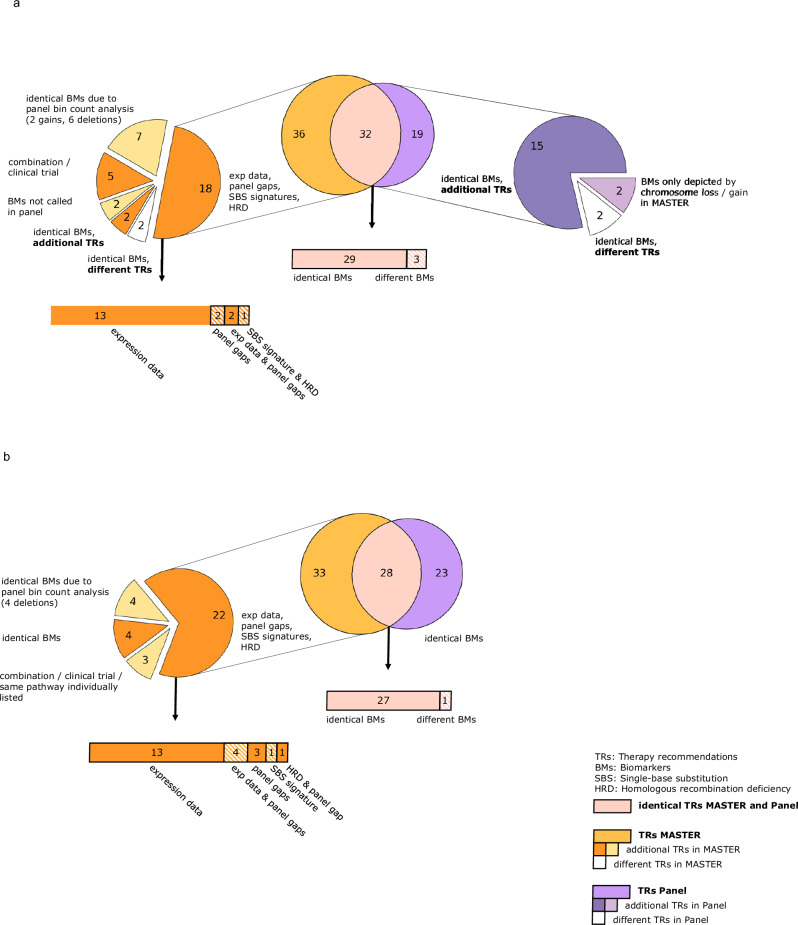
Fig. 3. Venn diagrams depicting the sum and categorization of therapy recommendations (TRs) and underlying biomarkers (BMs) in absolute numbers.
a Comparison 1: original whole-exome/whole-genome ± transcriptome sequencing (WES/WGS ± TS, MASTER 1) versus panel sequencing. b Comparison 2: reanalyzed WES/WGS ± TS (MASTER 2) versus panel sequencing. (exp data: RNA expression data, HRD Homologous recombination deficiency, SBS Single-base substitution).
Fig. 4
Fig. 4. Head-to-head comparison of the most important findings of therapy recommendations (TRs) from the original whole-exome/whole-genome ± transcriptome sequencing (WES/WGS ± TS, MASTER 1), the reanalysis WES/WGS ± TS (MASTER 2), and the panel sequencing.
a Distribution of identical and different TRs in comparison 1 (MASTER 1 versus panel) and comparison 2 (MASTER 2 versus panel), and their underlying biomarkers (BMs). b TRs in MASTER 1 and MASTER 2 based on BMs not covered by the panel. c TRs in MASTER 1 and MASTER 2 based on copy number variations retrospectively detected in the panel by bin count analysis. d TRs based on identical BMs, which were not used as a TR rationale in the comparative analysis. (exp data: RNA expression data, HRD homologous recombination deficiency, SBS single-base substitution).

References

    1. Malone, E. R., Oliva, M., Sabatini, P. J. B., Stockley, T. L. & Siu, L. L. Molecular profiling for precision cancer therapies. Genome Med.12, 8 (2020). - PMC - PubMed
    1. Murciano-Goroff, Y. R., Suehnholz, S. P., Drilon, A. & Chakravarty, D. Precision oncology: 2023 in review. Cancer Discov.13, 2525–2531 (2023). - PMC - PubMed
    1. Kaufman, B. et al. Olaparib monotherapy in patients with advanced cancer and a germline BRCA1/2 mutation. J. Clin. Oncol.33, 244–250 (2015). - PMC - PubMed
    1. Robson, Mark et al. Olaparib for metastatic breast cancer in patients with a germline BRCA mutation. N. Engl. J. Med.377, 523–533 (2017). - PubMed
    1. Golan, Talia et al. Maintenance olaparib for germline BRCA-mutated metastatic pancreatic cancer. N. Engl. J. Med.381, 317–327 (2019). - PMC - PubMed

LinkOut - more resources