


Maternal Long-Chain Polyunsaturated Fatty Acids Status in Pregnancy and Newborn Body Composition
- PMID: 39796500
- PMCID: PMC11722585
- DOI: 10.3390/nu17010066
Maternal Long-Chain Polyunsaturated Fatty Acids Status in Pregnancy and Newborn Body Composition
Abstract
Background: A number of clinical studies have shown a positive association between the maternal n-3 PUFA status during pregnancy and fetal and newborn development and health. Despite this well-documented role of n-3 PUFAs in pregnancy, data on maternal the LC-PUFAs status during pregnancy in the Indonesian population, to our knowledge, are not yet available. This study reports on the LC-PUFA dietary intake among pregnant women in a suburban population of Bogor City, West Java, Indonesia. It also explores the associations of maternal LC-PUFA intake with maternal blood, cord blood, and breast milk LC-PUFA levels and the associations of the latter with infant body composition.
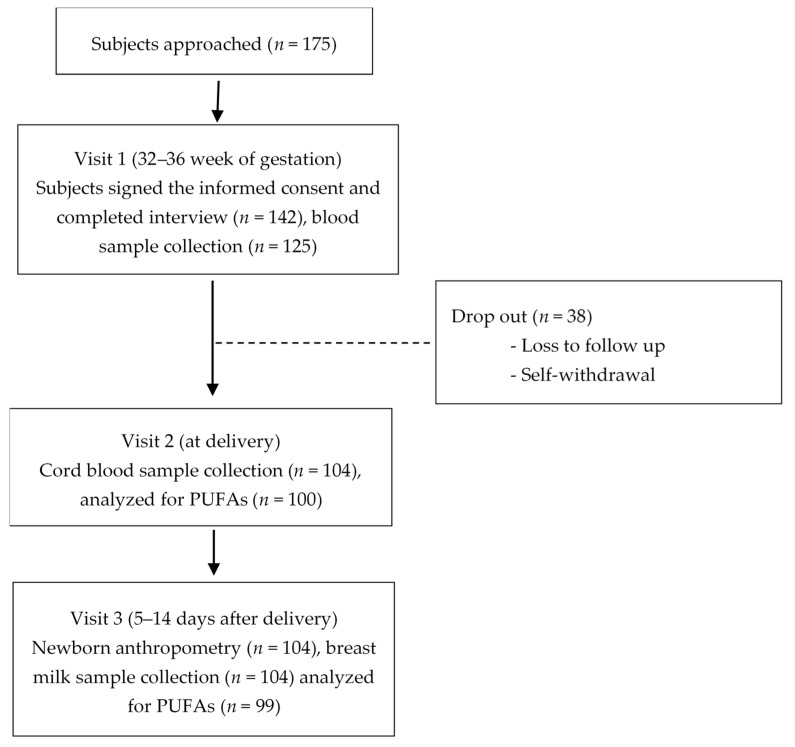
Methods: A total of 142 pregnant women and 104 newborn infants were included in this study. The dietary intake of energy, macronutrients, and selected LC-PUFAs (LA, ALA, EPA, and DHA) was assessed by 2 × 24 h food recall and FFQ. LC-PUFA levels were measured in maternal blood, cord blood, and breast milk. Newborn body composition was determined by anthropometric measures.
Results: The study found that the inadequate intake of energy, protein, and carbohydrates was highly prevalent among pregnant women subjects. The intake of the most important n-3 PUFAs (ALA, EPA, and DHA) was far below the recommended values. Maternal dietary DHA intakes were negatively associated with birth weight and infant fat mass at birth, and dietary intake of total fat and n-6 LA were associated with increased fat accumulation in newborns at specific body sites. Moreover, positive correlations were identified between the EPA in maternal blood and infant % fat mass, and between the DHA in cord blood and newborn birth weight.
Conclusions: Further longitudinal studies, including clinical and biomolecular analyses, are suggested to be conducted to monitor maternal and child health and nutrition in Indonesia and develop well-attuned intervention strategies.
Keywords: Indonesia; LC-PUFA; body composition; diet; newborn; pregnancy.
Conflict of interest statement
The authors declare no conflict of interest. The funders had no role in the design of the study or in the collection, analysis, or interpretation of data.
Figures
References
-
- Chen W. Ω-3 PUFA DHA: Benefits Associated with Brain. Trans. Mater. Biotechnol. Life Sci. 2023;1:46–49. doi: 10.62051/z3e6f320. - DOI
-
- Karmańska A., Cieślak M., Owczarek W., Karwowski B.T. The Role of Docosahexaenoic Acid in Neuronal Development and the Importance of DHA Supplementation during Pregnancy. Farm. Pol. 2023;79:335–345. doi: 10.32383/farmpol/174325. - DOI
-
- Gould J.F., Smithers L.G., Makrides M. The Effect of Maternal Omega-3 (N23) LCPUFA Supplementation during Pregnancy on Early Childhood Cognitive and Visual Development: A Systematic Review and Meta-Analysis of Randomized Controlled Trials1-3. Am. J. Clin. Nutr. 2013;97:531–544. doi: 10.3945/ajcn.112.045781. - DOI - PubMed
MeSH terms
Substances
Grants and funding
- Research Agreement 27/11/2017, the project entitled: "Associations of maternal dietary intake and blood level of long chain polyunsaturated fatty acids in pregnancy, and newborn body composition"/BASF South East Asia Pte Ltd
- Financial Support System for Scientists and Research Teams in the Warsaw University of Life Sciences (grant number 853-2-80-45-780400-S23017)./Warsaw University of Life Sciences
LinkOut - more resources
Full Text Sources
Medical
Research Materials
