


Maternal Perception and Childhood Overweight: Examining Parenting Styles and Eating Behaviors Among Preschoolers: A Cross-Sectional Study from Samsun, Türkiye
- PMID: 39796629
- PMCID: PMC11723418
- DOI: 10.3390/nu17010195
Maternal Perception and Childhood Overweight: Examining Parenting Styles and Eating Behaviors Among Preschoolers: A Cross-Sectional Study from Samsun, Türkiye
Abstract
Background: Accurate maternal perceptions of children's weight status are crucial for early childhood obesity prevention, with evidence suggesting that maternal misperception may delay timely interventions. This study investigated the accuracy of maternal perceptions of child weight and examined associations with parenting styles and children's eating behaviors and demographic factors among preschool-aged children in Samsun, Türkiye.
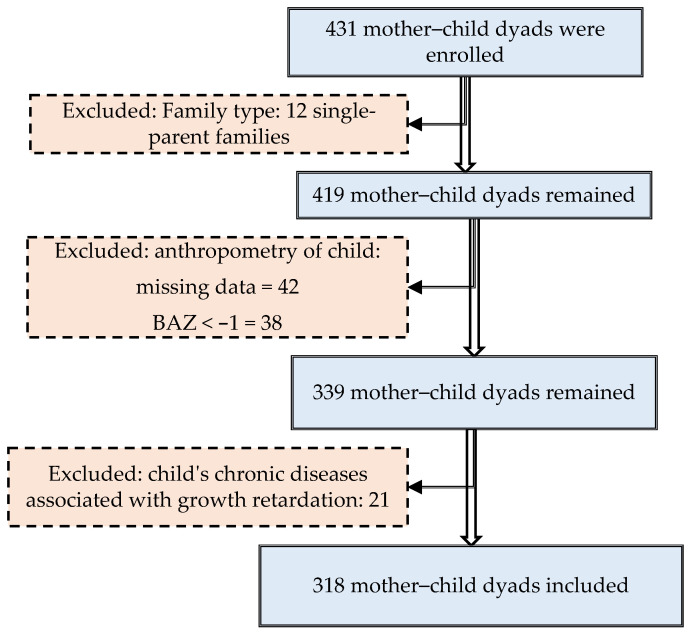
Methods: This cross-sectional study included 318 mother-child pairs recruited from preschools in socio-economically diverse areas of Samsun. Maternal perceptions of child weight status were assessed using a visual scale, while children's anthropometric measurements (height, weight) were recorded to calculate BMI-for-age Z-scores. Parenting styles and children's eating behaviors were evaluated using the Parental Attitude Scale (PAS) and the Children's Eating Behavior Questionnaire (CEBQ), respectively. Data analysis involved chi-square tests and multiple logistic regression to explore associations between maternal perception accuracy, parenting styles, and children's eating behaviors.
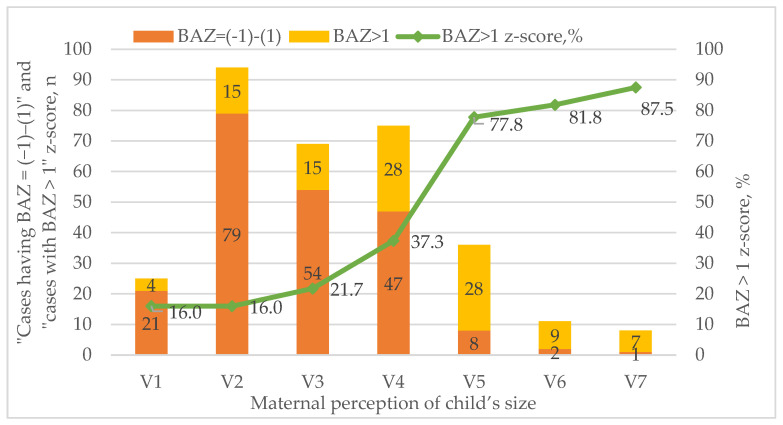
Results: Among 318 mother-child pairs, 59.7% underestimated their child's weight status, with this figure being 84.9% among overweight children. Authoritative parenting was the most common style (78%); no significant association was found between parenting style and maternal perception accuracy. Accurate estimators showed significantly higher scores for food responsiveness (median: 9 (7-12), p = 0.028) and the enjoyment of food (mean: 16.3 ± 4.8, p = 0.003), whereas underestimators scored higher for satiety responsiveness (mean: 23.2 ± 5.7, p = 0.042) and slowness in eating (mean: 11.2 ± 4.2, p = 0.004).
Conclusions: Maternal underestimations of child weight are prevalent, particularly for overweight children, are associated with children's specific eating behaviors. Targeted educational interventions focusing on improving maternal awareness and promoting responsive feeding practices are essential to combat childhood obesity.
Keywords: childhood obesity; children’s eating behaviors; maternal perception; nurturing care; parenting styles.
Conflict of interest statement
The authors declare no conflicts of interest.
Figures
Similar articles
-
Child weight status and accuracy of perceived child weight status as predictors of Latina mothers' feeding practices and styles.Appetite. 2019 Nov 1;142:104387. doi: 10.1016/j.appet.2019.104387. Epub 2019 Jul 29. Appetite. 2019. PMID: 31369764 Free PMC article.
-
Maternal concern and perception about child overweight risk, maternal feeding practices, and child eating behaviors: A cross-sectional study.PLoS One. 2024 Jun 11;19(6):e0302557. doi: 10.1371/journal.pone.0302557. eCollection 2024. PLoS One. 2024. PMID: 38861515 Free PMC article.
-
Associations between Parental Concerns about Preschoolers' Weight and Eating and Parental Feeding Practices: Results from Analyses of the Child Eating Behavior Questionnaire, the Child Feeding Questionnaire, and the Lifestyle Behavior Checklist.PLoS One. 2016 Jan 22;11(1):e0147257. doi: 10.1371/journal.pone.0147257. eCollection 2016. PLoS One. 2016. PMID: 26799397 Free PMC article.
-
Family environmental factors influencing the developing behavioral controls of food intake and childhood overweight.Pediatr Clin North Am. 2001 Aug;48(4):893-907. doi: 10.1016/s0031-3955(05)70347-3. Pediatr Clin North Am. 2001. PMID: 11494642 Review.
-
Nonresponsive Parenting Feeding Styles and Practices and Risk of Overweight and Obesity among Chinese Children Living Outside Mainland China: An Integrative Review of the Literature.Int J Environ Res Public Health. 2023 Feb 24;20(5):4090. doi: 10.3390/ijerph20054090. Int J Environ Res Public Health. 2023. PMID: 36901101 Free PMC article. Review.
References
-
- Shekar M., Popkin B. Obesity: Health and Economic Consequences of an Impending Global Challenge. World Bank Publications; Washington, DC, USA: 2020.
-
- UNICEF . UNICEF Advocacy Strategy Guidance for the Prevention of Overweight and Obesity in Children and Adolescents. UNICEF; New York, NY, USA: 2020.
-
- Hacettepe University Institute of Population . 2018 Turkey Demographic and Health Survey (TDHS) Hacettepe University Institute of Population Studies; Ankara, Türkiye: 2019.
-
- Barışkın E., Ersoy G., Görpelioğlu S., Karaoğlu L., Kılıç B.G., Köksal G., Pekcan G., Yalçın S.S., Yetkin İ., Zergeroğlu A.M. Birinci Basamak Hekimler İçin Obesite ile Mücadele El Kitabı. T.C. Sağlık Bakanlığı Türkiye Halk Sağlığı Kurumu Obezite Diyabet ve Metabolik Hastalıklar Daire Başkanlığı; Ankara, Türkiye: 2013.
MeSH terms
LinkOut - more resources
Full Text Sources
Medical
