


Evaluation of the risk factors for postoperative pectus excavatum and scoliosis in cystic lung disease
- PMID: 39797976
- PMCID: PMC11724798
- DOI: 10.1007/s00383-024-05925-4
Evaluation of the risk factors for postoperative pectus excavatum and scoliosis in cystic lung disease
Abstract
Purpose: To analyze the frequency and predictive factors of the development of postoperative pectus excavatum and scoliosis in children who underwent surgery for cystic lung disease.
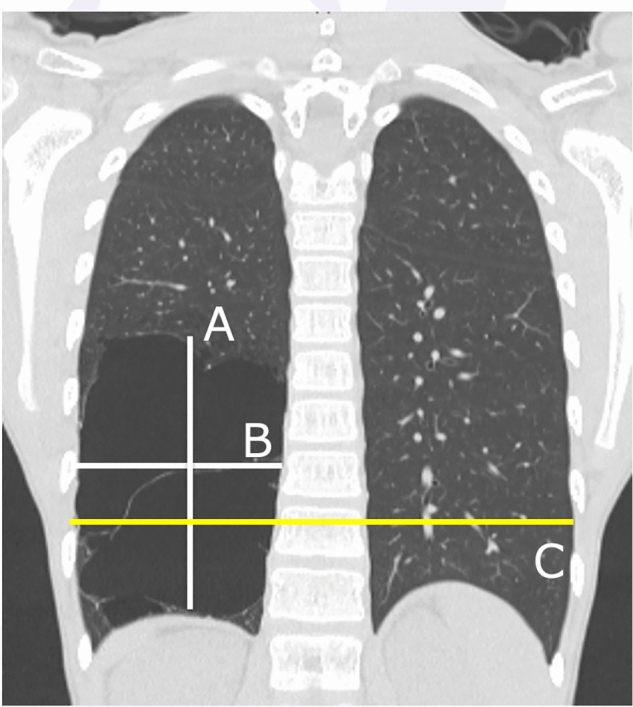
Methods: This study examined patients who underwent surgery for cystic lung disease (open and thoracoscopic) between July 2000 and December 2018 with a > 3-year follow-up period. Lesion size, surgical outcomes, and subsequent musculoskeletal complications were compared between the open surgery and thoracoscopic surgery groups. Univariate and multivariate analyses were performed to identify predictive factors.
Results: Overall, 90 patients (19 and 71 patients in the open and thoracoscopic groups, respectively) were included in this study. There was no significant difference in the incidence of pectus excavatum or scoliosis between open and thoracoscopic surgery; however, Haller's index and Cobb angle were significantly higher in the open surgery group. In the univariate analysis, neonatal surgery and lesion size were substantial predictors of musculoskeletal malformations.
Conclusion: Postoperative musculoskeletal deformities emerge after surgical treatment for cystic lung disease, with thoracoscopic surgery showing advantages in selected dimensions. Neonatal surgery and lesion size are pivotal prognostic factors for musculoskeletal complications. Further corroborative multicenter studies are imperative to substantiate these findings and foster enhanced patient outcomes.
Keywords: Cystic lung disease; Pectus excavatum; Scoliosis; Surgery; Thoracoscopic surgery; Thoracotomy.
© 2024. The Author(s).
Conflict of interest statement
Declarations. Conflict of interest: The authors declare no competing interests.
Figures
References
-
- Stocker LJ, Wellesley DG, Stanton MP, Parasuraman R, Howe DT (2015) The increasing incidence of foetal echogenic congenital lung malformations: an observational study. Prenat Diagn 35:148–153. 10.1002/pd.4507 - PubMed
-
- Rothenberg SS, Kuenzler KA, Middlesworth W, Kay S, Yoder S, Shipman K, Rodriguez R, Stolar CJ (2011) Thoracoscopic lobectomy in infants less than 10 kg with prenatally diagnosed cystic lung disease. J Laparoendosc Adv Surg Tech A 21:181–184. 10.1089/lap.2010.0138 - PubMed
-
- Adams S, Jobson M, Sangnawakij P, Heetun A, Thaventhiran A, Johal N, Bohning D, Stanton MP (2017) Does thoracoscopy have advantages over open surgery for asymptomatic congenital lung malformations? An analysis of 1626 resections. J Pediatr Surg 52:247–251. 10.1016/j.jpedsurg.2016.11.014 - PubMed
-
- Lam FKF, Lau CT, Yu MO, Wong KKY (2021) Comparison of thoracoscopy vs. thoracotomy on musculoskeletal outcomes of children with congenital pulmonary airway malformation (CPAM). J Pediatr Surg 56:1732–1736. 10.1016/j.jpedsurg.2021.01.028 - PubMed
-
- Van Biezen FC, Bakx PA, De Villeneuve VH, Hop WC (1993) Scoliosis in children after thoracotomy for aortic coarctation. J Bone Joint Surg Am 75:514–518. 10.2106/00004623-199304000-00006 - PubMed
MeSH terms
LinkOut - more resources
Full Text Sources
Medical
