. 2025 Jan 11;10(1):5.
doi: 10.1038/s41541-024-01053-1.

Novel oral adjuvant to enhance cytotoxic memory like NK cell responses in HIV vaccine platform

Affiliations

Novel oral adjuvant to enhance cytotoxic memory like NK cell responses in HIV vaccine platform

Mario Alles et al. NPJ Vaccines. .

Abstract

Natural killer (NK) cell-driven effector mechanisms, such as antibody-dependent cell-mediated cytotoxicity, emerged as a secondary correlate of protection in the RV144 HIV vaccine clinical trial, the only vaccine thus far demonstrating some efficacy in human trials. Therefore, leveraging NK cells with enhanced cytotoxic effector responses may bolster vaccine-induced protection against HIV. Here, we investigated the effect of orally administering indole-3-carbinol (I3C), an aryl hydrocarbon receptor (AHR) agonist, as an adjuvant to an RV144-like vaccine platform in a mouse model. We demonstrate the expansion of KLRG1-expressing NK cells induced by the vaccine together with I3C. This NK cell subset exhibited enhanced vaccine antigen-specific cytotoxic memory-like features. Our study underscores the potential of incorporating I3C as an oral adjuvant to HIV vaccine platforms to enhance antigen-specific cytotoxicity of NK cells against HIV-infected cells. This approach may contribute to enhancing the protective efficacy of HIV preventive vaccines against HIV acquisition.


Conflict of interest statement

Competing interests: The authors declare no competing interests.

Figures
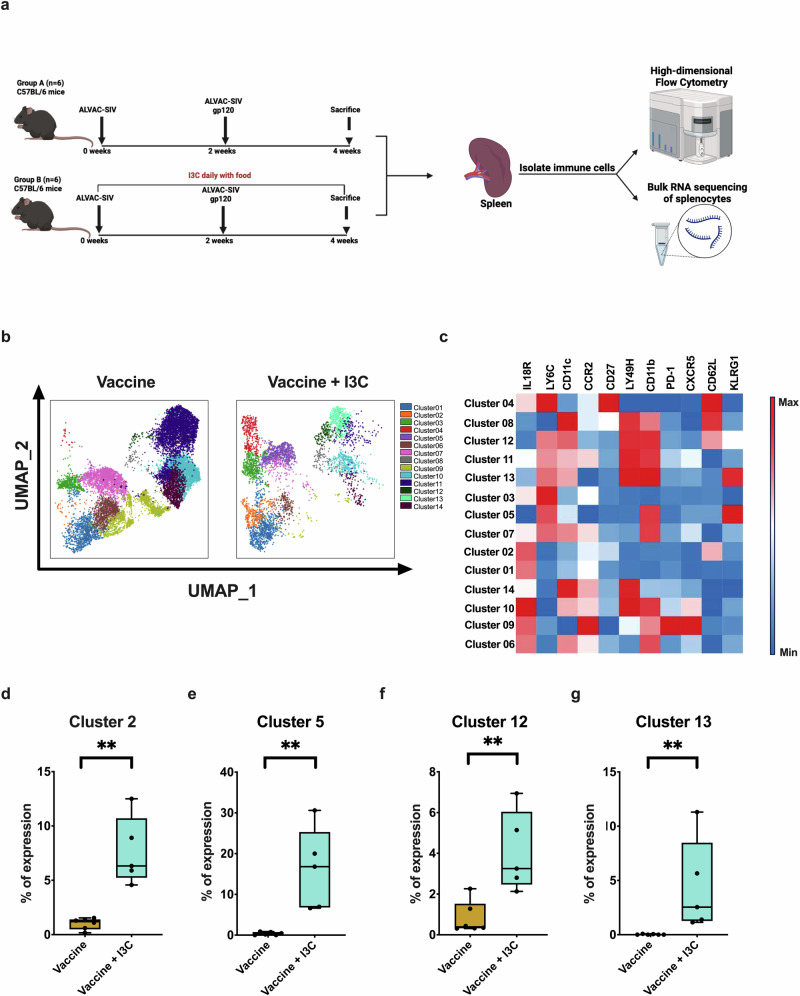
Fig. 1
Fig. 1. Differential characteristics of splenic NK cell populations between mice administered with an RV144-like vaccine regimen with oral I3C (Vaccine + I3C group), and mice administered the vaccine only (Vaccine group).
a Experimental design utilizing C57BL/6 mice (created using Biorender). b FlowSOM-based cluster analysis of viable splenic CD45+CD3CD19NK1.1+ cells of Vaccine and Vaccine + I3C groups depicted on a uniform manifold approximation and projection (UMAP). c Clusters-by-marker heatmap characterizing the receptor expression patterns of individual clusters. d–g Box plots depicting NK cell cluster frequency differences between Vaccine and Vaccine + I3C groups. The p-value was calculated using the Wilcoxon rank-sum test; *p < 0.05, **p < 0.01. I3C, Indole-3-carbinol.
Fig. 2
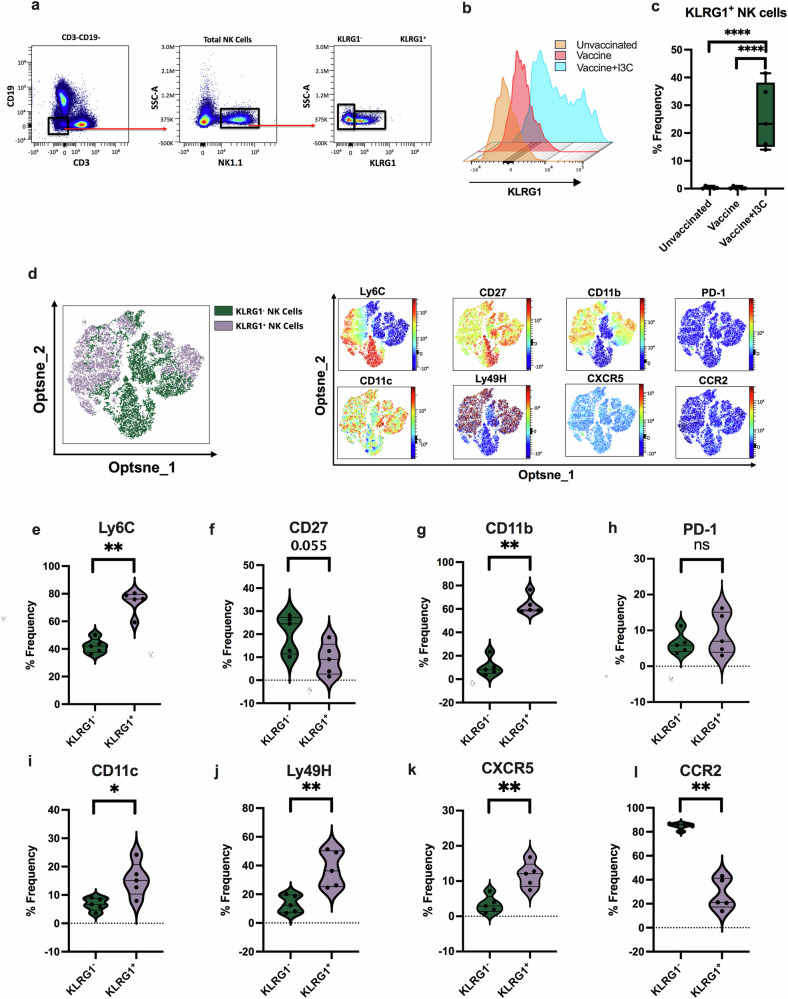
Fig. 2. Phenotypic differences are observed between splenic KLRG1 and KLRG1+ NK cells in Vaccine + I3C administered mice.
a Representative pseudo-color plots depicting the gating strategy for KLRG1+ NK cells. b Representative histogram and (c) box plot illustrating differential proportions of KLRG1+ NK cells (among total NK cells) between Unvaccinated, Vaccine-only, and Vaccine + I3C groups. d T-distributed stochastic neighbor embedding (t-SNE) analysis of concatenated samples gated on total viable NK1.1+ cells highlighting KLRG1 and KLRG1+ NK cell subsets in the Vaccine + I3C group. Differential expression of Ly6C, CD27, CD11b, PD-1, CD11c, Ly49H, CXCR5 and CCR2 between KLRG1 and KLRG1+ NK cell populations in the Vaccine + I3C group are visualized by t-SNE heatmaps. e–l Violin plots comparing frequencies of receptor expression between KLRG1 and KLRG1+ NK cells in the Vaccine + I3C administered group. The p-value was calculated using the Wilcoxon rank-sum test when comparing two groups and ordinary one-way ANOVA for multiple comparisons.; *p < 0.05, **p < 0.01, ****p < 0.0001.
Fig. 3
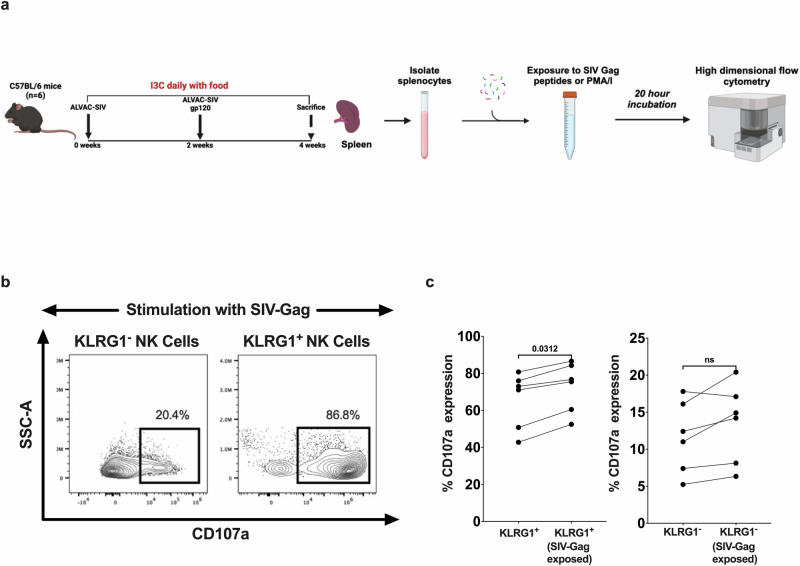
Fig. 3. In vitro demonstration of recall responses of KLRG1+ (memory-like) NK cells to SIV peptides in mice administered an RV144-like vaccine regimen with I3C.
a Experimental design (created using Biorender). b Representative contour plots depicting CD107a expression in KLRG1 and KLRG1+ NK cell subsets upon stimulation with SIV-Gag. c Paired line plots depicting differences in expression of CD107a by KLRG1+ and KLRG1 NK subsets upon stimulation with SIV-Gag peptides. The p-value was calculated using a paired t-test.
Fig. 4
Fig. 4. Transcriptome analysis suggests enhanced NK cell-mediated antiviral capabilities following I3C administration.
a Volcano plot depicting differentially expressed genes (DEGs) of splenocytes between Vaccine and Vaccine + I3C administered mice. b Heatmap highlighting upregulated DEGs in the Vaccine + I3C group that may promote the cytotoxicity and antiviral capacity of NK cells. c Kyoto Encyclopedia of Genes and Genomes (KEGG) pathway analysis generated using DEGs to identify pathways of biological processes that were enriched in the Vaccine + I3C group, compared with the Vaccine group. d Circos plots exploring relationships between DEGs and enriched pathways of biological processes among the analyzed groups.
Fig. 5
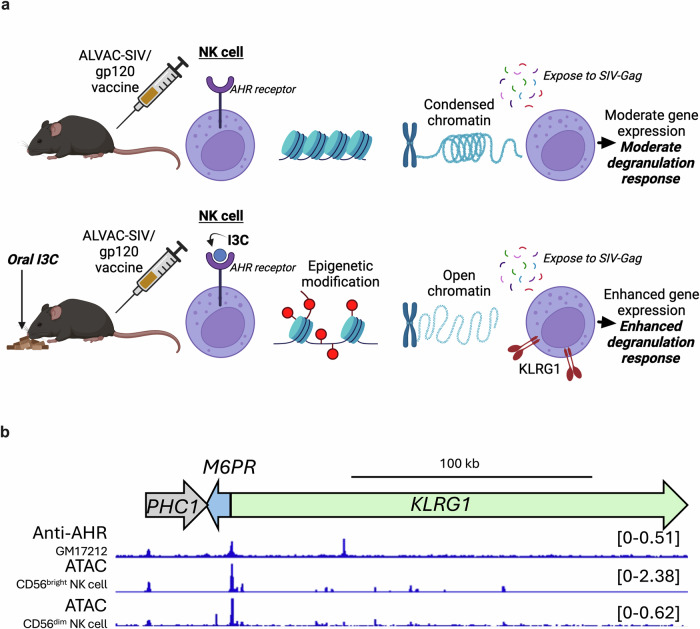
Fig. 5. Expansion of vaccine antigen-specific KLRG1+ NK cells may occur through I3C-mediated epigenetic modifications.
a Schematic diagram representing the hypothesis for expansion of vaccine antigen-specific KLRG1+ NK cells by concurrent oral I3C administration to mice (created using Biorender). b Integrative genomics viewer (IGV) snapshot showing the human KLRG1 gene region. The scale and relative location of genes are shown on top as arrows that denote promoter to transcriptional stop. Genes are killer cell lectin-like receptor G1 (KLRG1), mannose-6-phosphate receptor, cation dependent (M6PR), and Polyhomeotic Homolog 1 (PHC1). The histograms represent anti-AHR chromatin immunoprecipitation sequencing (ChIP-seq) data derived from a lymphoblastoid cell line termed GM17212, and assay for transposase-accessible chromatin with sequencing (ATAC-Seq) data from human CD56bright NK cells or CD56dim NK cells. Numbered brackets correspond to reads per million (RPM) values.

Update of

References

    1. Abel, A. M., Yang, C., Thakar, M. S. & Malarkannan, S. Natural killer cells: development, maturation, and clinical utilization. Front. Immunol.9, 1869 (2018). - PMC - PubMed
    1. De Saint Basile, G., Menasche, G. & Fischer, A. Molecular mechanisms of biogenesis and exocytosis of cytotoxic granules. Nat. Rev. Immunol.10, 568–579 (2010). - PubMed
    1. Lee, L. F., Silva, R. F., Cheng, Y. Q., Smith, E. J. & Crittenden, L. B. Characterization of monoclonal antibodies to avian leukosis viruses. Avian Dis.30, 132–138 (1986). - PubMed
    1. Kim, J. H., Excler, J. L. & Michael, N. L. Lessons from the RV144 Thai phase III HIV-1 vaccine trial and the search for correlates of protection. Annu. Rev. Med.66, 423–437 (2015). - PubMed
    1. Shubin, Z. et al. Additional boosting to the RV144 vaccine regimen increased Fc-mediated effector function magnitude but not durability. AIDS37, 1519–1524 (2023). - PMC - PubMed

LinkOut - more resources