


Identifying the mentorship needs among faculty in a large department of psychiatry- support for the creation of a formal mentorship program
- PMID: 39799335
- PMCID: PMC11724559
- DOI: 10.1186/s12909-024-06629-y
Identifying the mentorship needs among faculty in a large department of psychiatry- support for the creation of a formal mentorship program
Abstract
Background: Study aims were to assess the current state and needs of faculty to inform the design of a formal mentorship program in a large academic Department of Psychiatry.
Methods: A 57- item self-administered online survey questionnaire was distributed to all faculty members.
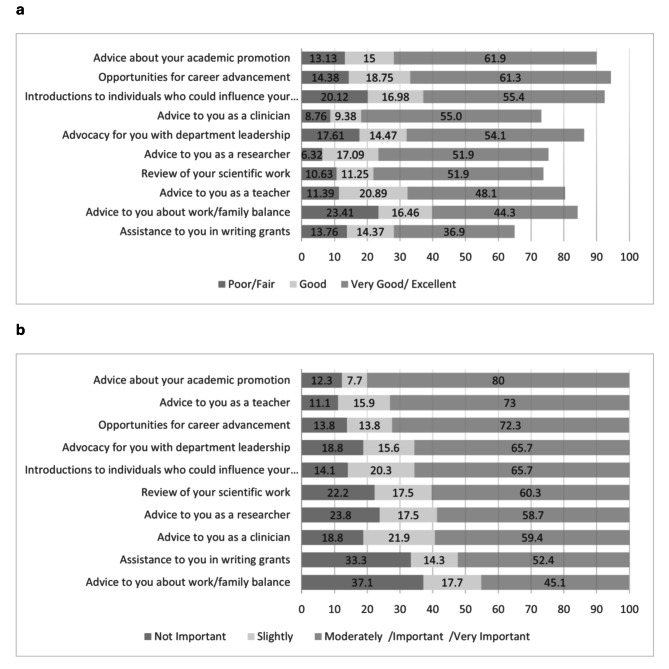
Results: 225 faculty members completed the survey (24%). 68% of respondents had a mentor and reported high satisfaction (mean = 4.3, SD = 1.05) (range 1 to 5). Among those respondents lacking access to mentorship, 65% expressed interest. Open-ended questions indicated that international medical graduates, faculty identifying as minority, women and clinician teachers may lack access to mentorship. PhD faculty felt disadvantaged compared to MD faculty in gaining first authorship (MNon-MD=1.64 ± 0.79 vs. MMD=1.36 ± 0.67; t = 2.51, p = .013); reported more authorship disputes (MNon-MD =1.99 ± 0.91 vs. MMD =1.66 ± 0.76; t = 2.63 p = .009) and experienced questionable scientific integrity concerning colleagues (MNon-MD =2.01 ± 0.92 vs. MMD =1.70 ± 0.81; t = 2.42 p = .017). For both MD and PhD faculty, women were significantly more likely to experience authorship disputes (χ2(2) = 8.67, p = .013). The department was perceived as treating faculty with respect (72% agreed) with 54% agreeing that it embraces diversity (54%). Identified benefits to mentorship included receiving advice about academic promotion, opportunities for career advancement, advocacy, and advice as a researcher, teacher or clinician. Only 26% of mentors received formal training to support their role; 59% expressed interest in education. Respondents supported a more formal, accessible, inclusive program, with training, tools, and a matching strategy based on mentee preferences.
Conclusions: Challenges and inequities were identified with the department's current ad hoc approach to mentorship. A limitation of the study was the response rate, while similar to response rates of other physician surveys, raises the potential for response bias. In comparing study participants to the department, the sample appeared to provide a fair representation. The study has implications for identifying the need and design of more formal mentorship programs in academic medicine.
Keywords: Inequities in mentorship; Mentorship; Priorities in mentorship; academic medicine; Psychiatry Department.
© 2024. The Author(s).
Conflict of interest statement
Declarations. Ethics approval and consent to participate: The study is conceptualized as a quality improvement initiative for the Department of Psychiatry, and therefore, was exempted from ethics review by the Human Research Ethics Program, University of Toronto. Competing interests: The authors declare no competing interests. Consent for publication: The manuscript does not contain data from any individual person, therefore, the consent is not applicable.
Figures


References
-
- Kashiwagi DT, Varkey P, Cook DA. Mentoring programs for physicians in academic medicine: a systematic review. Acad Med. 2013;88(7):1029–37. 10.1097/ACM.0b013e318294f368. - PubMed
MeSH terms
LinkOut - more resources
Full Text Sources
