


Food insecurity and early childhood development among children 24-59 months in Nigeria: A multilevel mixed effects modelling of the social determinants of health inequities
- PMID: 39804857
- PMCID: PMC11729974
- DOI: 10.1371/journal.pone.0316381
Food insecurity and early childhood development among children 24-59 months in Nigeria: A multilevel mixed effects modelling of the social determinants of health inequities
Abstract
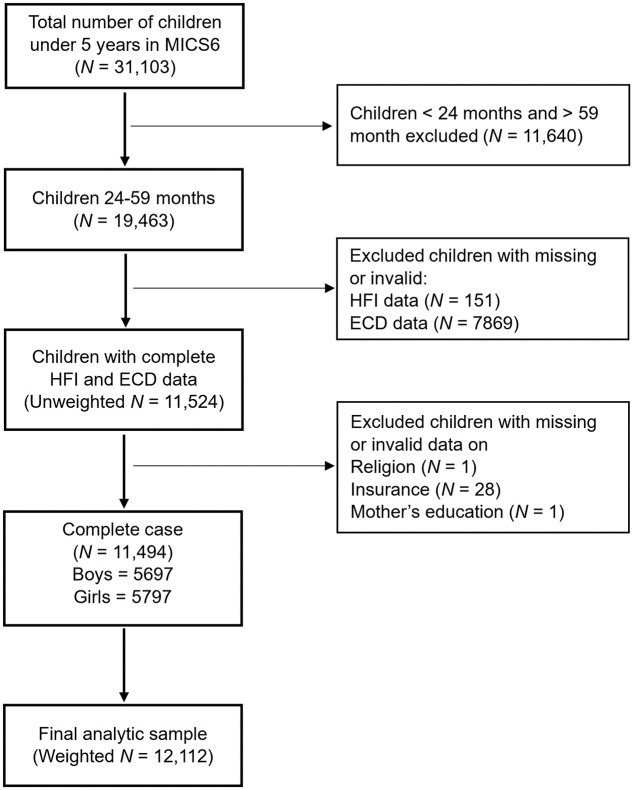
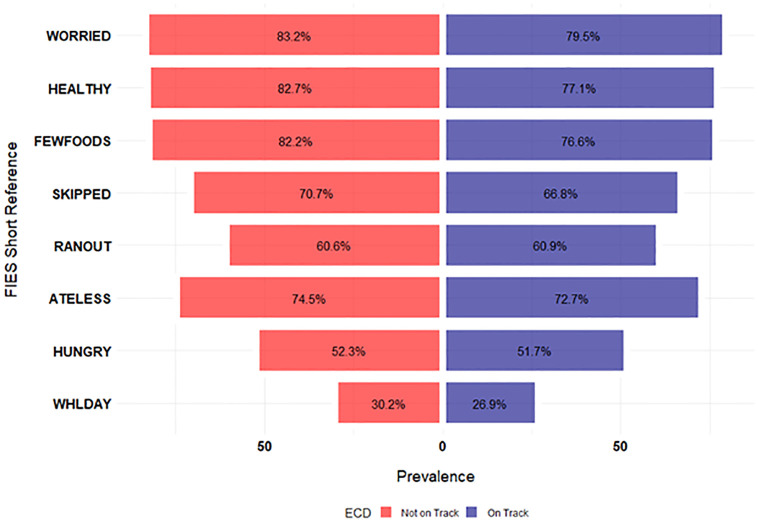
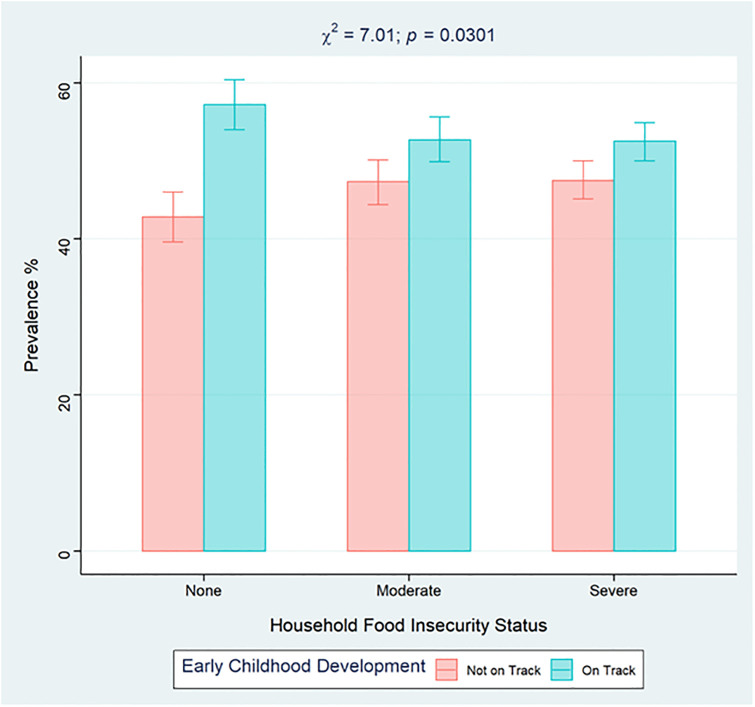
Food insecurity (FI) has been identified as a determinant of child development, yet evidence quantifying this association using the newly developed Early Childhood Development Index 2030 (ECDI2030) remains limited. Herein, we provide national estimates of early childhood development (ECD) risks using the ECDI2030 and examined to what extent FI was associated with ECD among children aged 24-59 months in Nigeria. This population based cross-sectional analyses used data from the UNICEF-supported 2021 Multiple Indicator Cluster Survey in Nigeria. The analytic sample comprised children aged 24-59 months (weighted N = 12,112). We measured early childhood development for each child using the ECDI2030, measured across three domains: learning, psychosocial well-being and health. Food insecurity was assessed using the Food Insecurity Experience Scale (FIES), categorized as none/mild, moderate and severe. We fitted mixed-effects multilevel logistic regression models, with random intercepts, to estimate the odds of association between FI status and ECD. A total of 11,494 children aged 24-59 months (mean ± SD age, 43.4 ± 9.9 months), including 5,797 boys (50.2%) and 5,697 girls (49.8%), were included in the study. Approximately 46.4% of children were developmentally off track and about 76% of children lived in food-insecure households. The intercept-only model indicated significant variation in ECD prevalence across communities (τ00 = 0.94, intraclass correlation = 0.22, p < 0.0001), suggesting nonignorable variability in ECD across communities. Adjusting for confounders, we observed no significant association between FI and ECD. However, increasing child's age and disability status appeared as significant risk factors for higher odds of children being developmentally off track. These findings highlight that while FI alone may not explain ECD, a combination of individual and contextual factors plays a crucial role. Future interventions addressing ECD in Nigeria should consider these multidimensional influences to promote optimal child development.
Copyright: © 2025 Ujah et al. This is an open access article distributed under the terms of the Creative Commons Attribution License, which permits unrestricted use, distribution, and reproduction in any medium, provided the original author and source are credited.
Conflict of interest statement
The authors have declared that no competing interests exist
Figures
References
-
- Alaimo K. Food insecurity in the United States: An overview. Topics in Clinical Nutrition. 2005;20(4):281–98.
-
- Organization WH. The State of Food Security and Nutrition in the World 2021: Transforming food systems for food security, improved nutrition and affordable healthy diets for all: Food & Agriculture Org.; 2021.
MeSH terms
LinkOut - more resources
Full Text Sources
Medical
