


Improving natural red pigment production by Streptomyces phaeolivaceus strain GH27 for functionalization of textiles with in silico ADME prediction
- PMID: 39806289
- PMCID: PMC11726976
- DOI: 10.1186/s12866-024-03697-4
Improving natural red pigment production by Streptomyces phaeolivaceus strain GH27 for functionalization of textiles with in silico ADME prediction
Abstract
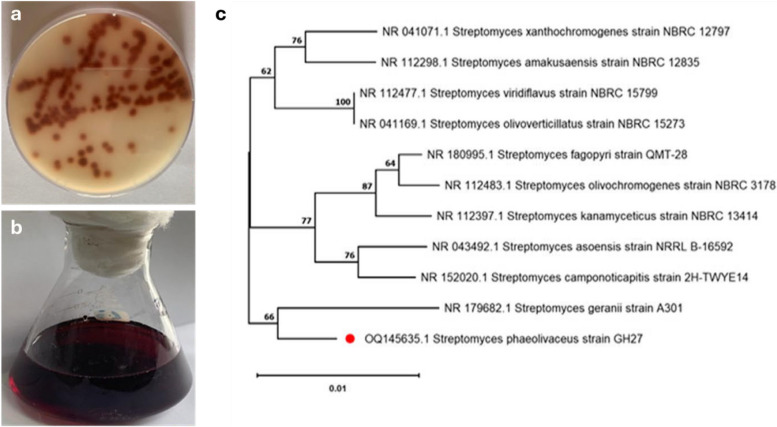
The red pigment was recovered from the S. phaeolivaceus GH27 isolate, which was molecularly identified using 16S rRNA gene sequencing and submitted to GenBank as OQ145635.1. The ideal growth conditions included 1% (w/v) starch, diammonium citrate, dibasic sodium phosphate, 5% (v/v) inoculum, pH 8, a rotation speed of 150 rpm, a temperature of 37 °C, and an incubation period of 9 days. Using ethanol as a solvent, the red pigment was effectively recovered. Data indicates that pigment content remained steady at 40 and 50 °C. Heating the pigment extract to 60, 70, 80, 90, and 100 °C for one hour results in pigment retention of 98%, 96.5%, 95.5%, 94.6%, and 92.6% of its pigment density, respectively. Studies indicate that the pigment extracts exhibited optimal stability at alkaline pH levels. The findings demonstrate that the red pigment extract has a peak absorbance range of 280-340 nm, with a λmax of 300 nm. GC/MS analysis revealed that the primary components of the pigment extract were linolenic acid methyl ester and oleic acid methyl ester, constituting 26.41% and 25.25%, respectively. Fabrics dyed with extracted red pigment exhibit excellent fastness when using the comprehensive green method. In comparison to conventional and nanotechnological attributes, printed samples exhibit significant color strength without environmental repercussions. The treatment of cotton, wool, and polyester samples suppressed pathogen growth to differing extents. Polyester had the most important inhibitory effects on Staphylococcus aureus (50.03%) and Bacillus cereus (39.49%). The ADME physicochemical properties of the predominant medication were assessed, together with its bioavailability. The radar plot demonstrated ideal parameters for size, polarity, lipophilicity, solubility, and saturation, excluding flexibility. It exhibited intermediate synthetic accessibility, exceptional permeability and absorption, elevated gastrointestinal absorption, and blood-brain barrier penetration; nonetheless, it did not adhere to the medicinal chemistry rule of three.
Keywords: Actinomycetes; Antimicrobial fabrics; Molecular docking; Optimization; Production; Red pigment; Textiles.
© 2025. The Author(s).
Conflict of interest statement
Declarations. Ethics approval and consent to participate: Not applicable. Consent for publication: Not applicable. Competing interests: The authors declare no competing interests.
Figures


References
-
- Kazi Z, Hungund BS, Yaradoddi JS, Banapurmath NR, Yusuf AA, Kishore KL, Soudagar MEM, Khan TMY, Elfasakhany A, Buyondo KA. Production, characterization, and antimicrobial activity of pigment from Streptomyces species. J Nanomaterials. 2022. 10.1155/2022/3962301.
-
- Banayan MS, Jahadi K, Khosravi-Darani K. Pigment productions by spirulina platensis as a renewable resource. J Appl Biotechnol Rep. 2022;9:2. 10.30491/JABR.2021.292076.1406.
-
- El Sayed GH, Fadel M, Marzouk M. Optimization, a potential production, GC-MS and characterization of dark green pigment from new local isolate streptomyces nigra strain GH12. J Adv Biol Biotechnol. 2023;26(9):11–29. 10.9734/jabb/2023/v26i9653.
-
- Usman HM, Abdulkadir N, Gani M, et al. Bacterial pigments and its significance. MOJ Bioequiv Availab. 2017;4(3):285–8. 10.15406/mojbb.2017.04.00073.
MeSH terms
Substances
LinkOut - more resources
Full Text Sources
Molecular Biology Databases
Miscellaneous
