


Association of caffeine intake and sleep duration with bone mineral density: a cross-sectional study from National Health and Nutrition Examination Survey between 2011 and 2018
- PMID: 39806321
- PMCID: PMC11726935
- DOI: 10.1186/s12891-025-08300-z
Association of caffeine intake and sleep duration with bone mineral density: a cross-sectional study from National Health and Nutrition Examination Survey between 2011 and 2018
Abstract
Objective: The association between sleep duration, caffeine intake, and bone mineral density (BMD) is not well understood, with previous studies providing controversial results. This study explores the associations among caffeine intake, sleep duration, and BMD.
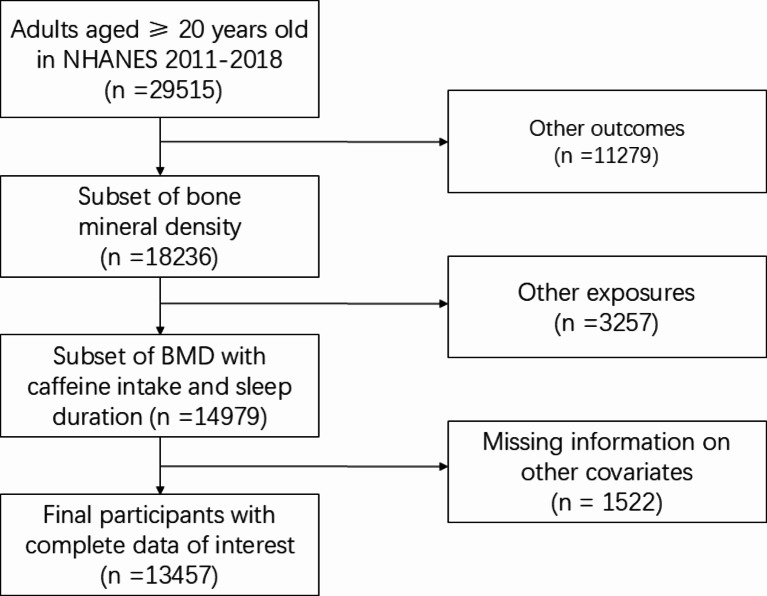
Methods: Data were sourced from the National Health and Nutrition Examination Survey (NHANES) from 2011 to 2018, including 13,457 participants who self-reported sleep duration and caffeine intake, with BMD measured via dual X-ray absorptiometry. Multivariable linear regression models, adjusted for confounders, were used alongside restricted cubic splines to examine dose-response association.
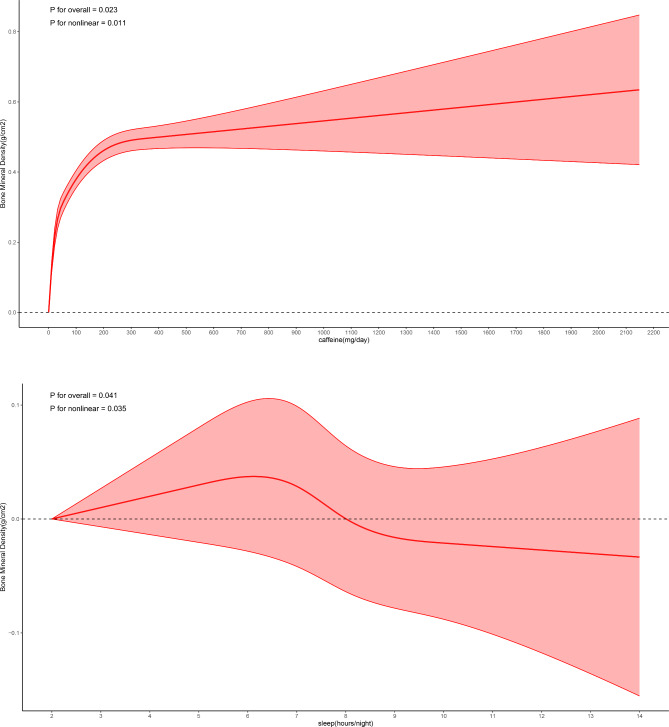
Results: Of all participants, 6821 (50.7%) were males and 6636 were females (49.3%). The mean caffeine intake and sleep duration were 93.4 mg/day and 7.19 h, respectively. RCS results showed that BMD increased with the increase in caffeine intake, especially in the low dose range of 0-200 mg/day. The dose-response association between sleep duration and BMD showed that sleep durations of 0-6 h may promote the increase of BMD, but after sleep durations greater than 6 h, BMD decreases. After adjustment for potential confounders, compared to the lowest referent quartile, individuals with caffeine intake in quartiles 2, 3, and 4 had a positive correlation with BMD (0.62 95% CI: 0.24-1.37; 0.51 95% CI: 0.22-1.13; 0.75 95% CI: 0.41-1.46; P for trend < 0.05). In covariate-adjusted linear regression models, compared with those sleeping 6 h or less per night, the difference in BMD among those sleeping 6-7 h, 7-8 h, and 8-14.5 h per night were 1.81 (95% CI: 0.4122.71), 1.25 (95% CI: 0.55-2.93), and 0.87 (95% CI: 0.38-1.69). Associations of caffeine intake, sleep duration, and BMD stratified by sex and age failed to reach statistical significance.
Conclusions: Association might exist between the consumption of caffeine, sleep duration, and BMD; however, when stratified by sex and age, the association did not reach statistical significance.
Keywords: Bone mineral density; Caffeine intake; Restricted cubic spline; Sleep duration.
© 2025. The Author(s).
Conflict of interest statement
Declarations. Ethics approval and consent to participate: The NCHS Ethics Review Board approves the study. informed consent form signed by all NHANES participants. study was in accordance with the Declaration of Helsinki. Consent for publication: Not Applicable. Competing interests: The authors declare no competing interests.
Figures
References
-
- Liu D, Li ZH, Shen D, Zhang PD, Song WQ, Zhang WT, Huang QM, Chen PL, Zhang XR, Mao C. Association of Sugar-Sweetened, artificially sweetened, and Unsweetened Coffee Consumption with all-cause and cause-specific mortality: a large prospective cohort study. Ann Intern Med. 2022;175(7):909–17. - PubMed
-
- Yuan S, Larsson SC. Coffee and caffeine intake and risk of kidney stones: a mendelian randomization study. Am J Kidney Diseases: Official J Natl Kidney Foundation. 2022;79(1):9–e1411. - PubMed
MeSH terms
Substances
LinkOut - more resources
Full Text Sources
Medical
