


Socioeconomic status moderate the relationship between mental health literacy, social participation, and active aging among Chinese older adults: evidence from a moderated network analysis
- PMID: 39806422
- PMCID: PMC11727262
- DOI: 10.1186/s12889-024-21201-5
Socioeconomic status moderate the relationship between mental health literacy, social participation, and active aging among Chinese older adults: evidence from a moderated network analysis
Abstract
Objective: The aging population represents a formidable global challenge, with China experiencing an accelerated demographic shift. While previous research has established a directional link between mental health literacy, social participation, and active aging, the moderating effect of socioeconomic status (SES) on these associations remains underexplored. This study sought to address this gap by employing moderated network analysis, in contrast to the total score approaches commonly used in prior literature.
Methods: A cross-sectional design was implemented, involving 1,032 Chinese individuals aged 60 and above, who completed the Mental Health Literacy Questionnaire, Active Aging Scale, Social Participation Questionnaire, and Socioeconomic Status Index Scale. The moderated network method was applied to explore the bidirectional relationships between mental health literacy, social participation, and active aging, while examining the moderating role of SES.
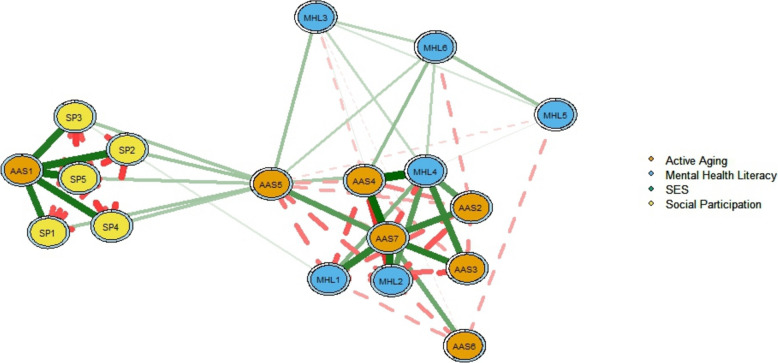
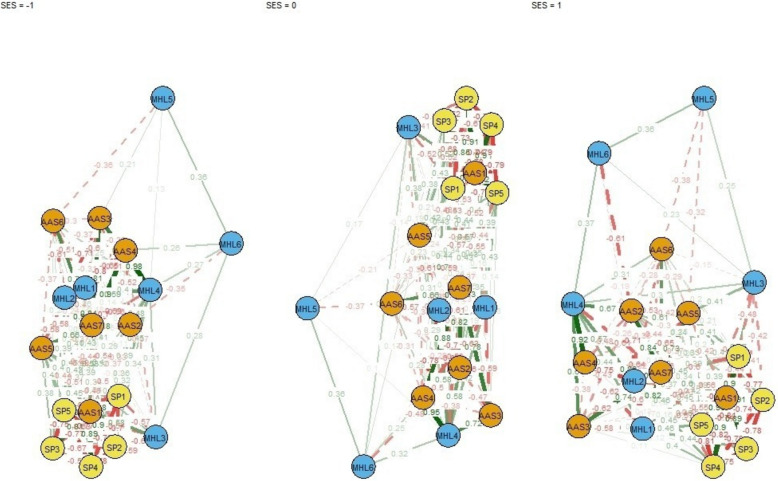
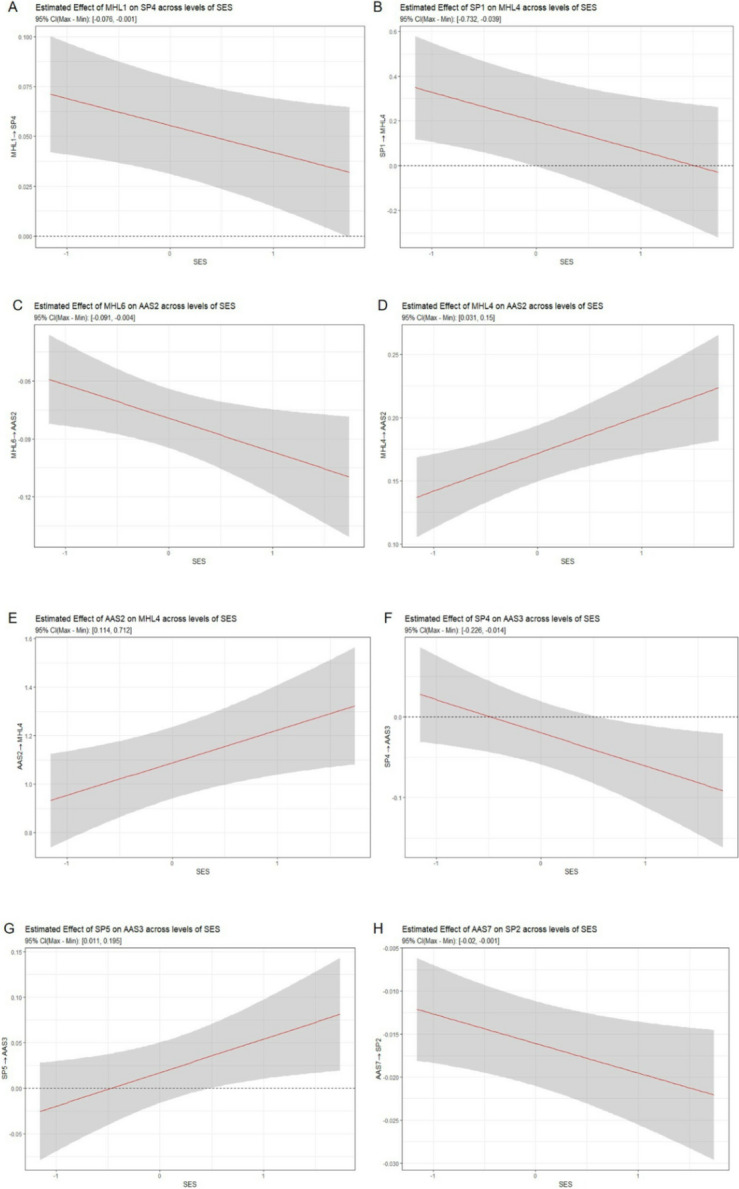
Results: The analysis identified the strongest bidirectional relationships between attitudes toward mental illness and the development of spiritual wisdom. Seven interaction terms emerged involving mental health literacy, social participation, and active aging, moderated by SES. Notably, the most significant interaction terms were found between attitudes toward mental illness and engagement in active learning.
Conclusions: These results contribute novel insights into the bidirectional relationships among mental health literacy, social participation, and active aging, as well as the role of SES in moderating these relationships. The findings highlight the need for targeted policy interventions to address socioeconomic inequalities in later life, thereby fostering active aging.
Keywords: Active aging; Mental health literacy; Moderated network analysis; Social participation; Socioeconomic status.
© 2025. The Author(s).
Conflict of interest statement
Declarations. Ethics approval and consent to participate: All participants signed an informed consent form. The study was conducted according to the Declaration of Helsinki guidelines, and received approval from the Ethics Committee of Chengdu Medical College (Chengdu, China, IRB number: 2021NO.39). Consent for publication: Not applicable. Competing interests: The authors declare no competing interests.
Figures





References
-
- China Research Center on Aging. Briefing on the Data of the Sample Survey on the Living Conditions of the Elderly in Urban and Rural China(2015). China Research Center on Aging. 2021. Retrieved April 25, 2021. http://www.crca.cn/index.php?option=com_content&view=article&id=27:2015&....
-
- Wang J, Wang Y, Cai H, Zhang J, Pan B, Bao G, Guo T. Analysis of the status quo of the Elderly’s demands of medical and elderly care combination in the underdeveloped regions of Western China and its influencing factors: a case study of Lanzhou. BMC Geriatr. 2020;20(1):338. 10.1186/s12877-020-01616-6. - PMC - PubMed
-
- World Health Organization. Active ageing : a policy framework. World Health Organization, 2002. https://iris.who.int/handle/10665/67215. - PubMed
-
- Liu, H., Byles, J. E., Xu, X., Zhang, M., Wu, X., & Hall, J. J. (2017). Evaluation of successful aging among older people in China: Results from China health and retirement longitudinal study. Geriatr Gerontol Int. 17(8):1183–1190. 10.1111/ggi.12848. - PubMed
MeSH terms
Supplementary concepts
Grants and funding
LinkOut - more resources
Full Text Sources
Medical
Miscellaneous
