


Proteins and pathways involved in inflammation are longitudinally associated with total body bone mineral density among primarily Hispanic overweight/obese adolescents and young adults
- PMID: 39808688
- PMCID: PMC11909736
- DOI: 10.1093/jbmr/zjaf002
Proteins and pathways involved in inflammation are longitudinally associated with total body bone mineral density among primarily Hispanic overweight/obese adolescents and young adults
Abstract
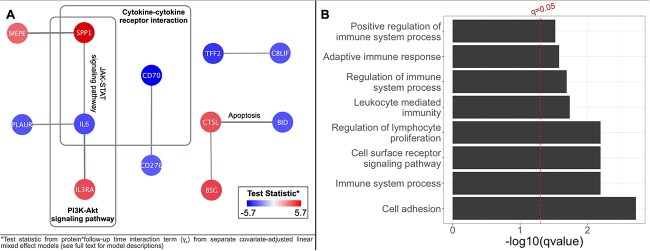
BMD, an important marker of bone health, is regulated by a complex interaction of proteins. Plasma proteomic analyses can contribute to identification of proteins associated with changes in BMD. This may be especially informative in stages of bone accrual and peak BMD achievement (ie, adolescence and young adulthood), but existing research has focused on older adults. This analysis in the Study of Latino Adolescents at Risk for Type 2 Diabetes (SOLAR; n = 304; baseline age 8-13, 100% Hispanic) explored associations between baseline proteins (n = 653 proteins) measured with Olink plasma protein profiling and repeated annual DXA measures of BMD (average of 3.2 visits per participant). Covariate-adjusted linear mixed effect regression models were applied to estimate longitudinal protein-BMD associations using an adjusted p value cutoff (p < .00068). Identified proteins were imported into the Search Tool for the Retrieval of Interacting Genes/Proteins (STRING) database to determine significantly enriched protein pathways. Forty-four proteins, many of which are involved in inflammatory processes, were associated with longitudinal changes in total body BMD, including several proteins previously linked to bone health such as osteopontin (SPP1) and microfibrillar-associated protein 5 (MFAP5; both p < .00068). These 44 proteins were associated with enrichment of pathways including PI3K-Akt signaling pathway and cytokine-cytokine receptor interaction, supporting results from existing proteomics analyses in older adults. To evaluate whether protein associations were consistent into young adulthood, linear mixed effect models were repeated in a young adult cohort (n = 169; baseline age 17-22; 62.1% Hispanic) with 346 available overlapping Olink protein measures. While there were no significant overlapping longitudinal protein associations between the cohorts, these findings suggest differences in protein regulation at different ages and provide novel insight on longitudinal protein associations with BMD in overweight/obese adolescents and young adults of primarily Hispanic origin, which may inform the development of biomarkers for bone health in youth.
Keywords: DXA; biochemical markers of bone turnover; cytokines; general population studies; osteoimmunology.
Plain language summary
Proteins are heavily involved in the formation of bone and maintenance of bone health over the life span. In this study, we examined associations between >650 proteins and annual measures of BMD in overweight/obese Hispanic adolescents. Proteins that were associated with BMD over time were imported into a database that recognizes pathways that the proteins are involved in, allowing us to identify pathways linked with changes in BMD in these adolescents. We found that proteins and pathways primarily involved in inflammation were associated with BMD over the study follow-up period. Several of these pathways have also been associated with bone health in studies on older adults. Additionally, we examined associations between >340 of the same proteins and BMD in a separate sample of young adults and found that several proteins had similar negative associations with BMD in the 2 groups. This is the known first study looking at the associations between proteins and BMD in a younger population, as the existing studies of this type were focused on older adults. Additionally, this is one of the first studies that evaluates these associations over years of follow-up, since most studies looked at associations at one time point only.
© The Author(s) 2025. Published by Oxford University Press on behalf of the American Society for Bone and Mineral Research.
Conflict of interest statement
The authors report no conflicts of interest.
Figures


References
MeSH terms
Grants and funding
LinkOut - more resources
Full Text Sources
Medical
Research Materials
Miscellaneous
