. 2024 Dec 17;11(1):e41236.
doi: 10.1016/j.heliyon.2024.e41236. eCollection 2025 Jan 15.

Melatonin induces drought stress tolerance by regulating the physiological mechanisms, antioxidant enzymes, and leaf structural modifications in Rosa centifolia L

Affiliations

Melatonin induces drought stress tolerance by regulating the physiological mechanisms, antioxidant enzymes, and leaf structural modifications in Rosa centifolia L

Muhammad Ahsan et al. Heliyon. .

Abstract

Melatonin is considered an effective bio-stimulant that is crucial in managing several abiotic stresses including drought. However, its potential mechanisms against drought stress in fragrant roses are not well understood. Here, we aim to investigate the role of melatonin on Rosa centifolia plants cultivated under drought stress (40 % field capacity) and normal irrigation (80 % field capacity). Plant growth traits, gaseous exchange, antioxidants, osmolytes, oxidative stress, and leaf anatomical attributes were measured. All pots were arranged with a completely randomized design with two-factor factorial setup. Foliar application of melatonin was carried out on the next day of drought treatment and was repeated weekly, while normal watering was regarded as control. Drought stress significantly enhanced oxidative stress markers and reduced growth parameters in water-deficit rose plants. However, melatonin spray (100 μM) produced increased plant height (16 %), flower yield (16 %), petal fresh and dry biomass (7 % and 38 %), total chlorophyll (48 %), contents of carotenoid (54 %), and gaseous exchange traits such as stomatal conductance (25 %), photosynthetic rate (91 %), and transpiration rate (3 %), in water-deficient plants. Likewise, the accretion of catalase, superoxide dismutase, soluble protein, proline, and glycine betaine contents was recorded by 22 %, 45 %, 58 %, 7 %, and 6 %, respectively, in drought-stressed plants, due to melatonin treatment. Increment of oxidative stress indicators i.e. malondialdehyde (-37 %) and hydrogen peroxide (-27 %) was diminished by melatonin triggered by drought stress. Furthermore, leaf cortex (51 %), vascular bundle area (76 %), palisade cell area (59 %), and lamina thickness (42 %) were remarkably increased with melatonin foliar sprays in water-deficit plants. The results of this study recommend that melatonin is a protective agent against drought stress and has potential application prospects in the rose-producing regions suffering from water deficiency. Future studies should focus on molecular responses of R. centifolia to drought stress to further develop stress alleviation strategies in floricultural crops.

Keywords: Enzyme activity; Photosynthesis; Proline; Sustainable floriculture; Water deficiency.


Conflict of interest statement

The authors declare that they have no known competing financial interests or personal relationships that could have appeared to influence the work reported in this paper.

Figures

Image 1
Graphical abstract
Fig. 1
Fig. 1
Impact of melatonin on the plant length (a), the leaves number branch−1 (b), the area of leaf (c), the number of flower plant−1 (d), the flower diameter (e), the number of petals flower−1 (f), petal fresh weight (g), petal dry weight (h) of Rosa centifolia under drought-stressed conditions. A mean of six replicates standard error are displayed in each bar. After using the least significant difference (LSD) test, alphabetical lettering that is different from one another shows statistically significant variations at p < 0.05. N = normal water; MT = melatonin; D = drought stress.
Fig. 2
Fig. 2
Impact of melatonin on stomatal conductance (a), net photosynthetic rate (b), transpiration rate (c) chlorophyll contents (d), and carotenoid contents (e) of Rosa centifolia under drought-stressed conditions. A mean of six replicates and standard error are displayed in each bar. After using the least significant difference (LSD) test, alphabetical lettering that is different from one another shows statistically significant variations at p < 0.05. N = normal water; MT = melatonin; D = drought stress.
Fig. 3
Fig. 3
Influence of melatonin on activities of antioxidant enzymes, catalase (a), peroxidase (b), ascorbate peroxidase (c), and superoxide dismutase (d) of Rosa centifolia leaves under drought-stressed conditions. A mean of six replicates and standard error are displayed in each bar. After using the least significant difference (LSD) test, alphabetical lettering that is different from one another shows statistically significant variations at p < 0.05. N = normal water; MT = melatonin; D = drought stress.
Fig. 4
Fig. 4
Influence of melatonin application on proline (a), total soluble protein (b), and glycen betaine (c) of Rosa centifolia under drought-stressed conditions. A mean of six replicates and standard error are displayed in each bar. After using the least significant difference (LSD) test, alphabetical lettering that is different from one another shows statistically significant variations at p < 0.05. N = normal water; MT = melatonin; D = drought stress.
Fig. 5
Fig. 5
Influence of melatonin application on malondialdehyde (a), and hydrogen peroxide (b) of Rosa centifolia under drought-stressed conditions. A mean of six replicates and standard error are displayed in each bar. After using the least significant difference (LSD) test, alphabetical lettering that is different from one another shows statistically significant variations at p < 0.05. N = normal water; MT = melatonin; D = drought stress.
Fig. 6
Fig. 6
Impact of melatonin on anatomical attributes i.e. cortical cell area (a), epidermal thickness (b), midrib thickness (c), vascular bundle area (d), xylem area (e), and phloem area (f) of Rosa centifolia leaves under drought-stressed conditions. A mean of six replicates and standard error are displayed in each bar. After using the least significant difference (LSD) test, alphabetical lettering that is different from one another shows statistically significant variations at p < 0.05. N = normal water; MT = melatonin; D = drought stress.
Fig. 7
Fig. 7
Impact of foliar melatonin supplementation on anatomical attributes like palisade cell area (a), spongy cell area (b), and lamina thickness (c) of Rosa centifolia leaves under drought-stressed conditions. A mean of six replicates and standard error are displayed in each bar. After using the least significant difference (LSD) test, alphabetical lettering that is different from one another shows statistically significant variations at p < 0.05. N = normal water; MT = melatonin; D = drought stress.
Fig. 8
Fig. 8
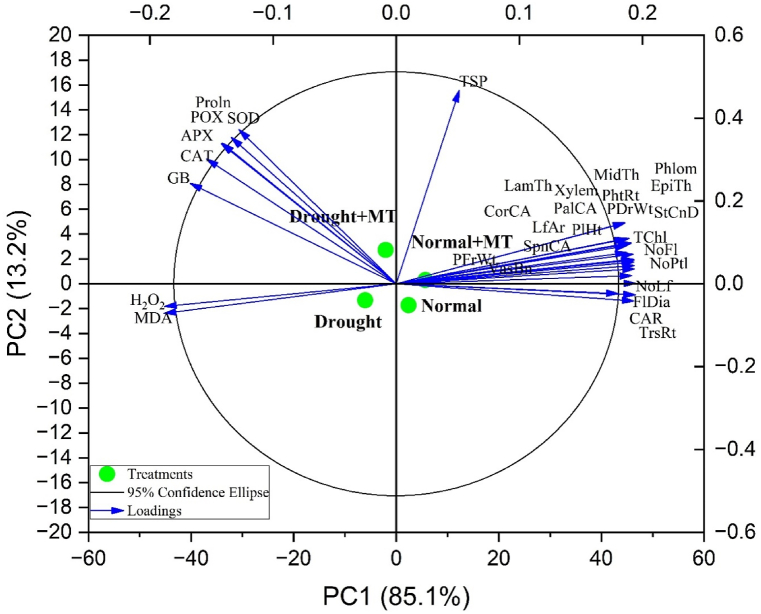
Principal component analysis biplots show correlation amongst different morpho-physiological, biochemical, and anatomical attributes of R. centifolia under normal and drought-stress conditions. PlHt = plant height; NoLf = number of leaf; LfAr = leaf area; NoFl = number of flowers; FlDia = flower diameter; NoPtl = number of petals flower−1; PFrWt = plant fresh weight; PDrWt = plant dry weight; StCnD = stomatal conductance; PhtRt = photosynthetic rate; TrsRt = transpiration rate; TChl = total chlorophyll; CAR = carotenoid; CAT = catalase; POX = peroxidase; APX = ascorbate peroxidase; SOD = superoxide dismutase; Proln = proline; TSP = total soluble protein; GB = glycinebetaine; MDA = malondialdehyde; H2O2 = hydrogen peroxide; CorCA = cortical cell area; EpiTh = epidermal thickness; MidTh = midrib thickness; VasBn = vascular bundle area; Xylem = xylem area; Phlom = phloem area; PalCA = palisade cell area; SpnCA = Spongy cell area; LamTh = lamina thickness.
Fig. 9
Fig. 9
Correlation matrix of different morpho-physiological, biochemical, and anatomical attributes of R. centifolia under normal and drought-stress conditions. PlHt = plant height; NoLf = number of leaf; LfAr = leaf area; NoFl = number of flowers; FlDia = flower diameter; NoPtl = number of petals flower−1; PFrWt = plant fresh weight; PDrWt = plant dry weight; StCnD = stomatal conductance; PhtRt = photosynthetic rate; TrsRt = transpiration rate; TChl = total chlorophyll; CAR = carotenoid; CAT = catalase; POX = peroxidase; APX = ascorbate peroxidase; SOD = superoxide dismutase; Proln = proline; TSP = total soluble protein; GB = glycinebetaine; MDA = malondialdehyde; H2O2 = hydrogen peroxide; CorCA = cortical cell area; EpiTh = epidermal thickness; MidTh = midrib thickness; VasBn = vascular bundle area; Xylem = xylem area; Phlom = phloem area; PalCA = palisade cell area; SpnCA = Spongy cell area; LamTh = lamina thickness. The color gradient showed the direction and strength of the correlations, with red color showing positive correlations and the blue color showing negative correlations among different characteristics of R. centifolia. ∗p ≤ 0.05, ∗∗p ≤ 0.01, ∗∗∗p ≤ 0.001.

References

    1. Ahsan M., et al. Morpho-physiological and enzymatic responses of zinnia (Zinnia elegans l.) to different metal hoarded wastewaters. J. Soil Sci. Plant Nutr. 2024;24:2910–2923. doi: 10.1007/s42729-024-01717-w. - DOI
    1. Zomorrodi N., et al. Potency of titanium dioxide nanoparticles, sodium hydrogen sulfide and salicylic acid in ameliorating the depressive effects of water deficit on periwinkle ornamental quality. Horticulturae. 2022;8:675. doi: 10.3390/horticulturae8080675. - DOI
    1. Schwalm C.R. Global patterns of drought recovery. Nature. 2017;548:202–205. doi: 10.1038/nature23021. - DOI - PubMed
    1. Toscano S., Romano D. Morphological, physiological, and biochemical responses of zinnia to drought stress. Horticulturae. 2021;7:362. doi: 10.3390/horticulturae7100362. - DOI
    1. Parveen A., et al. Silicon priming regulates morpho-physiological growth and oxidative metabolism in maize under drought stress. Plants. 2019;8:431. doi: 10.3390/plants8100431. - DOI - PMC - PubMed

LinkOut - more resources