. 2025 Jan 15;272(2):132.
doi: 10.1007/s00415-024-12876-2.

Balance recovery and its link to vestibular agnosia in traumatic brain injury: a longitudinal behavioural and neuro-imaging study

Affiliations

Balance recovery and its link to vestibular agnosia in traumatic brain injury: a longitudinal behavioural and neuro-imaging study

Zaeem Hadi et al. J Neurol. .

Abstract

Background: Vestibular dysfunction causing imbalance affects c. 80% of acute hospitalized traumatic brain injury (TBI) cases. Poor balance recovery is linked to worse return-to-work rates and reduced longevity. We previously showed that white matter network disruption, particularly of right inferior longitudinal fasciculus, mediates the overlap between imbalance and impaired vestibular perception of self-motion (i.e., vestibular agnosia) in acute hospitalized TBI. However, there are no prior reports tracking the acute-longitudinal trajectory of objectively measured vestibular function for hospitalized TBI patients. We hypothesized that recovery of vestibular agnosia and imbalance is linked and mediated by overlapping brain networks.

Methods: We screened 918 acute major trauma in-patients, assessed 146, recruited 39 acutely, and retested 34 at 6 months. Inclusion criteria were 18-65-year-old adults hospitalized for TBI with laboratory-confirmed preserved peripheral vestibular function. Benign paroxysmal positional vertigo and migraine were treated prior to testing. Vestibular agnosia was quantified by participants' ability to perceive whole-body yaw plane rotations via an automated rotating-chair algorithm. Subjective symptoms of imbalance (via questionnaires) and objective imbalance (via posturography) were also assessed.

Results: Acute vestibular agnosia predicted poor balance recovery at 6 months. Recovery of vestibular agnosia and linked imbalance was mediated by bihemispheric fronto-posterior cortical circuits. Recovery of subjective symptoms of imbalance and objective imbalance were not correlated.

Conclusion: Vestibular agnosia mediates balance recovery post-TBI. The link between subjective dizziness and brain injury recovery, although important, is unclear. Therapeutic trials of vestibular recovery post-TBI should target enhancing bi-hemispheric connectivity and linked objective clinical measures (e.g., posturography).

Keywords: Diffusion tensor imaging; Imbalance; Resting-state functional connectivity; Self-motion perception; Traumatic brain injury; Vestibular agnosia; Vestibular recovery.


Conflict of interest statement

Declarations. Conflict of interest: The authors report no competing interests.

Figures
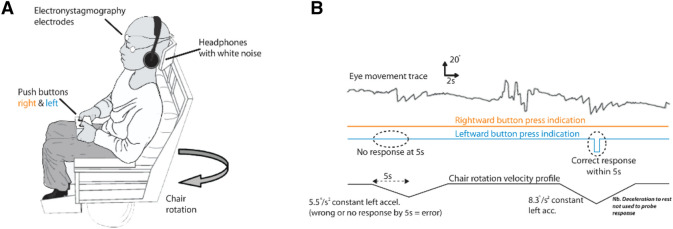
Fig. 1
Fig. 1
Vestibular agnosia measurement. A Patients were seated on a rotating chair in dark and rotated in yaw plane and were instructed to press right or left to indicate rightward or leftward rotation. Background noise was masked using white noise, whereas eye movements were also recorded. B Traces indicating eye movements, button-press by participant, and velocity profile of computer-controlled chair rotation
Fig. 2
Fig. 2
Recovery of dizziness symptoms, vestibular perceptual thresholds of self-motion and balance. A Recovery of objective vestibular perceptual function over time. Overall vestibular perceptual thresholds (VPTs) improved—i.e., reduced—over time across all patients (A—left panel, in red). For VA– patients, VPTs remained mainly within the normal range (A—middle panel, in green). For VA+ patients, there was persistence of abnormal VPTs at follow-up (A—right panel, in blue). B Recovery of objective balance function. Sway is shown as root mean square (RMS) of sway obtained during ‘eyes closed with soft surface’ condition. Overall sway improved—i.e., reduced—over time for all patients (B—left panel, in red). Balance recovery was worse, however, in the VA+ group with several patients showing persistently elevated sway RMS above the control range (B—right panel, in blue). C Recovery of dizziness over time. The dizziness handicap inventory (DHI) overall improved for both patients without vestibular agnosia (VA−; C—left panel, shown in green) and patients with vestibular agnosia (VA+; C—right panel, shown in blue)
Fig. 3
Fig. 3
Longitudinal trajectories of recovery of balance, vestibular perceptual thresholds of self-motion, and dizziness symptoms. A, B Recovery of patients’ balance and vestibular perceptual thresholds compared to controls. Patients’ vestibular perceptual thresholds (VPTs) and balance were higher than controls acutely (T0 – 0 months) and generally reduced on 6-month follow-up (T2). C Recovery of vestibular perceptual thresholds. Overall VPTs improved from acute (T0—0 months) to follow-up (T2—6 months) in patients with VA+. Few patients with VA + got worse on 6-month follow-up (T2—6 months) (in blue), whereas a few VA− patients also developed VA (in red). D Recovery of objective balance function. Sway is shown as root mean square (RMS) of sway obtained during ‘eyes closed with soft surface’ condition. Overall sway improved—i.e., reduced—over time for VA– patients (in red). However, several VA =+ had persistent imbalance at 6-month follow-up (T2—6 months) and some also got worse (in blue). E Recovery of dizziness over time. Dizziness scores (via “Dizziness Handicap Inventory”) generally reduced for all patients except a few patients with VA + who got worse from acute (T0—0 months) to 6-month (T2—6 months) follow-up (in blue)
Fig. 4
Fig. 4
Relationship between recovery from vestibular agnosia and balance. A Correlation between continuous measures of vestibular perception and balance. Change in sway RMS and VPTs from acute to 6-month follow-up testing were linked. B Recovery of balance linked to VA recovery according to acute VA status. Longitudinal change in the balance-VA relationship appeared more robust in VA+ vs VA− patients (although the two correlations were not statistically different). (RMS: root mean square; VPTs: vestibular perceptual thresholds; VA+ : group with vestibular agnosia; VA−: group without vestibular agnosia)
Fig. 5
Fig. 5
Interaction of change (Δ) in vestibular perceptual thresholds (VPTs), Δ sway, and the Δ connectivity values from different imaging modalities. L and R represent left and right hemisphere convention for all panels (A, B). A Diffusion tensor imaging analysis indicating a significant interaction (Δ VPT × Δ sway × Δ FA). Significant regions are highlighted in red and overlayed on mean FA skeleton (green) of all participants. (TFCE corrected findings at P < 0.0083). B Results from voxel-based morphometry (VBM) analysis showing interaction (Δ VPT × Δ sway × Δ Volume) at two clusters centred at left supplementary motor cortex, two at left precuneus, one at left precentral gyrus, one at left mid-frontal gyrus, and one at precentral lobule (FWE corrected at P < 0.05). (Colour-bar indicate F statistic)

References

    1. Langlois JA, Rutland-Brown W, Wald MM (2006) The epidemiology and impact of traumatic brain injury: a brief overview. J. Head Trauma Rehabil 21(5):375–378 - DOI - PubMed
    1. Thomas KE, Stevens JA, Sarmiento K, Wald MM (2008) Fall-related traumatic brain injury deaths and hospitalizations among older adults–United States, 2005. J Safety Res 39(3):269–272 - DOI - PubMed
    1. Marcus HJ, Paine H, Sargeant M, Wolstenholme S, Collins K, Marroney N et al (2019) Vestibular dysfunction in acute traumatic brain injury. J Neurol 266(10):2430–2433 - DOI - PMC - PubMed
    1. Maskell F, Chiarelli P, Isles R (2007) Dizziness after traumatic brain injury: results from an interview study. Brain Inj 21(7):741–752 - DOI - PubMed
    1. Maskell F, Chiarelli P, Isles R (2006) Dizziness after traumatic brain injury: overview and measurement in the clinical setting. Brain Inj 20(3):293–305. 10.1080/02699050500488041 - DOI - PubMed

MeSH terms

LinkOut - more resources
