. 2025 Feb 5;166(3):bqae166.
doi: 10.1210/endocr/bqae166.

Intranasal Delivery of a Ghrelin Mimetic Engages the Brain Ghrelin Signaling System in Mice

Affiliations

Intranasal Delivery of a Ghrelin Mimetic Engages the Brain Ghrelin Signaling System in Mice

Renée Poelman et al. Endocrinology. .

Abstract

Ghrelin, the endogenous ligand of the growth hormone secretagogue receptor (GHSR), promotes food intake and other feeding behaviors, and stimulates growth hormone (GH) release from the pituitary. Growth hormone secretagogues (GHS), such as GHRP-6 and MK-0677, are synthetic GHSR ligands that activate orexigenic neuropeptide Y neurons that coexpress agouti-related peptide (AgRP) in the arcuate nucleus of the hypothalamus when administered systemically. Systemic GHRP-6 also stimulates GH release in humans and rats. Thus, GHS and ghrelin have therapeutic relevance in patients who could benefit from its orexigenic and/or GH-releasing effects. This study examined whether intranasal delivery of ghrelin, GHRP-6, or MK-0677 engages the brain ghrelin signaling system. Effective compounds and doses were selected based on increased food intake after intranasal application in mice. Only GHRP-6 (5 mg/kg) increased food intake without adverse effects, prompting detailed analysis of meal patterns, neuronal activation in the arcuate nucleus (via Fos mapping) and neurochemical identification of c-fos messenger RNA (mRNA)-expressing neurons using RNAscope. We also assessed the effect of intranasal GHRP-6 on serum GH levels. Intranasal GHRP-6 increased food intake by increasing meal frequency and size. Fos expression in the arcuate nucleus was higher in GHRP-6-treated mice than in saline controls. When examining the neurochemical identity of c-fos-mRNA-expressing neurons, we found coexpression with 63.5 ± 1.9% Ghsr mRNA, 79 ± 6.8% Agrp mRNA, and 11.4 ± 2.5% Ghrh mRNA, demonstrating GHRP-6's ability to engage arcuate nucleus neurons involved in food intake and GH release. Additionally, intranasal GHRP-6 elevated GH serum levels. These findings suggest that intranasal GHRP-6, but not ghrelin or MK-0677, can engage the brain ghrelin signaling system.

Keywords: GHSR; arcuate nucleus; food intake; ghrelin receptor agonist; growth hormone; intranasal.


Figures

Figure 1.
Figure 1.
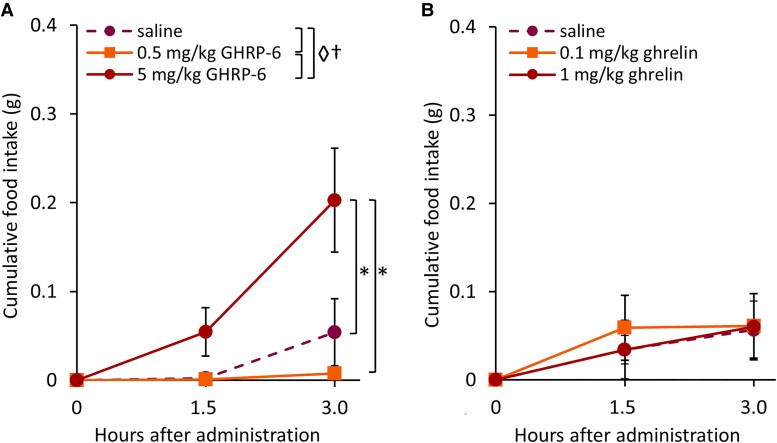
The effects of intranasal delivery of saline or one of 2 GHSR agonists at 2 different doses on cumulative food intake. A, A dose of 5 mg/kg but not 0.5 mg/kg GHRP-6 increased food intake; measurements were taken at baseline, at 1.5 hours and 3.0 hours (n = 6). Two-way analysis of variance (ANOVA) indicated that there was a time effect, a treatment effect, and a time × treatment effect. Tukey post hoc further indicated that food intake after the 5-mg/kg GHRP-6 treatment was significantly increased after 3 hours compared to the saline control and 0.5 mg/kg GHRP-6 dose. B, Intranasal ghrelin did not change cumulative food intake (n = 6). Two-way ANOVA did not indicate an effect of treatment or time. Data are shown as mean ± SEM. Symbols represent: ◊P less than .05 (general effect of treatment); †P less than .05 (general effect of time); *P less than .05.
Figure 2.
Figure 2.
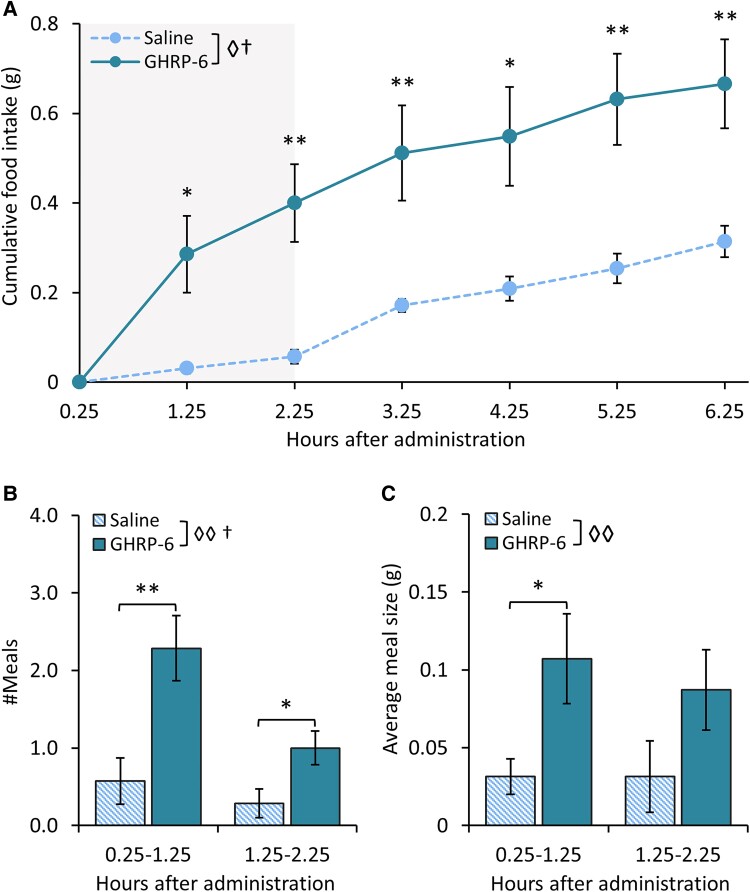
Intranasal GHRP-6 delivery increases food intake by increasing meal frequency and meal size. A, Cumulative chow intake at different time points, starting at 15 minutes after intranasal administration of 5-mg/kg GHRP-6 or saline to mice (n = 7). The gray box marks the time window for analysis of B, meal frequency and C, meal size. Symbols represent: ◊ P < .05 (general effect of treatment); †P < .05 (general effect of time) *P less than .05; **P less than .01 (5 mg/kg GHRP-6 vs saline). Data are shown as mean ± SEM.
Figure 3.
Figure 3.
Intranasal GHRP-6 increases the number of Fos expressing neurons in the arcuate nucleus (Arc). A, Representative Fos-DAB images from the Arc showing effects of intranasal GHRP-6 (bregma: −1.67 mm, 20 µm sections). Third ventricle = 3 V. B, Manual unilateral counting of nuclei that express Fos protein from GHRP-6 (n = 7) or saline-treated mice (n = 6). Symbols represent *P less than .05. Data are shown as mean ± SEM.
Figure 4.
Figure 4.
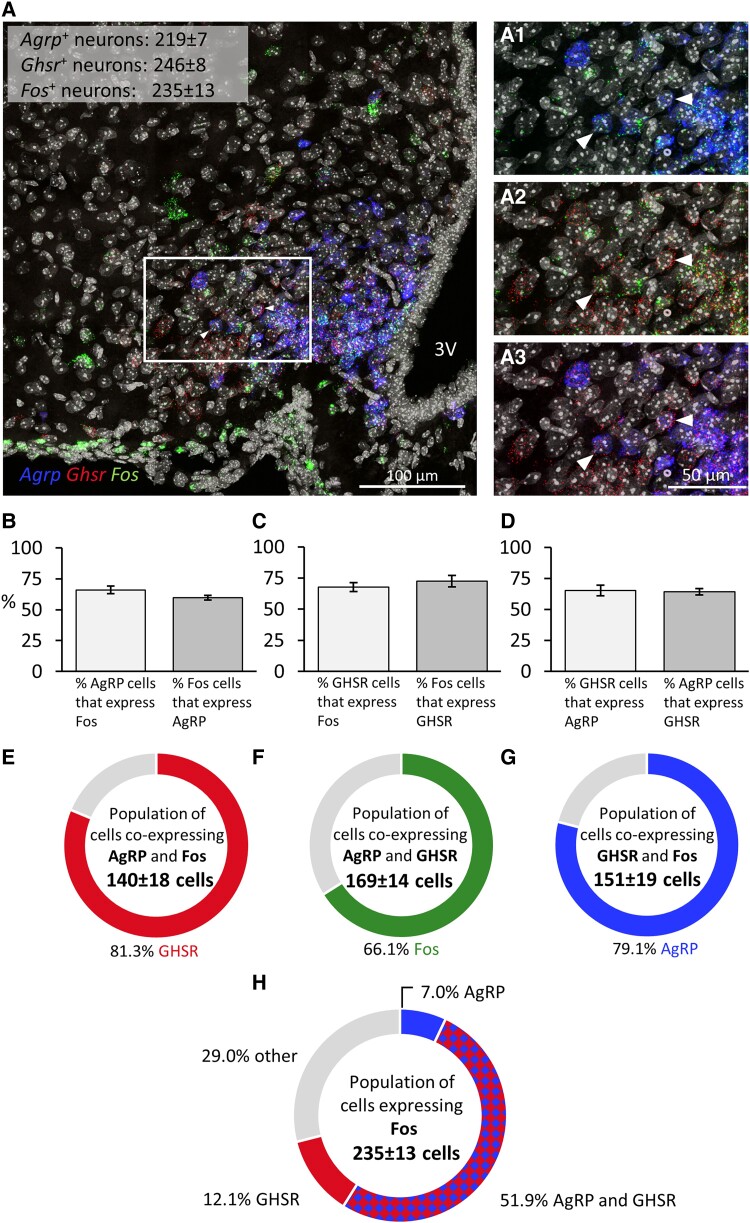
Neurochemical identification of arcuate neurons activated by intranasal GHRP-6 by colocalization of messenger RNAs (mRNAs) for c-fos, Ghsr, and Agrp. A, Representative confocal images of triple RNAscope in situ hypbridization for c-fos, Ghsr, and Agrp in a section showing the arcuate nucleus of a GHRP-6–treated mouse. The panels on the right show the area inside the rectangle, enlarged (A1-A3) with colocalization of Agrp and c-fos (A1), Ghsr, and c-fos (A2) and Agrp and Ghsr (A3). The white arrows in A1 to A3 provide examples of triple-positive neurons. B to D, Bar graphs illustrate colocalization in percentage between mRNA pairs. E to H, Neurochemical identity of E to G, triple-positive neurons and H, c-fos–expressing neurons. 3 V = third ventricle, bregma = −1.79. One to 2 hemisections per mouse were quantified (n = 6). Data are shown as mean ± SEM.
Figure 5.
Figure 5.
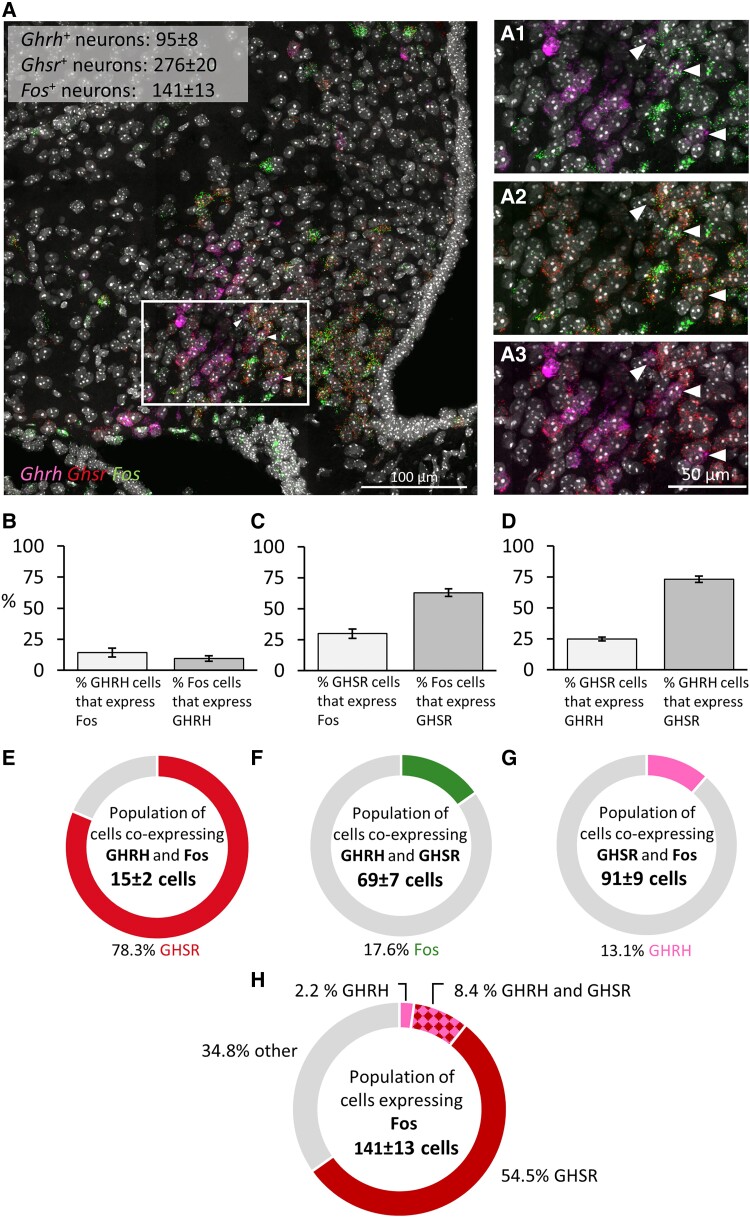
Neurochemical identification of arcuate neurons activated by intranasal GHRP-6 by colocalization of messenger RNAs (mRNAs) for c-fos, Ghsr, and Ghrh. A, Representative confocal images of triple RNAscope in situ hypbridization for c-fos, Ghsr, and Ghrh in a section containing the arcuate nucleus of a GHRP-6–treated mouse. The panels on the right show the area inside the rectangle, enlarged (A1-A3) with colocalization of Ghrh and c-fos (A1), Ghsr, and c-fos (A2) and Ghrh and Ghsr (A3). The white arrows in A1 to A3 give examples of triple-positive neurons. B to D, Bar graphs illustrate colocalization in percentage between mRNA pairs. E to H, Neurochemical identities of E to G, triple-positive neurons and H, c-fos–expressing neurons. 3 V = third ventricle, bregma = −1.79. Two to 4 hemisections per mouse were quantified (n = 5). Data are shown as mean ± SEM.
Figure 6.
Figure 6.
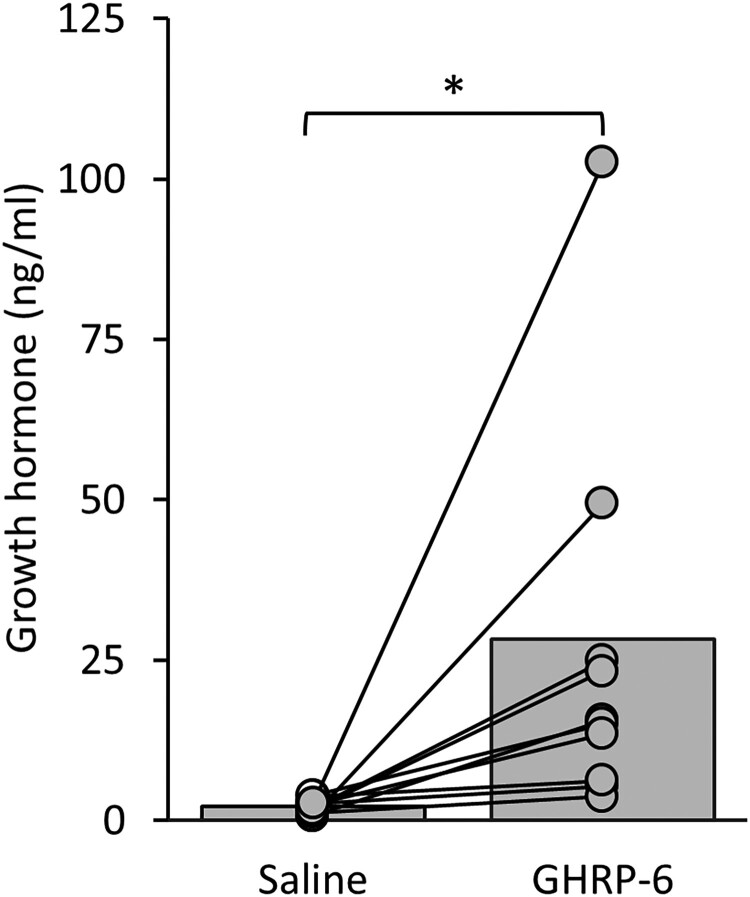
Intranasal delivery of GHRP-6 increases serum growth hormone (GH) levels in mice. GH levels were measured in blood serum samples collected 10 to 20 minutes following intranasal administration of GHRP-6 (5 mg/kg) or saline (n = 10). Symbols represent *P less than .05. Data are shown as mean ± SEM.

References

    1. Kojima M, Hosoda H, Date Y, Nakazato M, Matsuo H, Kangawa K. Ghrelin is a growth-hormone-releasing acylated peptide from stomach. Nature. 1999;402(6762):656‐660. - PubMed
    1. de la Cour CD, Norlén P, Håkanson R. Secretion of ghrelin from rat stomach ghrelin cells in response to local microinfusion of candidate messenger compounds: a microdialysis study. Regul Pept. 2007;143(1-3):118‐126. - PubMed
    1. Howard AD, Feighner SD, Cully DF, et al. A receptor in pituitary and hypothalamus that functions in growth hormone release. Science. 1996;273(5277):974‐977. - PubMed
    1. Bowers CY, Momany FA, Reynolds GA, Hong A. On the in vitro and in vivo activity of a new synthetic hexapeptide that acts on the pituitary to specifically release growth hormone. Endocrinology. 1984;114(5):1537‐1545. - PubMed
    1. Smith RG, Cheng K, Schoen WR, et al. A nonpeptidyl growth hormone secretagogue. Science. 1993;260(5114):1640‐1643. - PubMed

MeSH terms