


GestaltGAN: synthetic photorealistic portraits of individuals with rare genetic disorders
- PMID: 39815041
- PMCID: PMC11894188
- DOI: 10.1038/s41431-025-01787-z
GestaltGAN: synthetic photorealistic portraits of individuals with rare genetic disorders
Abstract
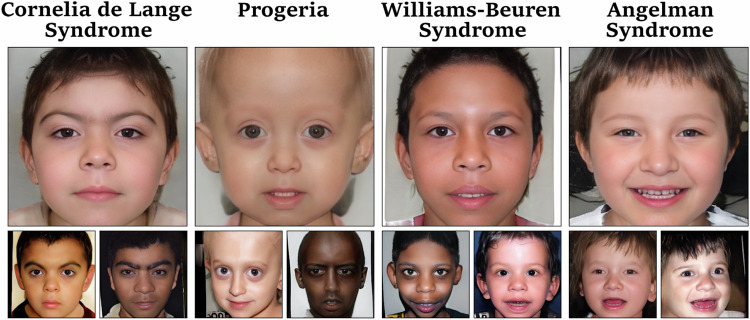
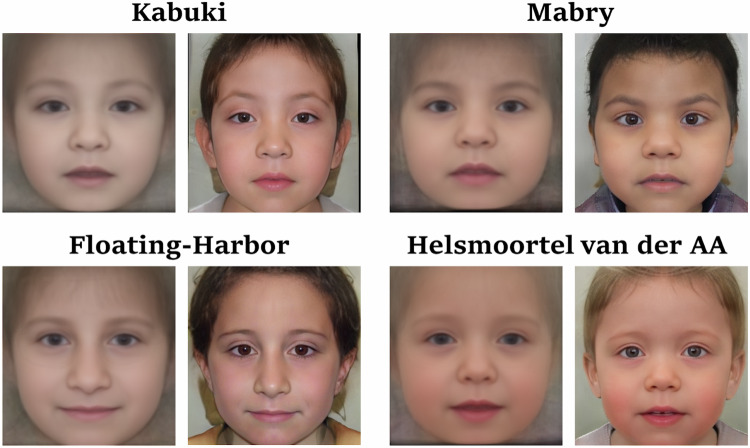
The facial gestalt (overall facial morphology) is a characteristic clinical feature in many genetic disorders that is often essential for suspecting and establishing a specific diagnosis. Therefore, publishing images of individuals affected by pathogenic variants in disease-associated genes has been an important part of scientific communication. Furthermore, medical imaging data is also crucial for teaching and training deep-learning models such as GestaltMatcher. However, medical data is often sparsely available, and sharing patient images involves risks related to privacy and re-identification. Therefore, we explored whether generative neural networks can be used to synthesize accurate portraits for rare disorders. We modified a StyleGAN architecture and trained it to produce artificial condition-specific portraits for multiple disorders. In addition, we present a technique that generates a sharp and detailed average patient portrait for a given disorder. We trained our GestaltGAN on the 20 most frequent disorders from the GestaltMatcher database. We used REAL-ESRGAN to increase the resolution of portraits from the training data with low-quality and colorized black-and-white images. To augment the model's understanding of human facial features, an unaffected class was introduced to the training data. We tested the validity of our generated portraits with 63 human experts. Our findings demonstrate the model's proficiency in generating photorealistic portraits that capture the characteristic features of a disorder while preserving patient privacy. Overall, the output from our approach holds promise for various applications, including visualizations for publications and educational materials and augmenting training data for deep learning.
© 2025. The Author(s).
Conflict of interest statement
Competing interests: The authors declare no competing interests. Ethical approval: Ethical approval for the GestaltMatcher Database was granted by the IRB of the University Hospital Bonn.
Figures


References
-
- Richards S, Aziz N, Bale S, Bick D, Das S, Gastier-Foster J, et al. Standards and guidelines for the interpretation of sequence variants: a joint consensus recommendation of the American College of Medical Genetics and Genomics and the Association for Molecular Pathology. Genet Med. 2015;17:405–24. - DOI - PMC - PubMed
-
- Schmidt A, Danyel M, Grundmann K, Brunet T, Klinkhammer H, Hsieh T-C, et al. Next-generation phenotyping integrated in a national framework for patients with ultra-rare disorders improves genetic diagnostics and yields new molecular findings. medRxiv. 2023. 10.1101/2023.04.19.23288824. - PMC - PubMed
-
- Saranya A, Subhashini R. A systematic review of Explainable Artificial Intelligence models and applications: Recent developments and future trends. Decis Analytics J. 2023;7:100230. - DOI
MeSH terms
LinkOut - more resources
Full Text Sources
Medical
