


Number of Previous Strokes and the Association With Clinical Outcomes of Patients With Atrial Fibrillation: Longitudinal Data From the GLORIA-AF Registry
- PMID: 39817504
- PMCID: PMC12054405
- DOI: 10.1161/JAHA.124.038448
Number of Previous Strokes and the Association With Clinical Outcomes of Patients With Atrial Fibrillation: Longitudinal Data From the GLORIA-AF Registry
Abstract
Background: Patients with atrial fibrillation (AF) who suffered a previous stroke are at increased risk of recurrent thromboembolic events and other major outcomes. The impact of the number of stroke episodes on the natural history of patients with AF is still unclear.
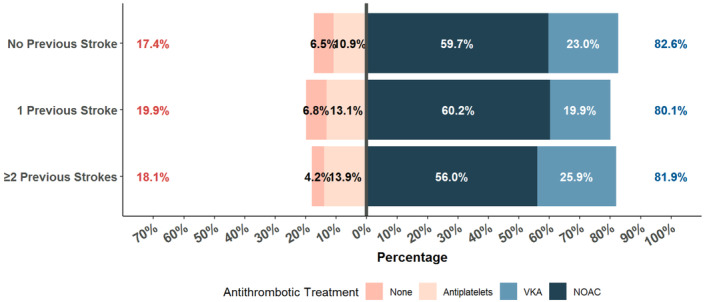
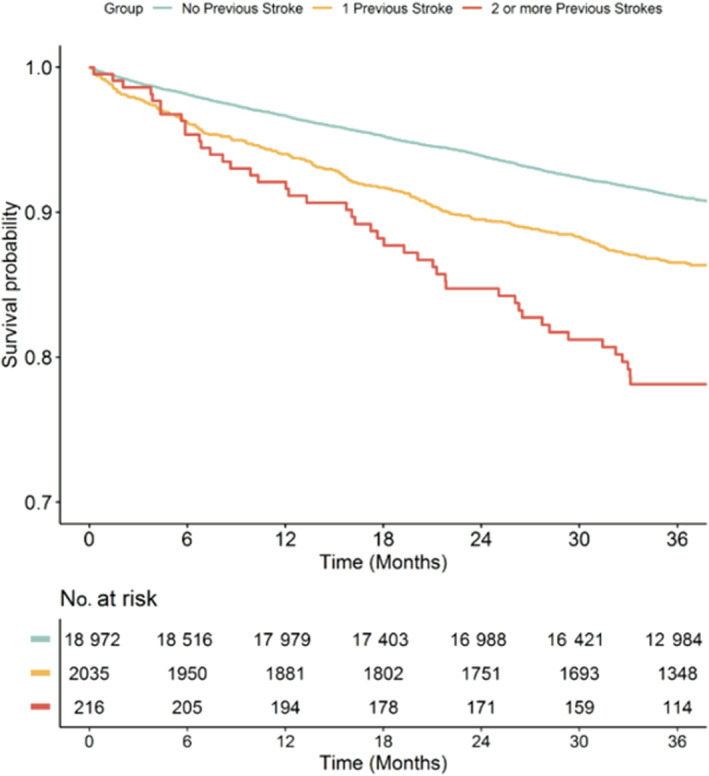
Methods and results: Using data from the international, multicenter, and prospective GLORIA-AF (Global Registry on Long-Term Oral Antithrombotic Treatment in Patients With Atrial Fibrillation) Registry Phase III, we categorized patients with a recent diagnosis of non-valvular AF according to the number of previous strokes (either 0, 1, or ≥2 episodes). We analyzed use of oral anticoagulants through multiple logistic regression model, and risk of major outcomes using multiple Cox-regression models; our primary outcome was all-cause death. Among 21 223 patients (mean age: 70.2±10.3 years; 44.9% female) included, 2251 (10.6%) had a previous history of stroke, and 216 (1.0%) had ≥2 or more strokes. Oral anticoagulants were used in ≥80% of patients regardless of the numbers of previous stroke, although those with 1 (versus >1) prior stroke showed lower odds of receiving oral anticoagulants (odds ratio [95% CI]: 0.83 [0.73-0.94]). During 3-years follow-up, the risk of all-cause mortality increased with the number of previous strokes (hazard ratio [95% CI]: 1.46 [1.28-1.67] and 2.43 [1.79-3.29] for 1 versus 0 and ≥2 versus 0 previous strokes, respectively). Similar results were observed for other secondary outcomes, including thromboembolism, but not for major bleeding.
Conclusions: History of stroke still represents a key risk factor in patients with AF. Patients who suffered more than 1 episodes of stroke had significantly worse prognosis and further efforts may be required to improve their clinical outcomes.
Keywords: atrial fibrillation; cardiovascular risk; number of stroke events.
Conflict of interest statement
G.F.R. reports consultancy for Boehringer Ingelheim and an educational grant from Anthos. No fees are directly received personally. B.O. has one disclosure AstraZeneca DSMB, Consultant for Boehringer Ingelheim. T.F.C. reported honoraria for lectures from Boehringer Ingelheim, Bayer, Pfizer, and Daiichi Sankyo, outside the submitted work. M.V.H. has been receiving research grants from the Dutch Healthcare Fund, Dutch Heart Foundation, BMS‐Pfizer, Bayer Healthcare and Boehringer Ingelheim and consulting fees from BMS‐Pfizer, Bayer Healthcare and Boehringer Ingelheim to the institution. G.Y.H.L. has been consultant and speaker for BMS/Pfizer, Boehringer Ingelheim, Anthos and Daiichi‐Sankyo. No fees are directly received personally. All the disclosures happened outside the submitted work. He is a National Institute for Health and Care Research Senior Investigator and co‐PI of the AFFIRMO project on multimorbidity in AF (grant agreement No 899871), TARGET project on digital twins for personalized management of atrial fibrillation and stroke (grant agreement No 101136244) and ARISTOTELES project on artificial intelligence for management of chronic long term conditions (grant agreement No 101080189), which are all funded by the EU's Horizon Europe Research & Innovation program. The remaining authors have no disclosures to report.
Figures
Comment in
-
Stroke by Stroke: The Compounding Burden of Prior Strokes on Outcomes in Atrial Fibrillation.J Am Heart Assoc. 2025 Jan 21;14(2):e039646. doi: 10.1161/JAHA.124.039646. Epub 2025 Jan 16. J Am Heart Assoc. 2025. PMID: 39817547 Free PMC article. No abstract available.
Similar articles
-
Long-term clinical outcomes of oral anticoagulation in the older patients with atrial fibrillation aged ≥80 years: a report from the GLORIA-AF registry phase III.Age Ageing. 2025 May 31;54(6):afaf139. doi: 10.1093/ageing/afaf139. Age Ageing. 2025. PMID: 40462483 Free PMC article.
-
Direct oral anticoagulants versus warfarin for preventing stroke and systemic embolic events among atrial fibrillation patients with chronic kidney disease.Cochrane Database Syst Rev. 2017 Nov 6;11(11):CD011373. doi: 10.1002/14651858.CD011373.pub2. Cochrane Database Syst Rev. 2017. PMID: 29105079 Free PMC article.
-
Atrial fibrillation outcomes in patients from Asia and non-Asia countries: insights from GARFIELD-AF.Open Heart. 2025 Feb 6;12(1):e003109. doi: 10.1136/openhrt-2024-003109. Open Heart. 2025. PMID: 39914996 Free PMC article.
-
Oral anticoagulants versus antiplatelet therapy for preventing stroke in patients with non-valvular atrial fibrillation and no history of stroke or transient ischemic attacks.Cochrane Database Syst Rev. 2007 Jul 18;(3):CD006186. doi: 10.1002/14651858.CD006186.pub2. Cochrane Database Syst Rev. 2007. PMID: 17636831
-
Asundexian or Apixaban in Patients With Atrial Fibrillation According to Prior Oral Anticoagulant Use: A Subgroup Analysis of the OCEANIC-AF Randomized Clinical Trial.JAMA Cardiol. 2025 Jun 1;10(6):555-563. doi: 10.1001/jamacardio.2025.0277. JAMA Cardiol. 2025. PMID: 40136309 Clinical Trial.
Cited by
-
Stroke by Stroke: The Compounding Burden of Prior Strokes on Outcomes in Atrial Fibrillation.J Am Heart Assoc. 2025 Jan 21;14(2):e039646. doi: 10.1161/JAHA.124.039646. Epub 2025 Jan 16. J Am Heart Assoc. 2025. PMID: 39817547 Free PMC article. No abstract available.
References
-
- Teppo K, Airaksinen KEJ, Jaakkola J, Halminen O, Linna M, Haukka J, Putaala J, Mustonen P, Kinnunen J, Hartikainen J, et al. Trends in treatment and outcomes of atrial fibrillation during 2007‐17 in Finland. Eur Heart J Qual Care Clin Outcomes. 2023;9:673–679. doi: 10.1093/ehjqcco/qcac086 - DOI - PMC - PubMed
Publication types
MeSH terms
Substances
LinkOut - more resources
Full Text Sources
Medical
