


Neuropsychiatric symptoms and neuroimaging-based brain age in mild cognitive impairment and early dementia: A multicenter study
- PMID: 39821434
- PMCID: PMC11962355
- DOI: 10.1111/pcn.13777
Neuropsychiatric symptoms and neuroimaging-based brain age in mild cognitive impairment and early dementia: A multicenter study
Abstract
Aim: Despite the clinical importance and significant social burden of neuropsychiatric symptoms (NPS) in dementia, the underlying neurobiological mechanism remains poorly understood. Recently, neuroimaging-derived brain-age estimation by machine-learning analysis has shown promise as an individual-level biomarker. We investigated the relationship between NPS and brain-age in amnestic mild cognitive impairment (MCI) and early dementia.
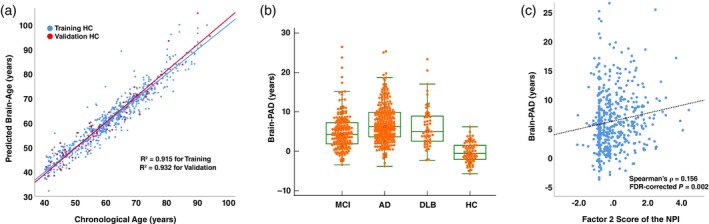
Methods: In this cross-sectional study, clinical data, including neuropsychiatric inventory (NPI), and structural brain MRI of 499 individuals with clinical diagnoses of amnestic MCI (n = 185), early Alzheimer's disease (AD) (n = 258) or dementia with Lewy bodies (DLB) (n = 56) were analyzed. We established a brain-age prediction model using 694 healthy brain MRIs and a support vector regression model and applied it to the participants' data. Finally, the brain-predicted age difference (brain-PAD: predicted age minus chronological age) was calculated.
Results: All groups showed significantly increased brain-PAD, and the median (IQR) brain-PAD was 4.3 (5.4) years in MCI, 6.3 (6.2) years in AD, and 5.0 (6.5) years in DLB. The NPI scores were subdivided into the following four categories: (i) Agitation and Irritability, (ii) Depression and Apathy, (iii) Delusions and Hallucinations, and (iv) Euphoria and Disinhibition. We found a significantly positive correlation between brain-PAD and the depression/apathy factor (Spearman's rs = 0.156, FDR-corrected P = 0.002), whereas no significance was shown for the other NPS factors.
Conclusion: Higher brain-age may be associated with depression and apathy symptoms presented in MCI to early dementia stages, and brain-age analysis may be useful as a novel biomarker for the assessment or monitoring of NPS.
Keywords: dementia; machine learning; magnetic resonance imaging; mild cognitive impairment; neuropsychiatric symptoms.
© 2025 The Author(s). Psychiatry and Clinical Neurosciences published by John Wiley & Sons Australia, Ltd on behalf of Japanese Society of Psychiatry and Neurology.
Figures
References
-
- Missotten P, Squelard G, Ylieff M et al. Relationship between quality of life and cognitive decline in dementia. Dement. Geriatr. Cogn. Disord. 2008; 25: 564–572. - PubMed
-
- Germain S, Adam S, Olivier C et al. Does cognitive impairment influence burden in caregivers of patients with Alzheimer's disease? J. Alzheimers Dis. 2009; 17: 105–114. - PubMed
Publication types
MeSH terms
Grants and funding
LinkOut - more resources
Full Text Sources
Medical
