


Explainable machine learning framework for cataracts recognition using visual features
- PMID: 39821539
- PMCID: PMC11748710
- DOI: 10.1186/s42492-024-00183-6
Explainable machine learning framework for cataracts recognition using visual features
Abstract
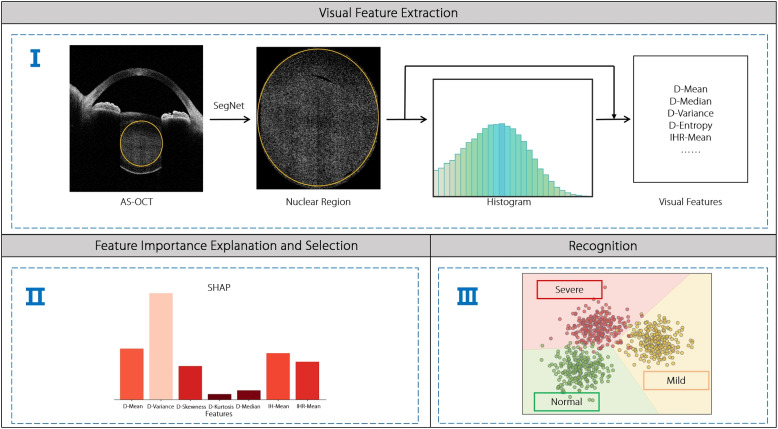
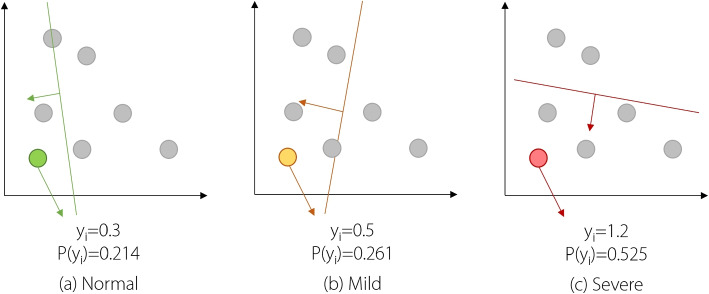
Cataract is the leading ocular disease of blindness and visual impairment globally. Deep neural networks (DNNs) have achieved promising cataracts recognition performance based on anterior segment optical coherence tomography (AS-OCT) images; however, they have poor explanations, limiting their clinical applications. In contrast, visual features extracted from original AS-OCT images and their transform forms (e.g., AS-OCT-based histograms) have good explanations but have not been fully exploited. Motivated by these observations, an explainable machine learning framework to recognize cataracts severity levels automatically using AS-OCT images was proposed, consisting of three stages: visual feature extraction, feature importance explanation and selection, and recognition. First, the intensity histogram and intensity-based statistical methods are applied to extract visual features from original AS-OCT images and AS-OCT-based histograms. Subsequently, the SHapley Additive exPlanations and Pearson correlation coefficient methods are applied to analyze the feature importance and select significant visual features. Finally, an ensemble multi-class ridge regression method is applied to recognize the cataracts severity levels based on the selected visual features. Experiments on a clinical AS-OCT-NC dataset demonstrate that the proposed framework not only achieves competitive performance through comparisons with DNNs, but also has a good explanation ability, meeting the requirements of clinical diagnostic practice.
Keywords: Anterior segment optical coherence tomography; Explainable; Machine learning; Nuclear cataract; Visual feature.
© 2025. The Author(s).
Conflict of interest statement
Declarations. Competing interests: No potential competing interest was reported by the authors.
Figures


References
-
- Wang W, Yan W, Fotis K, Prasad NM, Lansingh VC, Taylor HR et al (2017) Cataract surgical rate and socioeconomics: a global study. Invest Ophthalmol Vis Sci 57(14):5872–5881. 10.1167/iovs.16-19894 - PubMed
-
- Zhang XQ, Hu Y, Xiao ZJ, Fang JS, Higashita R, Liu J (2022) Machine learning for cataract classification/grading on ophthalmic imaging modalities: a survey. Mach Intell Res 19(3):184–208. 10.1007/s11633-022-1329-0
-
- Gali HE, Sella R, Afshari NA (2019) Cataract grading systems: a review of past and present. Curr Opin Ophthalmol 30(1):13–18. 10.1097/ICU.0000000000000542 - PubMed
-
- Liu YC, Wilkins M, Kim T, Malyugin B, Mehta JS (2017) Cataracts. Lancet 390(10094):600–612. 10.1016/S0140-6736(17)30544-5 - PubMed
-
- Fu HZ, Xu YW, Lin S, Zhang XQ, Wong DWK, Liu J et al (2017) Segmentation and quantification for angle-closure glaucoma assessment in anterior segment OCT. IEEE Trans Med Imaging 36(9):1930–1938. 10.1109/TMI.2017.2703147 - PubMed
Grants and funding
LinkOut - more resources
Full Text Sources
Research Materials