


There Goes the Neighbourhood-A Multi-City Study Reveals Ticks and Tick-Borne Pathogens Commonly Occupy Urban Green Spaces
- PMID: 39821965
- PMCID: PMC11967321
- DOI: 10.1111/zph.13208
There Goes the Neighbourhood-A Multi-City Study Reveals Ticks and Tick-Borne Pathogens Commonly Occupy Urban Green Spaces
Abstract
Introduction: Humans acquire tick-borne pathogens (TBPs) from infected ticks contacted during outdoor activities. Outdoor activity is at its highest in urban green spaces, where the presence of tick populations has increasingly been observed. Consequently, more insight into factors influencing the presence of ticks therein is needed. Here, we assess the occurrence of ticks and several TBPs in urban green spaces in Finland, estimate related human hazard and assess how landscape features influence tick and TBP occurrence therein.
Methods: Ticks collected from five cities during 2019-2020 were utilised. Borrelia, Rickettsia, Neoehrlichia mikurensis, Anaplasma phagocytophilum , Babesia and TBEV were screened from ticks using qPCR. Various landscape features were calculated and utilised in generalised linear mixed models to assess their contribution towards tick and TBP occurrence in green spaces. Finally, human population density proximate to each study site was calculated and used to create population-weighted risk indices.
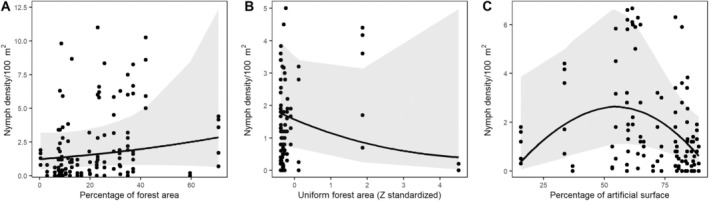
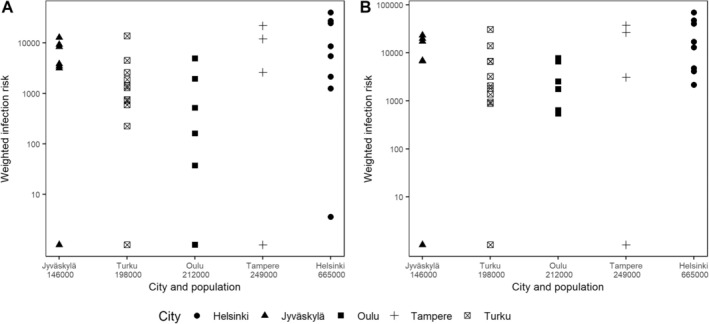
Results: Borrelia were the most common pathogens detected, with 22% of nymphs and 43% of adults infected. Increasing forest cover had a positive effect on the densities of nymphs and adults, whereas forest size had a negative effect. Middling percentages of artificial surfaces predicted higher nymph densities than low or high values. Human population-weighted risk estimates were highly varied, even within cities. A positive correlation was observed between total city population and risk indices.
Conclusions: Ticks and TBPs are commonplace in urban green spaces in Finland. Enzootic cycles for Borrelia and Rickettsia appear to be well maintained within cities, leading to widespread risk of infection therein. Our results suggest that nymph densities are highest in urban forests of medium size, whereas small or large forests show reduced densities. Green spaces of roughly similar risk can be found in cities of different sizes, emphasising that the identification of areas of particularly high hazard is important for effective mitigation actions.
Keywords: landscape features; public health; risk index; ticks; tick‐borne pathogens; urban green spaces.
© 2025 The Author(s). Zoonoses and Public Health published by Wiley‐VCH GmbH.
Conflict of interest statement
The authors declare no conflicts of interest.
Figures
References
-
- Bourdin, A. , Dokhelar T., Bord S., et al. 2023. “Forests Harbor More Ticks Than Other Habitats: A Meta‐Analysis.” Forest Ecology and Management 541: 121081.
-
- Buczek, A. , Ciura D., Bartosik K., Zając Z., and Kulisz J.. 2014. “Threat of Attacks of <styled-content style="fixed-case"> Ixodes ricinus </styled-content> Ticks (Ixodida: Ixodidae) and Lyme Borreliosis Within Urban Heat Islands in South‐Western Poland.” Parasites & Vectors 7, no. 1: 1–9. - PMC - PubMed
-
- Cat, J. , Beugnet F., Hoch T., Jongejan F., Prangé A., and Chalvet‐Monfray K.. 2017. “Influence of the Spatial Heterogeneity in Tick Abundance in the Modeling of the Seasonal Activity of <styled-content style="fixed-case"> Ixodes ricinus </styled-content> Nymphs in Western Europe.” Experimental and Applied Acarology 71: 115–130. - PubMed
Publication types
MeSH terms
Grants and funding
LinkOut - more resources
Full Text Sources
Medical
