This is a preprint.
Race and ethnic disparities in rehabilitation services and functional recovery post-stroke
- PMID: 39830239
- PMCID: PMC11741466
- DOI: 10.1101/2025.01.06.25320085
Race and ethnic disparities in rehabilitation services and functional recovery post-stroke
Update in
-
Race and Ethnic Disparities in Rehabilitation Services and Functional Recovery After Stroke.Arch Phys Med Rehabil. 2025 Dec 11:S0003-9993(25)01100-1. doi: 10.1016/j.apmr.2025.11.029. Online ahead of print. Arch Phys Med Rehabil. 2025. PMID: 41390049
Abstract
Objective: To identify race/ethnic disparities in rehabilitation services after stroke and characterize the independent associations of each of race/ethnicity and rehabilitation to functional recovery post-stroke.
Methods: The Transitions of Care Stroke Disparities Study (TCSD-S) is a prospective cohort study designed to reduce disparities and to optimize the transitions of care for stroke survivors throughout the state of Florida. Participant characteristics were extracted from the American Heart Association's Get-With-The-Guidelines-Stroke dataset. Rehabilitation services, and modified Rankin Scale were recorded via follow up phone calls at 30- and 90-days after hospital discharge. Logistic regression models adjusted for potential confounders were used to determine: 1) race/ethnic differences in rehabilitation services received; 2) race/ethnic differences in functional change from discharge to 30- and 90-days, respectively; and 3) the influence of rehabilitation on functional change from discharge to 30- and 90-days.
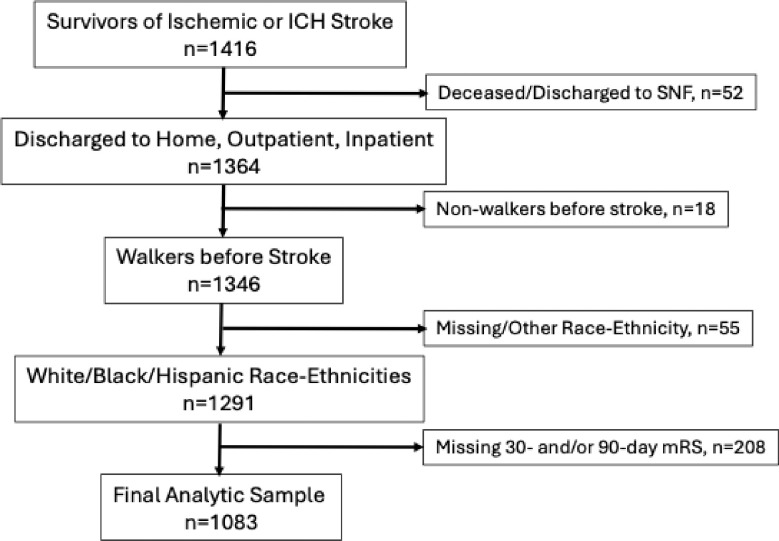
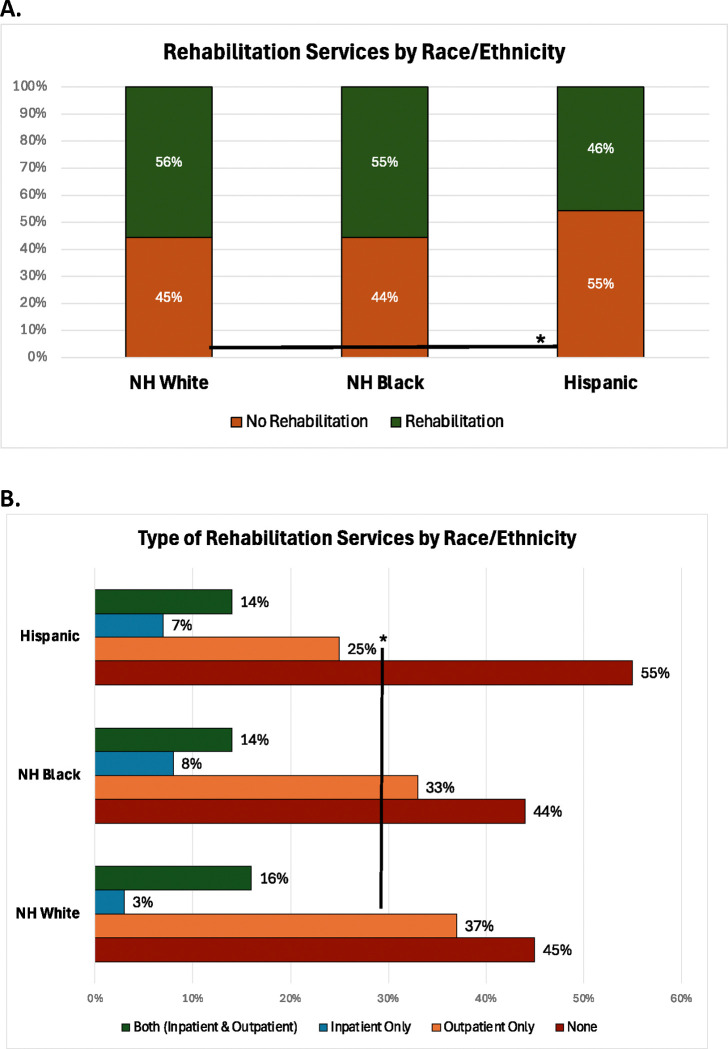
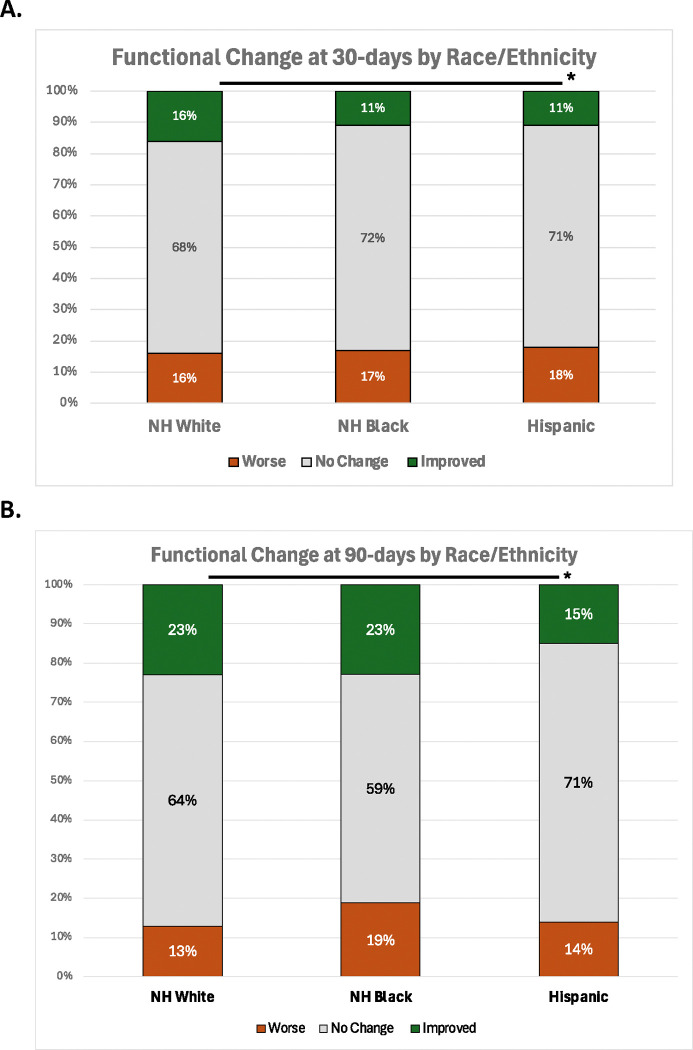
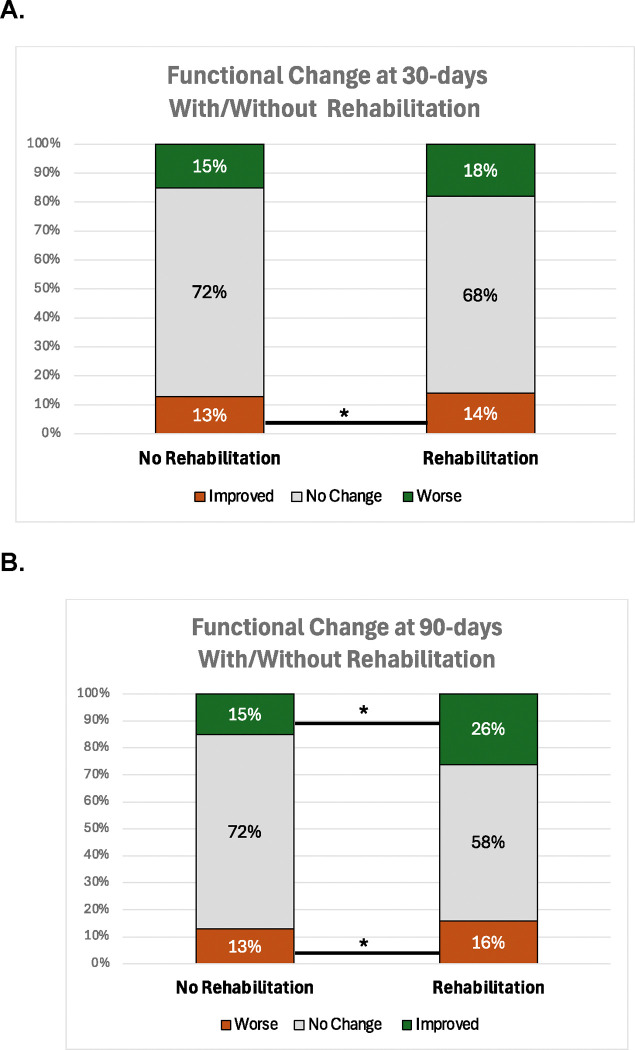
Results: Of 1,083 individuals, 43% were female, 52% were Non-Hispanic White (NHW), 22% were Non-Hispanic Black (NHB), and were 22% Hispanic. Individuals who engaged in rehabilitation were more likely to show improvements [aOR=1.820, 95%CI (1.301,2.545)] at 90-days from hospital discharge. Irrespective of rehabilitation services, there were no differences in functional change between NHW and NHB individuals, yet Hispanic individuals were less likely to improve [aOR=0.647, 95%CI (0.425,0.983)] compared to NHW. Additionally, Hispanic individuals were significantly less likely to receive any rehabilitation services [aOR=0.626, 95%CI (0.442,0.886)] and were half as likely to receive outpatient services [aOR=0.543, 95%CI (0.368,0.800)] as compared to NHW.
Conclusions: Rehabilitation is key to functional improvement after stroke. We are making strides in health equity between NHW and NHB individuals, yet there remain disparities in functional outcomes and in rehabilitation services particularly for Hispanic individuals after stroke.
Keywords: Stroke; functional outcomes; recovery; rehabilitation.
Conflict of interest statement
Disclosures: There are no disclosures in addition to the funding sources identified above.
Figures
References
Publication types
Grants and funding
LinkOut - more resources
Full Text Sources