Who is at risk for tPA/DNase treatment failure in empyema?-protocol to identify key predictors for early surgical intervention from a retrospective study
- PMID: 39831208
- PMCID: PMC11740072
- DOI: 10.21037/jtd-24-1256
Who is at risk for tPA/DNase treatment failure in empyema?-protocol to identify key predictors for early surgical intervention from a retrospective study
Abstract
Background: Empyema, characterized by the accumulation of pus in the pleural cavity, poses significant treatment challenges. While intrapleural tissue plasminogen activator (tPA) and deoxyribonuclease (DNase) therapy is effective for many patients, a substantial proportion require surgical intervention, such as video-assisted thoracoscopic surgery (VATS), following treatment failure. Identifying tPA/DNase treatment failure-associated predictors is crucial for optimizing patient management and improving outcomes. This study aims to identify clinical and biochemical predictors of tPA/DNase treatment failure in empyema patients, facilitating early and targeted interventions.
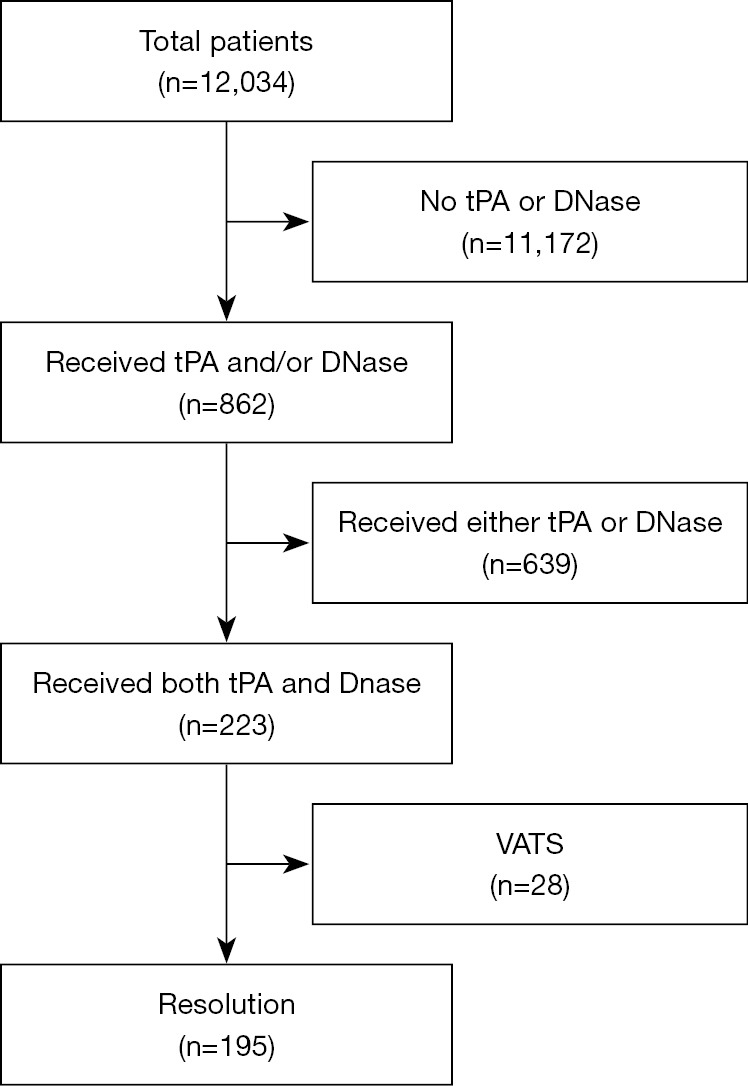
Methods: We conducted a retrospective analysis of 223 empyema patients treated with tPA/DNase at Northeast Georgia Medical Center between January 2018 and December 2023. Data were collected on demographics, comorbidities, pleural fluid analysis, radiological findings, and laboratory results. Multivariable logistic regression was used to identify predictors of treatment failure, with statistical significance set at a P value <0.05.
Results: Of the 223 patients, 28 (12.6%) experienced treatment failure and required VATS. Several predictors of treatment failure were identified. Younger age was associated with a higher likelihood of treatment failure [odds ratio (OR) =0.97; 95% confidence interval (CI): 0.94-0.99; P=0.03]. The presence of Staphylococcus aureus (S. aureus) infection significantly predicted treatment failure (OR =4.1; 95% CI: 1.2-14.5; P=0.03). Biochemical markers in pleural fluid, such as pH, lactate dehydrogenase (LDH), and protein levels, were not associated with tPA/DNase failure.
Conclusions: Key predictors of tPA/DNase treatment failure in empyema patients include younger age (median age of 60.5 vs. 67 years old) and S. aureus infection. Recognizing these predictors can guide clinicians in identifying high-risk patients and considering early surgical intervention. Future studies should aim to validate these findings in diverse populations to refine and confirm these predictive models.
Keywords: Empyema; deoxyribonuclease (DNase); tissue plasminogen activator (tPA); treatment failure; video-assisted thoracoscopic surgery (VATS).
2024 AME Publishing Company. All rights reserved.
Conflict of interest statement
Conflicts of Interest: All authors have completed the ICMJE uniform disclosure form (available at https://jtd.amegroups.com/article/view/10.21037/jtd-24-1256/coif). The authors have no conflicts of interest to declare.
Figures
References
-
- Garvia V, Paul M. Empyema(Archived). Treasure Island, FL, USA: StatPearls Publishing; 2024. - PubMed
LinkOut - more resources
Full Text Sources