


Robot-assisted upper limb therapy for personalized rehabilitation in children with cerebral palsy: a systematic review
- PMID: 39835154
- PMCID: PMC11743387
- DOI: 10.3389/fneur.2024.1499249
Robot-assisted upper limb therapy for personalized rehabilitation in children with cerebral palsy: a systematic review
Abstract
Introduction: Cerebral palsy (CP) is a group of permanent disorders of movement development that may cause activity limitations. In this context, robot-assisted therapy might play a key role in clinical management. This comprehensive systematic review aimed to investigate the efficacy of robotic systems in improving upper limb (UL) functions in children with CP.
Methods: PubMed, EMBASE, Scopus, and PEDro were searched from inception to February 2024. The risk of bias was assessed with the Joanna Briggs Institute critical appraisal tools battery.
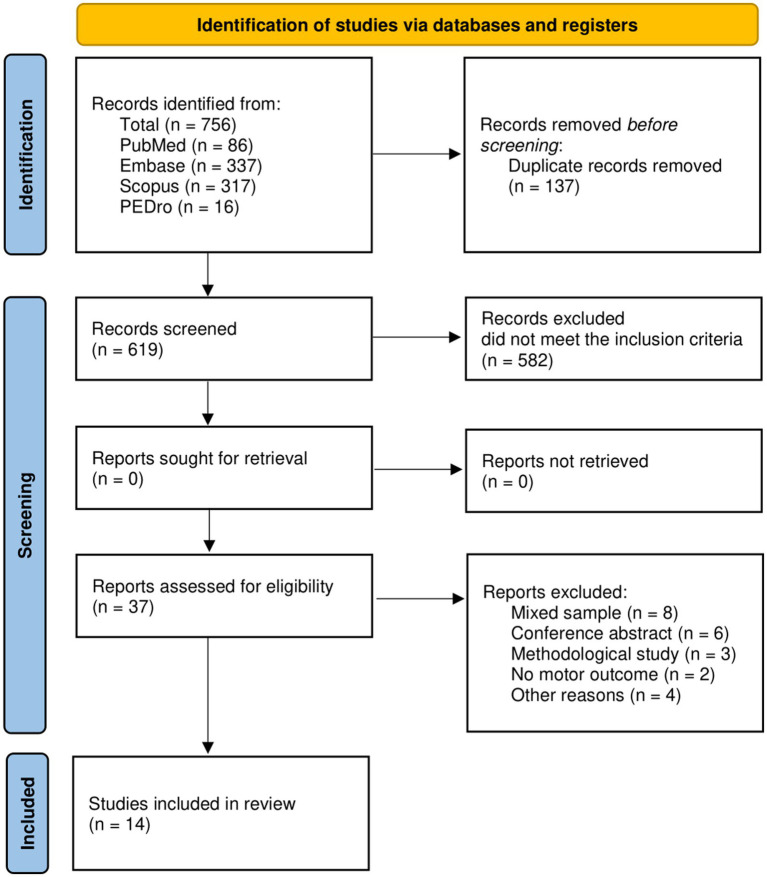
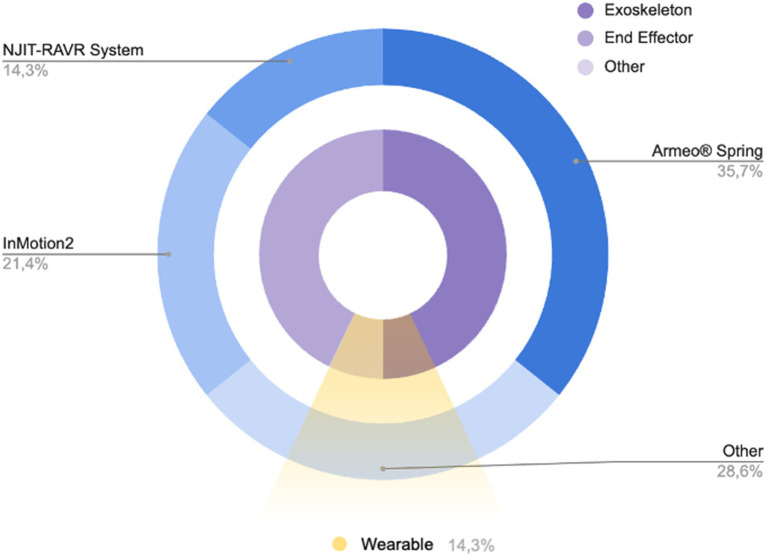
Results: Of 756 articles identified, 14 studies involving 193 children with CP with a judged to be of good methodological quality, but with a lack in the study design, were included in the final synthesis. In the included studies a wide range of devices was used, both exoskeletons and end-effectors, both wearable and non-wearable. The CP children who underwent robot-assisted therapy reported a significant overall increase in clinical assessment, specifically in UL movements and manual dexterity. The clinical improvement was often accompanied by a gain also in instrumental assessments (i.e., kinematic analysis, EMG).
Discussion: The present review suggested that robot-assisted therapy can improve UL motor functions in children with CP. Moreover, the availability of different devices with adjustable parameters can represent an important resource in proposing patient-centered-personalized rehabilitation protocols to enhance the efficacy of rehabilitation and integration into daily life. However, the limited sample size and lack of standardized and clearly reproducible protocols impose to recommend the use of robot-assisted therapy as an integration to usual rehabilitation and not as a replacement.
Systematic review registration: https://osf.io/a78zb/.
Keywords: endeffector; exoskeleton; hemiplegia; rehabilitation; robotics; upper extremities.
Copyright © 2025 Cardone, Perpetuini, Di Nicola, Merla, Morone, Ciancarelli, Moretti, Gimigliano, Cichelli, De Flaviis, Martino Cinnera and Paolucci.
Conflict of interest statement
The authors declare that the research was conducted in the absence of any commercial or financial relationships that could be construed as a potential conflict of interest.
Figures
References
-
- Krigger KW. Cerebral Palsy: An Overview. Cerebral Palsy. (2006) 73:91-100. - PubMed
Publication types
LinkOut - more resources
Full Text Sources
Miscellaneous
