


Optimising Instrumented Mouthguard Data Analysis: Video Synchronisation Using a Cross-correlation Approach
- PMID: 39836341
- PMCID: PMC11929623
- DOI: 10.1007/s10439-025-03679-1
Optimising Instrumented Mouthguard Data Analysis: Video Synchronisation Using a Cross-correlation Approach
Erratum in
-
Correction: Optimising Instrumented Mouthguard Data Analysis: Video Synchronisation Using a Cross-correlation Approach.Ann Biomed Eng. 2025 Apr;53(4):934. doi: 10.1007/s10439-025-03690-6. Ann Biomed Eng. 2025. PMID: 39885049 Free PMC article. No abstract available.
Abstract
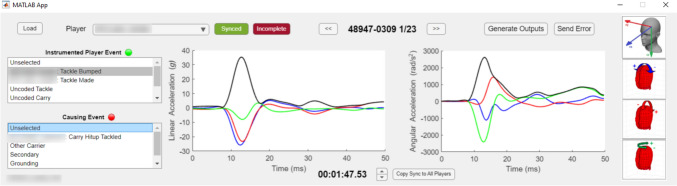
Purpose: Head acceleration events (HAEs) are a growing concern in contact sports, prompting two rugby governing bodies to mandate instrumented mouthguards (iMGs). This has resulted in an influx of data imposing financial and time constraints. This study presents two computational methods that leverage a dataset of video-coded match events: cross-correlation synchronisation aligns iMG data to a video recording, by providing playback timestamps for each HAE, enabling analysts to locate them in video footage; and post-synchronisation event matching identifies the coded match event (e.g. tackles and ball carries) from a video analysis dataset for each HAE, this process is important for calculating the probability of match events resulting in HAEs. Given the professional context of iMGs in rugby, utilising commercial sources of coded match event datasets may expedite iMG analysis.
Methods: Accuracy and validity of the methods were assessed via video verification during 60 rugby matches. The accuracy of cross-correlation synchronisation was determined by calculating synchronisation error, whilst the validity of post-synchronisation event matching was evaluated using diagnostic accuracy measures (e.g. positive predictive value [PPV] and sensitivity).
Results: Cross-correlation synchronisation yielded mean synchronisation errors of 0.61-0.71 s, with all matches synchronised within 3 s' error. Post-synchronisation event matching achieved PPVs of 0.90-0.95 and sensitivity of 0.99-1.00 for identifying correct match events for SAEs.
Conclusion: Both methods achieved high accuracy and validity with the data sources used in this study. Implementation depends on the availability of a dataset of video-coded match events; however, integrating commercially available video-coded datasets offers the potential to expedite iMG analysis, improve feedback timeliness, and augment research analysis.
Keywords: Brain injury; Head acceleration; Instrumented mouthguards; Video analysis.
© 2025. Crown.
Conflict of interest statement
Declarations. Conflict of interest: GT and BJ have received research funding from Prevent Biometrics. EF, LS, and RT are employed by World Rugby. BJ is employed in a consultancy capacity by Premiership Rugby and Rugby Football League. KT is employed in a consultancy capacity by Leeds Rhinos. DA and RT are employed in a consultancy capacity by World Rugby. GR role is part funded by World Rugby and Premiership Rugby. TS role is part funded by Premiership Rugby. ÉF and LS are employed by World Rugby. JT and CO role is part funded by Rugby Football League. KS is employed by the Rugby Football Union. There are no competing interests for the remaining authors. Ethical approval: Participants provided written consent. Ethics approval was received from the Leeds Beckett University Ethics Committee (REF #108638) and by World Rugby’s internal Ethics Committee. The study was performed in accordance with the standards of ethics outlined in the Declaration of Helsinki.
Figures



References
-
- Le Flao, E., G.P. Siegmund, and R. Borotkanics, Head Impact Research Using Inertial Sensors in Sport: A Systematic Review of Methods, Demographics, and Factors Contributing to Exposure. Sports Medicine, 2021: p. 1-24. - PubMed
-
- Instrumented Mouthguard (iMG) update. 2024; Available from: https://www.world.rugby/news/912305/instrumented-mouthguard-img-update.
MeSH terms
LinkOut - more resources
Full Text Sources
