Review
. 2025 Mar;12(11):e2413364.
doi: 10.1002/advs.202413364. Epub 2025 Jan 21.

Transfusion-Related Acute Lung Injury: from Mechanistic Insights to Therapeutic Strategies

Affiliations
Review

Transfusion-Related Acute Lung Injury: from Mechanistic Insights to Therapeutic Strategies

Xiaobin Fang et al. Adv Sci (Weinh). 2025 Mar.

Abstract

Transfusion-related acute lung injury (TRALI) is a potentially lethal complication of blood transfusions, characterized by the rapid onset of pulmonary edema and hypoxemia within six hours post-transfusion. As one of the primary causes of transfusion-related mortality, TRALI carries a significant mortality rate of 6-12%. However, effective treatment strategies for TRALI are currently lacking, underscoring the urgent need for a comprehensive and in-depth understanding of its pathogenesis. This comprehensive review provides an updated and detailed analysis of the current landscape of TRALI, including its clinical presentation, pathogenetic hypotheses, animal models, cellular mechanisms, signaling pathways, and potential therapeutic targets. By highlighting the critical roles of these pathways and therapies, this review offers valuable insights to inform the development of preventative and therapeutic strategies and to guide future research efforts aimed at addressing this life-threatening condition.

Keywords: immune response; pathogenesis; signaling pathways; therapeutic strategies; transfusion‐related acute lung injury (TRALI).


Conflict of interest statement

The authors declare no conflict of interests.

Figures
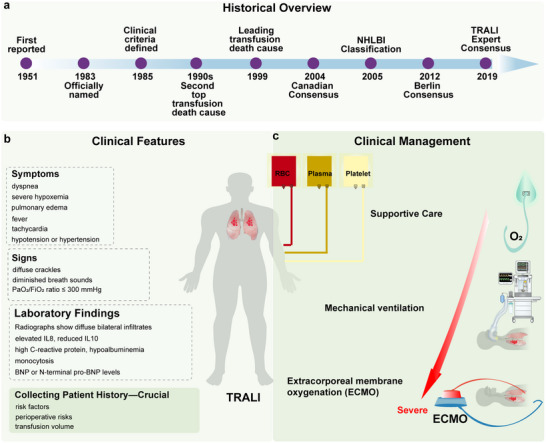
Figure 1
Figure 1
Clinical overview of TRALI. TRALI has high mortality and incidence in critically ill patients, with a lack of specific diagnostic markers and targeted therapies. The accurate definition drives research advancements. a) Historical overview of TRALI; b) Clinical features of TRALI; c) Clinical management of TRALI.
Figure 2
Figure 2
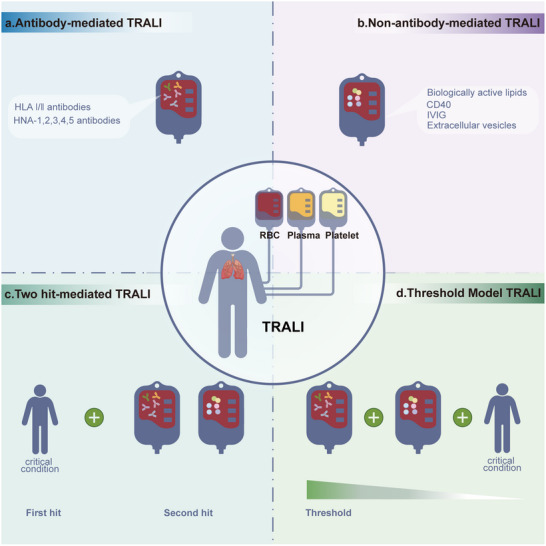
TRALI‐related pathogenetic hypotheses. The threat of TRALI and the lack of diagnostic markers and therapies drive the exploration of its pathogenesis. Four hypotheses have been proposed to explain its pathogenesis. a) antibody‐mediated TRALI; b) non‐antibody‐mediated TRALI; c) Two‐hit‐mediated TRALI; d) threshold models for TRALI.
Figure 3
Figure 3
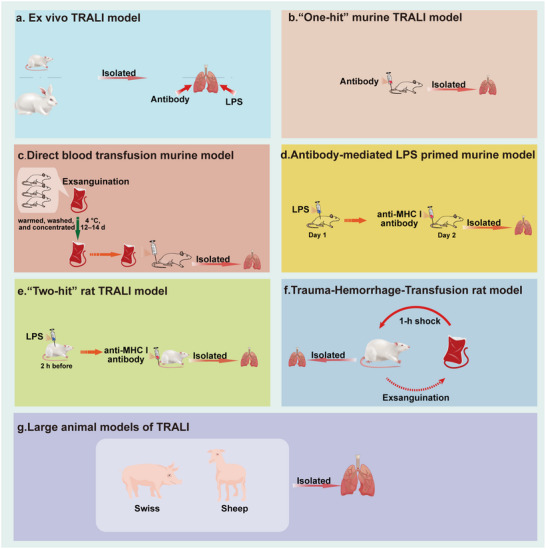
Experimental models for TRALI. While animal models are essential to its mechanism research, they often replicate only parts of a disease mechanism, requiring further optimization. a) Ex vivo TRALI models; b) “One‐hit” murine TRALI model; c) Direct blood transfusion murine model; d) Antibody‐mediated LPS‐primed murine TRALI model; e) “Two‐hit” rat TRALI model; f) Trauma‐hemorrhage‐Transfusion rat TRALI model; g) Large animal models of TRALI.
Figure 4
Figure 4
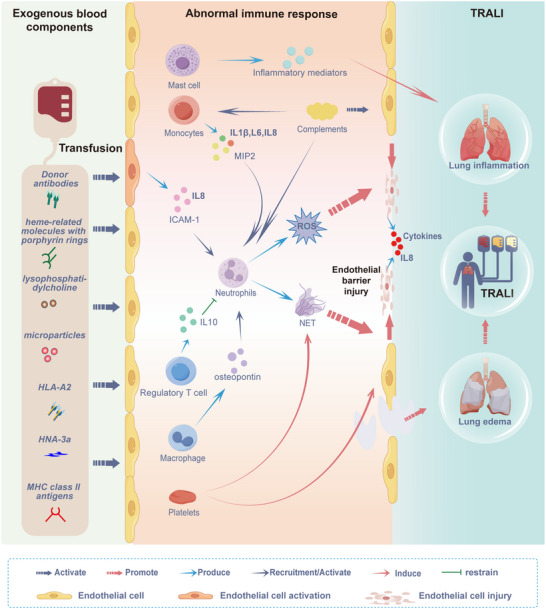
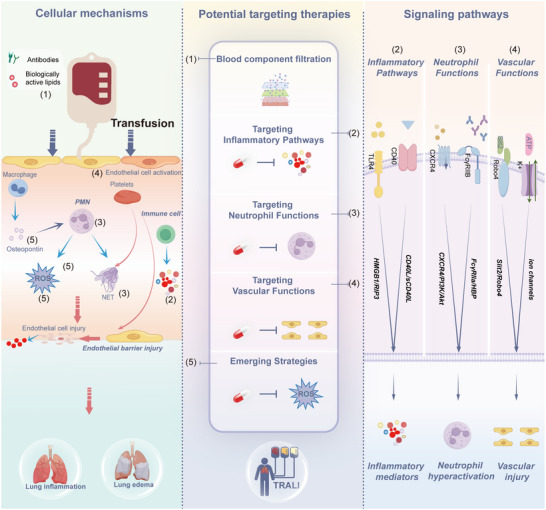
Cellular mechanisms underlying TRALI. Upon transfusion, antibodies and biologically active materials in blood products enter the circulation of the recipients. These components activate the immune system, leading to pulmonary inflammation and edema, which ultimately results in TRALI. The primary TRALI mechanism involves an abnormal immune response to exogenous blood components.
Figure 5
Figure 5
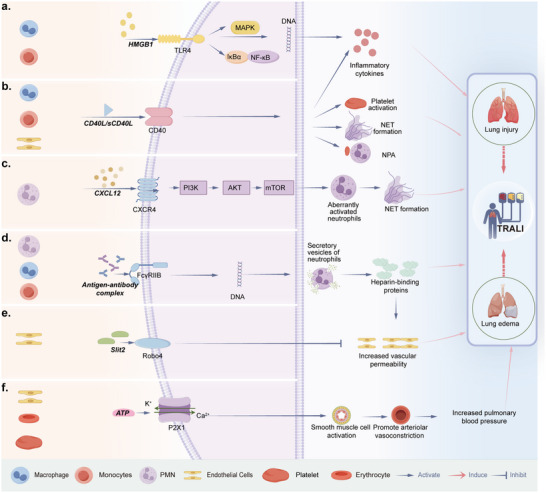
Signaling pathways in TRALI. Critical signaling pathways involved in the pathogenesis of TRALI. Left panels: Cells express those potential signaling pathways. a) HMGB1/RIP3 signaling pathway, b) sCD40L/CD40/CD40L signaling pathway, c) CXCR4/PI3K/Akt/mTOR signaling pathway, d) FcγRIIa/HBP signaling pathway, e) Slit2/Robo4 signaling pathway, and f) the ATP‐gated P2RX1 ion channel pathway.
Figure 6
Figure 6
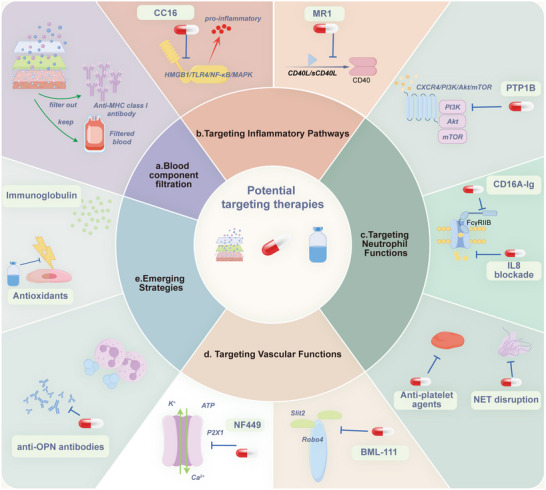
Potential TRALI‐targeting therapies. Potential targeting therapies for TRALI, including: a) Blood component filtration; b) Targeting inflammatory pathways, including HMGB1/RIP3 and CD40/CD40L signaling pathways; c) Targeting neutrophil functions, including the CXCR4/PI3K/Akt pathway, FcγRIIa signaling, IL‐8 and its receptors, neutrophil extracellular traps, and blood platelets; d) Targeting vascular functions, including the Slit2/Robo4 signaling pathway and ion channels; e) Emerging strategies, including reactive oxygen species (ROS), osteopontin, and intravenous immunoglobulin (IVIG).
Figure 7
Figure 7
Cellular mechanisms, signaling pathways, and potential therapeutic targets in TRALI. The pathogenesis involves immune responses to immunogenic blood product components, with key pathways including inflammation, neutrophil activation, and endothelial dysfunction. Based on these molecular and pathway insights, therapeutic strategies focus on removing immunogenic components of exogenous blood products, modulating inflammation, and targeting neutrophils and endothelial cells. Emerging therapies, such as those targeting reactive oxygen species (ROS), intravenous immunoglobulin (IVIG), and osteopontin, are in preclinical stages.

Similar articles

References

    1. a) Vlaar A. P. J., Juffermans N. P., Lancet 2013, 382, 984. - PubMed
    2. b) Vlaar A. P. J., Toy P., Fung M., Looney M. R., Juffermans N. P., Bux J., Bolton‐Maggs P., Peters A. L., Silliman C. C., Kor D. J., Kleinman S., Transfusion. 2019, 59, 2465. - PMC - PubMed
    1. Popovsky M. A., Abel M. D., Moore S. B., Am. Rev. Respir. Dis. 1983, 128, 185. - PubMed
    1. Kleinman S., Caulfield T., Chan P., Davenport R., McFarland J., McPhedran S., Meade M., Morrison D., Pinsent T., Robillard P., Slinger P., Transfusion 2004, 44, 1774. - PubMed
    1. Barnard R. D., N. Y. State J. Med. 1951, 51, 2399. - PubMed
    1. Popovsky M. A., Moore S. B., Transfusion 1985, 25, 573. - PubMed

MeSH terms

LinkOut - more resources