. 2025 Jan 21;18(1):3.
doi: 10.1186/s13041-025-01172-3.

Distribution and functional significance of KLF15 in mouse cerebellum

Affiliations

Distribution and functional significance of KLF15 in mouse cerebellum

Dan Li et al. Mol Brain. .

Abstract

Kruppel-like factor 15 (KLF15), a member of the KLF family, is closely involved in many biological processes. However, the mechanism by which KLF15 regulates neural development is still unclear. Considering the complexity and importance of neural network development, in this study, we investigated the potent regulatory role of KLF15 in neural network development. KLF15 was detected highly expressed in the cerebellum and enriched in Purkinje cells, with a significant increase in KLF15 expression between 15 and 20 days of neural development. Knockdown of KLF15 led to loss of Purkinje cells and impaired motility in mice. Therefore, our study aims to elucidate the relationship between KLF15 and Purkinje cells in mice, may provide a new research idea for the developmental mechanism of the mouse cerebellum.

Keywords: Ataxia; Cerebellum; Gait analysis; KLF15; Neural development; Neurotransmitters; Purkinje cells; Transcription factor.


Conflict of interest statement

Declarations. Ethics approval and consent to participate: Approval for all experimental animals was provided by the Ethics Committee of Anhui Medical University. Ethical approval for this study (No. LLSC20190763) was provided by the Institutional Animal Care Unit Committee of Anhui Medical University on October 10, 2019. Consent for publication: Not applicable. Competing interests: The authors declare that they have no competing interests.

Figures
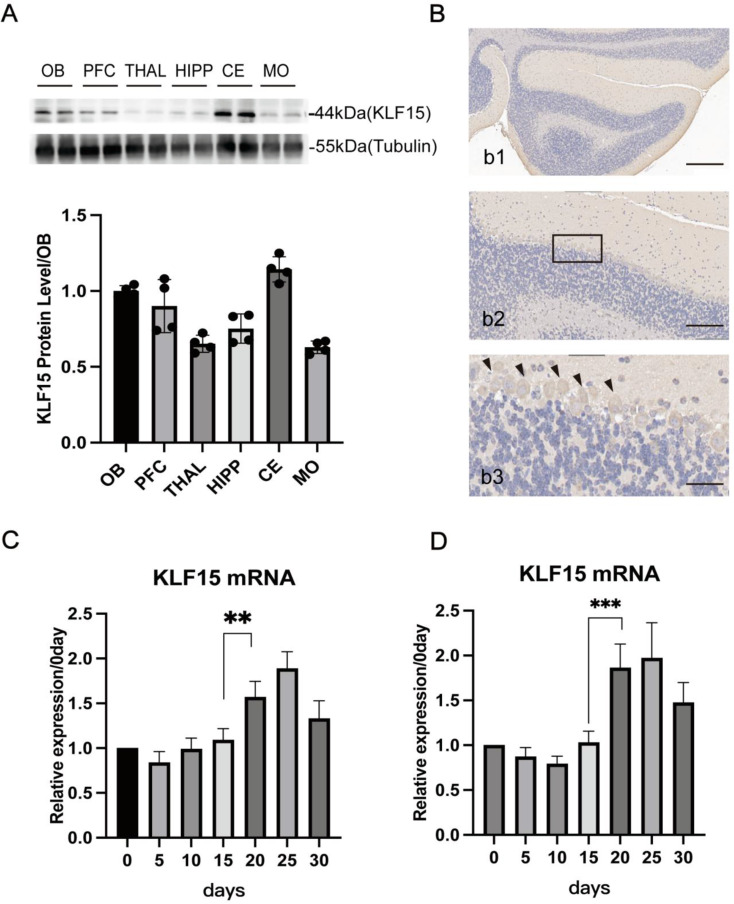
Fig. 1
Fig. 1
KLF15 is highly expressed in the cerebellum and significantly increases in the later stages of growth and development. A KLF15 is expressed in brain tissue with low tissue specificity, and its expression in the cerebellum is slightly higher than in other brain regions. (OB: olfactory bulb; PFC: prefrontal cortex; HIPP: hippocampus; THAL: thalamus; CE: cerebellum; MO: medulla oblongata). B KLF15 is highly expressed in Purkinje cells in the cerebellum. (b1: Scale bar = 200 μm; b2: Scale bar = 100 μm; b3: Scale bar = 50 μm). C The expression of KLF15 in the whole brain (excluding the cerebellum) at different ages (n = 5). D The expression of KLF15 in the cerebellum at different ages (n = 5). Data are shown as the mean ± SD. **P < 0.01, ***P < 0.001, vs. 15days (two-tailed Student’s t-test)
Fig. 2
Fig. 2
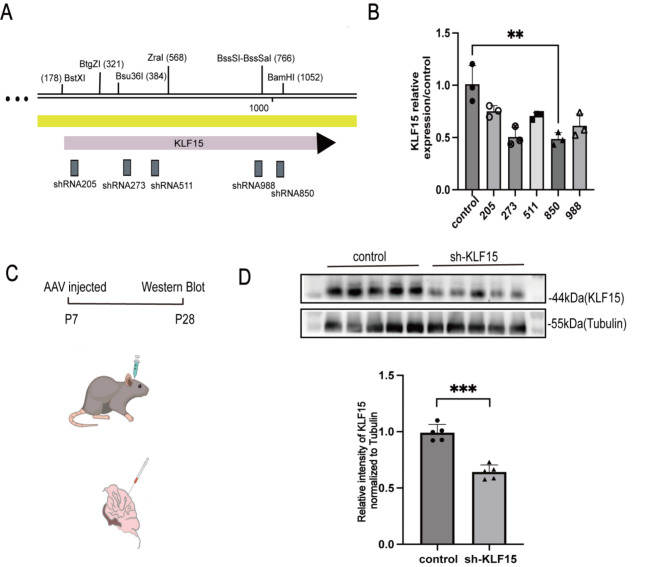
KLF15 knockdown virus can effectively knock down mouse cerebellar KLF15. A The positions of five interfering sites on the KLF15 gene. B Real time fluorescence quantitative PCR detection of plasmid knockdown efficiency at different target sites. C Sh-KLF15 virus stereotactic injection into the cerebellum. Target 850 site plasmid as the optimal knockdown target for virus packaging and cerebellum stereotactic injection. D Western blot verifies virus knockdown efficiency on the 21st day after injection. Data are shown as the mean ± SD. **P < 0.01, ***P < 0.001, vs. control group (two-tailed Student’s t-test)
Fig. 3
Fig. 3
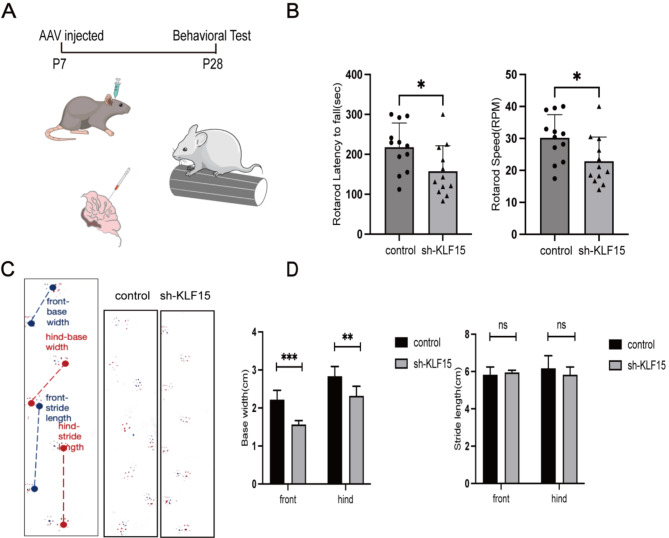
Impaired motor ability in KLF15 cerebellum knockdown mice. A Schematic diagram of 7-day-old cerebellum AAV microinjection (left). The rotarod test measures the balance and coordination ability of a rotating stick on the 21st day after the virus is infected (right). B Compared to the control group, knockdown mice showed a significant decrease in their time spent on the rod before falling. The rod speed at which KLF15 knockdown mice fall from the pole also yielded similar results. C Gait analysis. After 21 days of virus infection, mice were allowed to walk in a narrow 50 cm corridor with ink showing footprints. D Gait analysis statistical results. Compared to the control group, there was no significant difference in step length between the knockdown group and the control group, but the step width significantly narrowed (n = 6). Data are shown as the mean ± SD. *P < 0.05, **P < 0.01, ***P < 0.001, ns, no significant, vs. control group (two-tailed Student’s t-test)
Fig. 4
Fig. 4
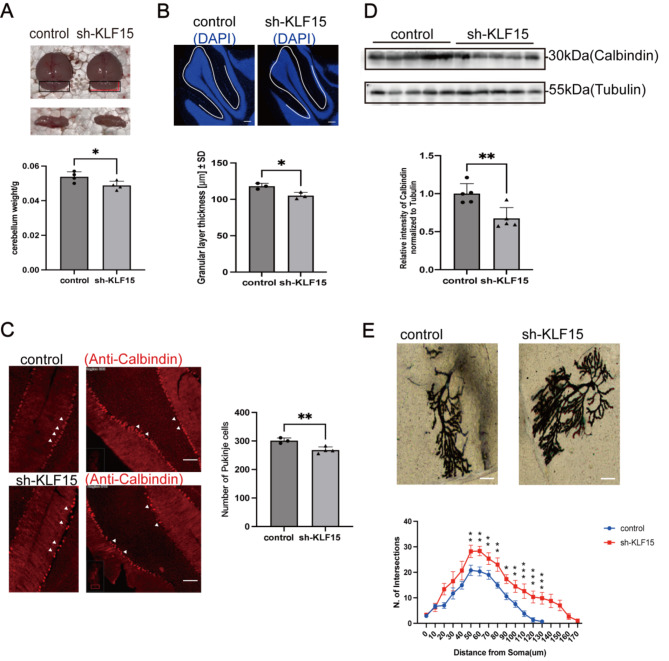
Loss and morphological abnormalities of Purkinje cells in the cerebellum of KLF15 knockdown mice. A Weighting the cerebellum of control mice and KLF15 knockdown mice. The cerebellum weight of the knockdown group was significantly lower than that of the control group. B Immunofluorescence staining of cerebellum in the control mice and sh-KLF15 mice. KLF15 knockdown mice have significantly thinner granular layer than control group mice. Scale bar = 200 μm. The white line represents the thickness of the granular layer in the control group. C Immunofluorescence staining of cerebellum in the control mice and sh-KLF15 mice. On the right is the quantitative statistics of Purkinje cell number. Scale bar = 200 μm. D Western blot and grayscale analysis of calbindin in the cerebellum of control mice and KLF15 knockdown mice. E Representative images of Golgi staining in the cerebellum of control mice and KLF15 knockdown mice. Scale bar = 80 μm. Sholl analysis images of Purkinje cells (n = 6). Data are shown as the mean ± SD. *P < 0.05, **P < 0.01, ***P < 0.001, vs. control group. Two-tailed Student’s t-test A, B, C, D and two-way ANOVA followed by Tukey’s test E were used for data comparison
Fig. 5
Fig. 5
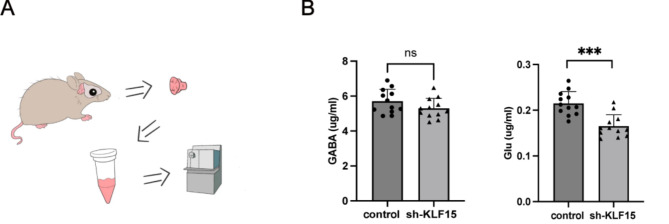
KLF15 knockdown mice display abnormal levels of cerebellum neurotransmitters. A High-performance liquid chromatography/mass spectra analysis of mouse cerebellum homogenate. B Compared to the control mice, knockdown mice showed no significant changes in the content of neurotransmitter GABA, but a significant decrease in the content of neurotransmitter Glu in the cerebellum. Data are shown as the mean ± SD. ***P < 0.001, ns, no significant, vs. control group (two-tailed Student’s t-test)

References

    1. Koziol LF, Budding D, Andreasen N, D’Arrigo S, Bulgheroni S, Imamizu H, Ito M, Manto M, Marvel C, Parker K, et al. Consensus paper: the cerebellum’s role in movement and cognition. Cerebellum. 2014;13(1):151–77. - PMC - PubMed
    1. Beckinghausen JSillitoe RV. Insights into cerebellar development and connectivity. Neurosci Lett. 2019;688:2–13. - PMC - PubMed
    1. Wu Q, Huang QYTan GH. [Abnormalities in signal transduction of Purkinje cells in spinocerebellar ataxias: a review]. Sheng Li Xue Bao. 2024;76(1):77–88. - PubMed
    1. Spitzer NC. Electrical activity in early neuronal development. Nature. 2006;444(7120):707–12. - PubMed
    1. Jansson LCAkerman KE. The role of glutamate and its receptors in the proliferation, migration, differentiation and survival of neural progenitor cells. J Neural Transm (Vienna). 2014;121(8):819–36. - PubMed

Substances

LinkOut - more resources