Review
. 2025 Jan 23;380(1918):20230483.
doi: 10.1098/rstb.2023.0483. Epub 2025 Jan 23.

PERspectives on circadian cell biology

Affiliations
Review

PERspectives on circadian cell biology

Andrei Mihut et al. Philos Trans R Soc Lond B Biol Sci. .

Abstract

Daily rhythms in the activities of PERIOD proteins are critical to the temporal regulation of mammalian physiology. While the molecular partners and genetic circuits that allow PERIOD to effect auto-repression and regulate transcriptional programmes are increasingly well understood, comprehension of the time-resolved mechanisms that allow PERIOD to conduct this daily dance is incomplete. Here, we consider the character and controversies of this central mammalian clock protein with a focus on its intrinsically disordered nature.This article is part of the Theo Murphy meeting issue 'Circadian rhythms in infection and immunity'.

Keywords: PERIOD/ PER; biomolecular condensation/ phase separation; cellular clock; circadian rhythm; intrinsically disordered regions (IDRs); post-translational modification.


Conflict of interest statement

We declare we have no competing interests.

Figures

Schematic representation of models for circadian rhythm generation.
Figure 1.
Schematic representation of models for circadian rhythm generation. The TTFL model for cellular circadian timekeeping: it intrinsically generates and sustains oscillations by itself, with a post-translational delay-timer being responsible for conferring the approx. 24 hour periodicity. It imparts rhythmic cellular functions by directly regulating the transcription of clock-controlled genes. On the other hand, the post-translational oscillator model proposes a post-translational timekeeping mechanism capable of autonomously generating and sustaining approx. 24 hour oscillations in protein activity on its own. It conveys timing information to the TTFL, which acts as a signal transducer, via post-translational modifications of TTFL components to regulate the transcription of TTFL genes and downstream clock-controlled genes. While the post-translational oscillator confers timing information to the TTFL, the latter may confer robustness in return, by further amplifying the timing information received and by regulating enzyme activity directly via interactions with TTFL proteins. Figure created with BioRender.com.
Schematic illustration of general PER2 protein features.
Figure 2.
Schematic illustration of general PER2 protein features. Schematic of the human PER2 protein sequence annotated with its most well-characterized domains, relative residue conservation calculated via ConSurf, sequence disorder analysis calculated by CAID and known phosphorylation sites compiled from literature and PhosphoSitePlus. CK1δ/ε binds the CK1-binding domain on PER2 and can stabilize PER2 via phosphorylation at the FASP region, or facilitate degradation through phosphorylation in the degron region at S480 and, to a lesser degree, at S95, by promoting recruitment of the E3 ubiquitin ligase β-TrCP. The balance of phosphorylation between the FASP and the degron region determines overall PER2 stability and constitutes the phosphoswitch model. Figure created with BioRender.com.
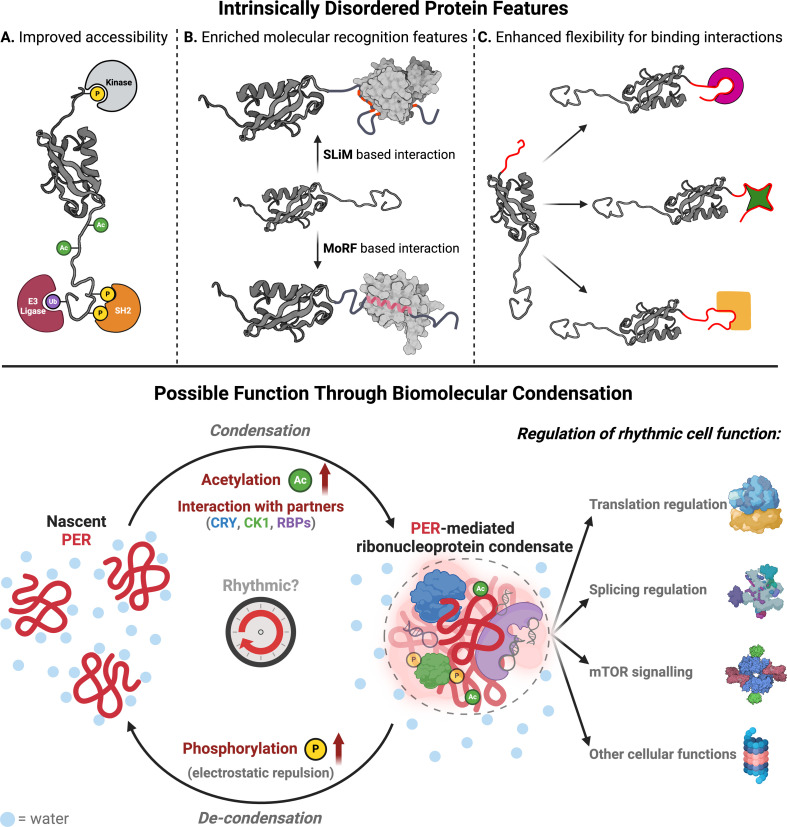
Schematic representation of properties associated with intrinsically disordered proteins and how they relate to PER function.
Figure 3.
Schematic representation of properties associated with intrinsically disordered proteins and how they relate to PER function. The flexibility of intrinsically disordered regions improves their accessibility to proteins involved in the addition or removal of post-translational modification. Additionally, the availability of molecular recognition features such as SLiMs or MoRFs mediates the recruitment of a variety of binding partners through multivalent low-affinity interactions, thereby enhancing the network of protein–protein interactions available to IDR-containing proteins. The conformational flexibility and adaptability of disordered regions enable conformational plasticity at binding interfaces. Given the IDP features of PER, we hypothesize a model of PER activity through biomolecular condensation: the disordered conformation of nascent PER renders it unfavourable for hydration as an extended polypeptide, driving the adoption of more compacted states through biomolecular condensation that is modulated by homo-/heteromeric interaction with partners and favourable post-translational modifications, i.e. those which reduce the overall charge on PER, such as acetylation. Dissociation of PER and partners from condensates may be driven through electrostatic repulsion generated through progressive phosphorylation, by CK1 for example. PER-containing ribonucleoprotein condensates would therefore be perfectly positioned to impart circadian regulation to cell function. This testable model may provide a basis for understanding rhythmic PER activity, that we predict would be amplified and reinforced by feedback via canonical TTFL-mediated changes in PER production. Figure created with BioRender.com.

References

    1. Paranjpe DA, Sharma VK. 2005. Evolution of temporal order in living organisms. J. Circadian Rhythms 3, 7. ( 10.1186/1740-3391-3-7) - DOI - PMC - PubMed
    1. Hut RA, Beersma DG. 2011. Evolution of time-keeping mechanisms: early emergence and adaptation to photoperiod. Phil. Trans. R. Soc. B 366, 2141–2154. ( 10.1098/rstb.2010.0409) - DOI - PMC - PubMed
    1. Bell-Pedersen D, Cassone VM, Earnest DJ, Golden SS, Hardin PE, Thomas TL, Zoran MJ. 2005. Circadian rhythms from multiple oscillators: lessons from diverse organisms. Nat. Rev. Genet. 6, 544–556. ( 10.1038/nrg1633) - DOI - PMC - PubMed
    1. Eelderink-Chen Z, Bosman J, Sartor F, Dodd AN, Kovács ÁT, Merrow M. 2021. A circadian clock in a nonphotosynthetic prokaryote. Sci. Adv. 7. ( 10.1126/sciadv.abe2086) - DOI - PMC - PubMed
    1. Rzechorzek NM, et al. 2022. A daily temperature rhythm in the human brain predicts survival after brain injury. Brain 145, 2031–2048. ( 10.1093/brain/awab466) - DOI - PMC - PubMed

MeSH terms

Substances