


Reorganization of gray matter networks in patients with Moyamoya disease
- PMID: 39843464
- PMCID: PMC11754602
- DOI: 10.1038/s41598-025-86553-3
Reorganization of gray matter networks in patients with Moyamoya disease
Abstract
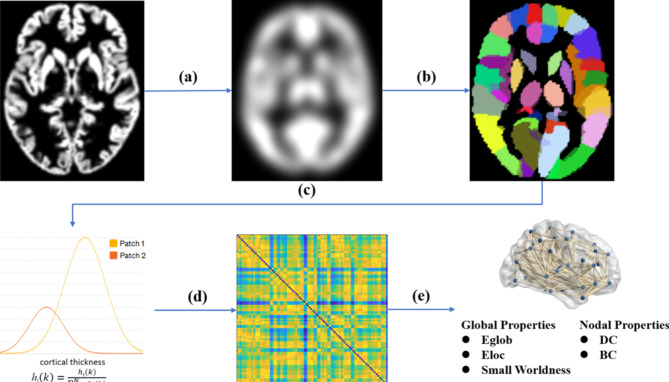
Patients with Moyamoya disease (MMD) exhibit significant alterations in brain structure and function, but knowledge regarding gray matter networks is limited. The study enrolled 136 MMD patients and 99 healthy controls (HCs). Clinical characteristics and gray matter network topology were analyzed. Compared to HCs, MMD patients exhibited decreased clustering coefficient (Cp) (P = 0.006) and local efficiency (Eloc) (P = 0.013). Ischemic patients showed decreased Eloc and increased characteristic path length (Lp) compared to asymptomatic and hemorrhagic patients (P < 0.001, Bonferroni corrected). MMD patients had significant regional abnormalities, including decreased degree centrality (DC) in the left medial orbital superior frontal gyrus, left orbital inferior frontal gyrus, and right calcarine fissure and surrounding cortex (P < 0.05, FDR corrected). Increased DC was found in bilateral olfactory regions, with higher betweenness centrality (BC) in the right median cingulate, paracingulate fusiform gyrus, and left pallidum (P < 0.05, FDR corrected). Ischemic patients had lower BC in the right hippocampus compared to hemorrhagic patients, while hemorrhagic patients had decreased DC in the right triangular part of the inferior frontal gyrus compared to asymptomatic patients (P < 0.05, Bonferroni corrected). Subnetworks related to MMD and white matter hyperintensity volume were identified. There is significant reorganization of gray matter networks in patients compared to HCs, and among different types of patients. Gray matter networks can effectively detect MMD-related brain structural changes.
Keywords: Graph theory; Gray Matter Network; Gray Matter volume; Moyamoya Disease; Network-based statistic.
© 2025. The Author(s).
Conflict of interest statement
Declarations. Competing interests: The authors declare no competing interests.
Figures


References
-
- Research Committee on the Pathology and Treatment of Spontaneous Occlusion of the Circle of Willis & Health Labour Sciences Research Grant for Research on Measures for Infractable Diseases. Guidelines for diagnosis and treatment of moyamoya disease (spontaneous occlusion of the circle of Willis). Neurol. Med. Chir. (Tokyo). 52, 245–266 (2012). - PubMed
-
- Karzmark, P., Zeifert, P. D., Bell-Stephens, T. E., Steinberg, G. K. & Dorfman, L. J. Neurocognitive impairment in adults with moyamoya disease without stroke. Neurosurgery70, 634–638 (2012). - PubMed
-
- Kazumata, K. et al. Combined structural and diffusion tensor imaging detection of ischemic injury in Moyamoya disease: relation to disease advancement and cerebral hypoperfusion. J. Neurosurg.134, 1155–1164 (2020). - PubMed
-
- Lei, Y. et al. Reconfigured functional network dynamics in adult moyamoya disease: a resting-state fMRI study. Brain Imaging Behav.14, 715–727 (2020). - PubMed
Publication types
MeSH terms
Grants and funding
LinkOut - more resources
Full Text Sources
Miscellaneous
