


Coproantigen detection and molecular identification of Cryptosporidium species among newborn and adult farm animals
- PMID: 39843766
- PMCID: PMC11754770
- DOI: 10.1186/s13568-024-01817-x
Coproantigen detection and molecular identification of Cryptosporidium species among newborn and adult farm animals
Abstract
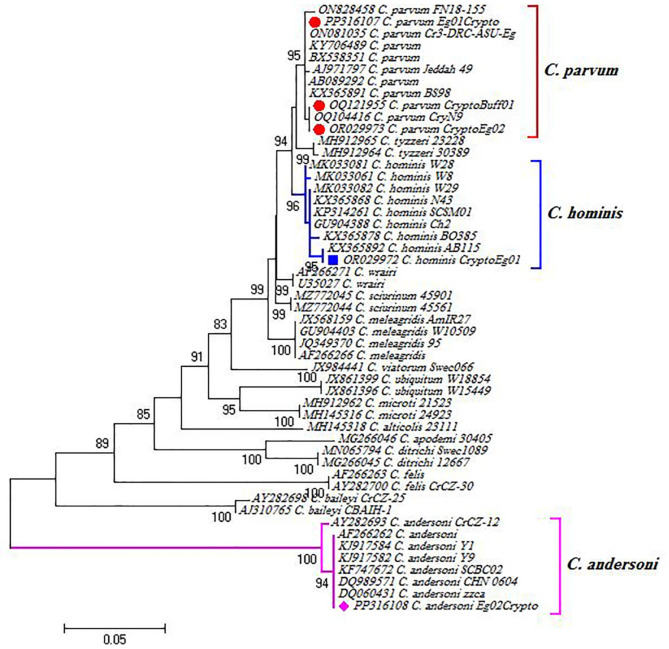
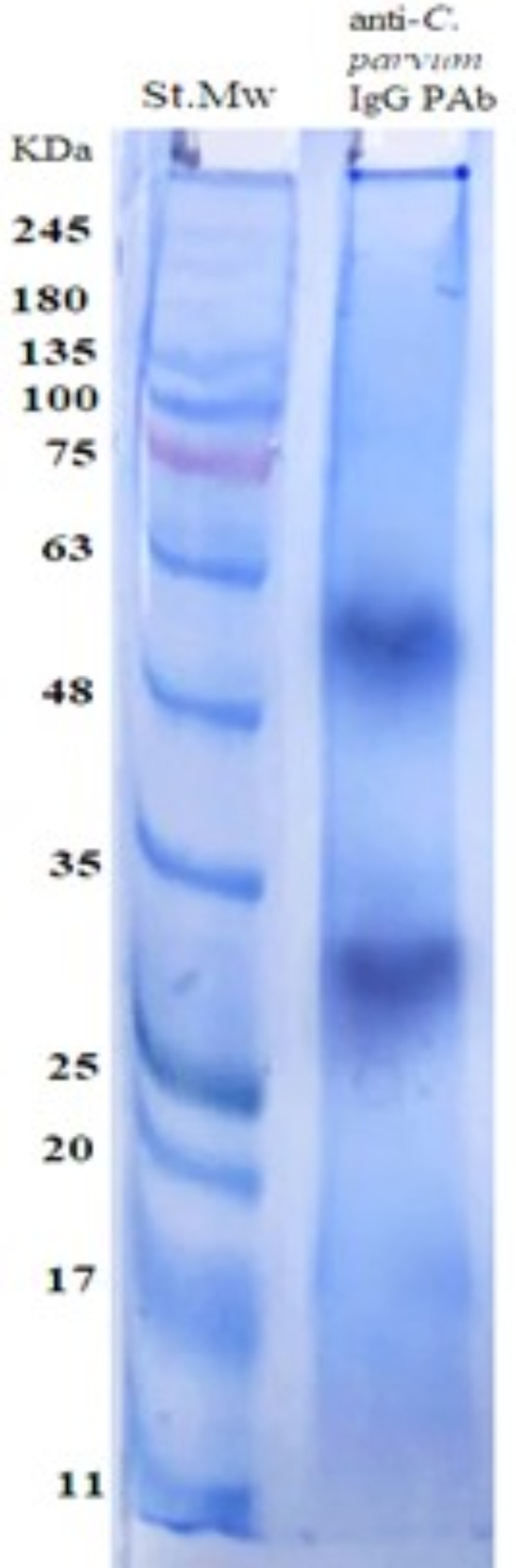
Cryptosporidium sp. is an obligatory intracellular apicomplexan protozoan parasite that causes a disease called cryptosporidiosis with substantial veterinary and medical importance. Therefore, this study aimed to evaluate an early diagnosis of cryptosporidiosis using the anti-Cryptosporidium parvum oocyst immunoglobulin IgG polyclonal antibodies (anti-C. parvum IgG PAbs)-based sandwich enzyme-linked immunosorbent assay (ELISA) for the detection of Cryptosporidium oocyst antigens in fecal samples of farm animals in Egypt. Further molecular identification and sequencing were performed for the detected isolates. Eight hundred and twenty fecal samples of farm animals; 102 buffalo calves, 120 cattle calves, 100 lambs and 98 goat kids, 80 buffaloes, 60 cattle, 160 sheep and 100 goats, collected from different small-scale farms and local holders were examined for cryptosporidiosis by Modified Ziehl-Neelsen (MZN) technique. The percentage of positivity was 45.1%, 50%, 20%, 18.4%, 31.25%, 38.3%, 18.8%, and 11% in buffalo calves, cattle calves, lambs, goat kids, adult buffaloes, adult cattle, sheep, and goats, respectively. Molecular identification of Cryptosporidium samples was performed based on COWP gene, revealing the isolates: GenBank: OQ121955.1, OR029973.1 and PP316107.1 which were identical to the C. parvum and GenBank: PP316108.1 and OR029972.1 which were identical to C. hominis and C. andersoni, respectively. Then, C. parvum oocysts were used for preparation of antigens and rabbit immunization. Anti-C. parvum IgG PAbs were purified and characterized by SDS-PAGE and then labeled with horseradish peroxidase (HRP). Anti-C. parvum IgG PAbs in-house sandwich ELISA was prepared, then tested this ELISA on 820 samples and compared results with MZN microscopical examination and a commercial sandwich ELISA kit. In this study, in-house sandwich ELISA scored higher sensitivity of 98%, 100% specificity, validity 99% and relative agreement 98.6% than (92%, 90%, 91% and 91.4%) of MZN and (96%, 95%, 95.5% and 95.7%) of coproantigen commercial sandwich ELISA kit, respectively. Moreover, we used PCR to evaluate the positivity of in-house sandwich ELISA results, and the total PCR positive samples were 263 out of 268 sandwich ELISA positive samples (98.13%). In conclusion, the prepared Anti-C. parvum IgG PAbs based sandwich ELISA offered a simple and accurate diagnostic method for cryptosporidiosis in the fecal samples of different species of farm animals in Egypt with high sensitivity (98%) and specificity (100%). Further studies on this Anti-C. parvum IgG PAbs may help also in the protection against cryptosporidiosis.
Keywords: C. andersoni; C. hominis; C. parvum; Cryptosporidium; PAbs; PCR; Sandwich ELISA.
© 2025. The Author(s).
Conflict of interest statement
Declarations. Ethics approval and consent to participate: This study protocol was approved by the International Animal Ethics Committee and Institutional Guidelines of the National Research Centre (NRC) Animal Research Committee under the number: (13010124-2). All fecal samples used in this study were collected from farm animals with the permission of their owners. We confirm that all methods and experiments were performed in accordance with the relevant guidelines and regulations under the above-mentioned approval and in accordance with ARRIVE guidelines. Competing interests: The authors declare no competing interests.
Figures



References
-
- Abd El Hafez SM, Anwar AM, Ibrahim AM, Mahmoud MB, Hassan HM (2010) Preparation of fluoresce isothiocyanate conjugated IgG (FITC) anti-camel and anti-buffalo. Nat Sci 8(10):342–347
-
- Aboelsoued D, Hendawy S, Abdullah HH, Abdel Megeed KN, Hassan SE, El Hakim AE, Toaleb NI (2022a) Diagnosis of cryptosporidiosis using affinity purified antigen. Egypt J Vet Sci 53(3):459–473. 10.21608/EJVS.2022.145814.1354 - DOI
LinkOut - more resources
Full Text Sources
