


Towards a characterization of human spatial exploration behavior
- PMID: 39843885
- PMCID: PMC11754322
- DOI: 10.3758/s13428-024-02581-3
Towards a characterization of human spatial exploration behavior
Abstract
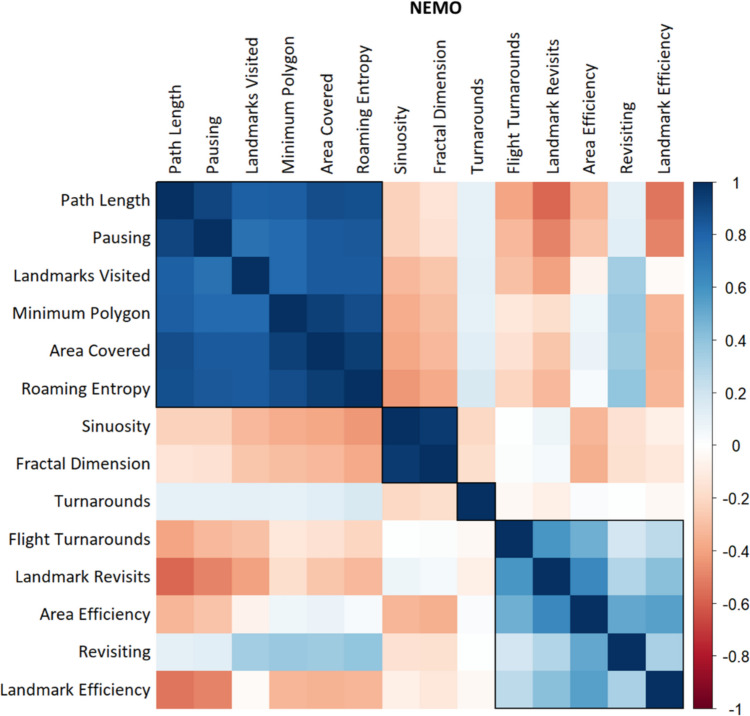
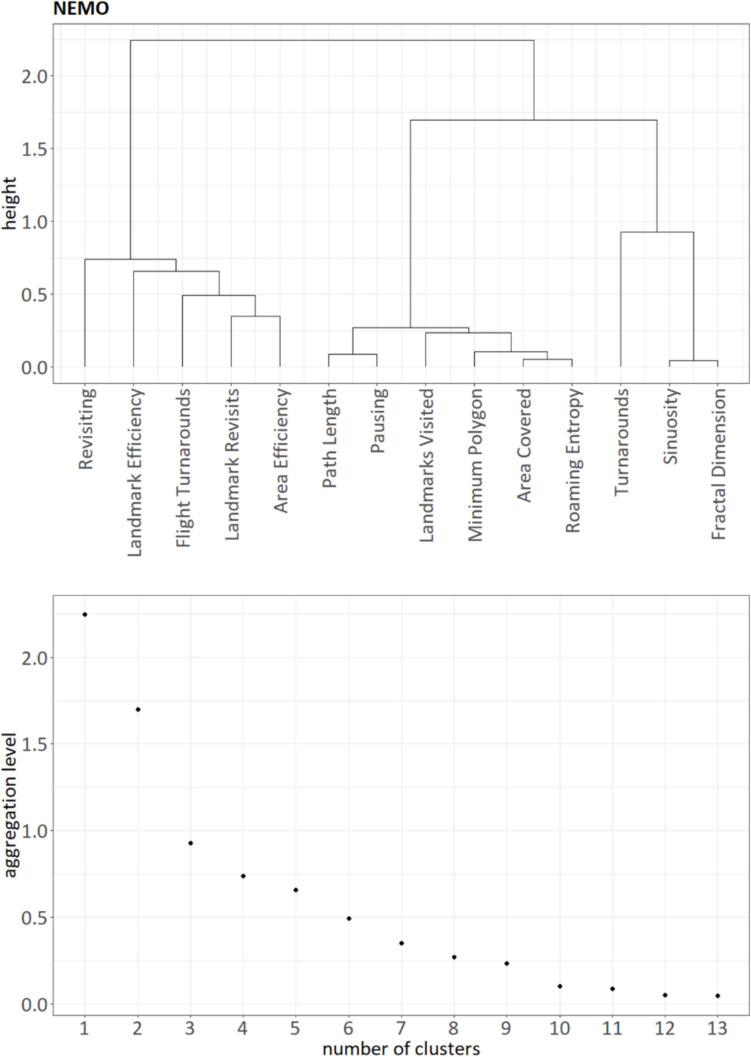
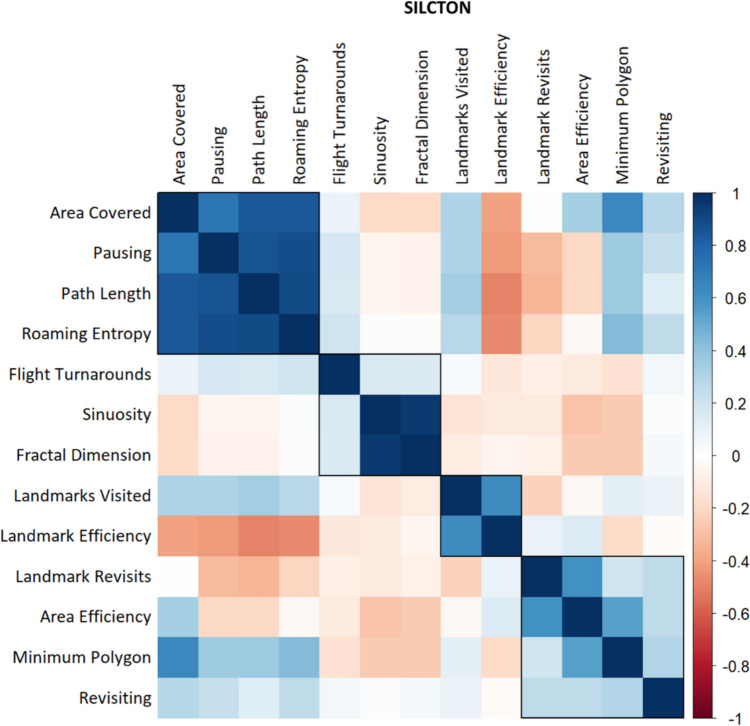
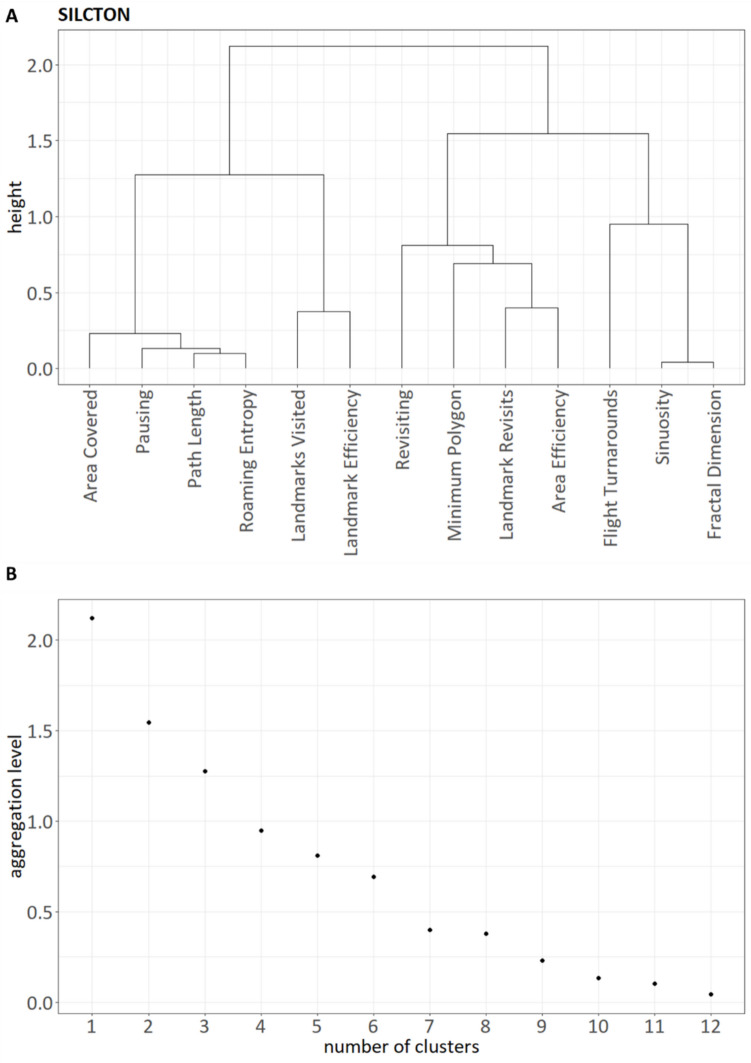
Spatial exploration is a complex behavior that can be used to gain information about developmental processes, personality traits, or mental disorders. Typically, this is done by analyzing movement throughout an unknown environment. However, in human research, until now there has been no overview on how to analyze movement trajectories with regard to exploration. In the current paper, we provide a discussion of the most common movement measures currently used in human research on spatial exploration, and suggest new indices to capture the efficiency of exploration. We additionally analyzed a large dataset (n = 409) of human participants exploring a novel virtual environment to investigate whether movement measures could be assigned to meaningful higher-order components. Hierarchical clustering of the different measures revealed three different components of exploration (exploratory behavior, spatial shape, and exploration efficiency) that in part replicate components of spatial exploratory behavior identified in animal studies. A validation of our analysis on a second dataset (n = 102) indicated that two of these clusters are stable across different contexts as well as participant samples. For the exploration efficiency cluster, our validation showed that it can be further differentiated into a goal-directed versus a general, area-directed component. By also sharing data and code for our analyses, our results provide much-needed tools for the systematic analysis of human spatial exploration behavior.
Keywords: Exploratory behavior; Human exploration; Novelty seeking; Spatial exploration; Virtual environment.
© 2025. The Author(s).
Conflict of interest statement
Declarations. Ethics approval: Not applicable (see Schomaker et al., 2022; as well as Brunec et al., 2022). Consent for publication: Not applicable (see Schomaker et al., 2022; as well as Brunec et al., 2022). Conflicts of interest: The authors declare no competing interests.
Figures


References
-
- Ai, P., Liu, Y., & Zhao, X. (2019). Big Five personality traits predict daily spatial behavior: Evidence from smartphone data. Personality and Individual Differences,147, 285–291. 10.1016/j.paid.2019.04.027
-
- Alessandretti, L., Lehmann, S., & Baronchelli, A. (2018). Understanding the interplay between social and spatial behaviour. EPJ Data Science 2018 7:1, 7(1), 1–17. 10.1140/EPJDS/S13688-018-0164-6
-
- Alessandretti, L., Sapiezynski, P., Sekara, V., Lehmann, S., & Baronchelli, A. (2018). Evidence for a conserved quantity in human mobility. Nature Human Behaviour 2018 2:7, 2(7), 485–491. 10.1038/s41562-018-0364-x - PubMed
-
- Batrancourt, B., Lecouturier, K., Ferrand-Verdejo, J., Guillemot, V., Azuar, C., Bendetowicz, D., Migliaccio, R., Rametti-Lacroux, A., Dubois, B., & Levy, R. (2019). Exploration deficits under ecological conditions as a marker of apathy in frontotemporal dementia. Frontiers in Neurology, 10(AUG), 941. 10.3389/FNEUR.2019.00941/BIBTEX - PMC - PubMed
-
- Baumann, V., Birnbaum, T., Breitling-Ziegler, C., Tegelbeckers, J., Dambacher, J., Edelmann, E., Bergado-Acosta, J. R., Flechtner, H.-H., & Krauel, K. (2020). Exploration of a novel virtual environment improves memory consolidation in ADHD. Scientific Reports,10(1), 21453. 10.1038/s41598-020-78222-4 - PMC - PubMed
Publication types
MeSH terms
LinkOut - more resources
Full Text Sources
