


Atherogenic index of plasma and coronary artery disease: a systematic review and meta-analysis of observational studies
- PMID: 39844262
- PMCID: PMC11756160
- DOI: 10.1186/s12933-025-02582-2
Atherogenic index of plasma and coronary artery disease: a systematic review and meta-analysis of observational studies
Abstract
Background: Atherogenic index of plasma (AIP), a novel logarithmic index that combines fasting triglyceride and high-density lipoprotein cholesterol concentrations, is associated with the burden of atherosclerosis. This study aimed to evaluate the relationship between AIP and coronary artery disease (CAD) risk, severity, and prognosis in populations with and without established CAD.
Methods: PubMed, Embase, and Web of Science were systematically searched from the inception of each database to August 13, 2024. Cross-sectional studies, case-control studies, and prospective or retrospective cohort studies using multivariate analysis were included. Given that the true effect size may differ across studies, a random-effects model for all analyses was applied.
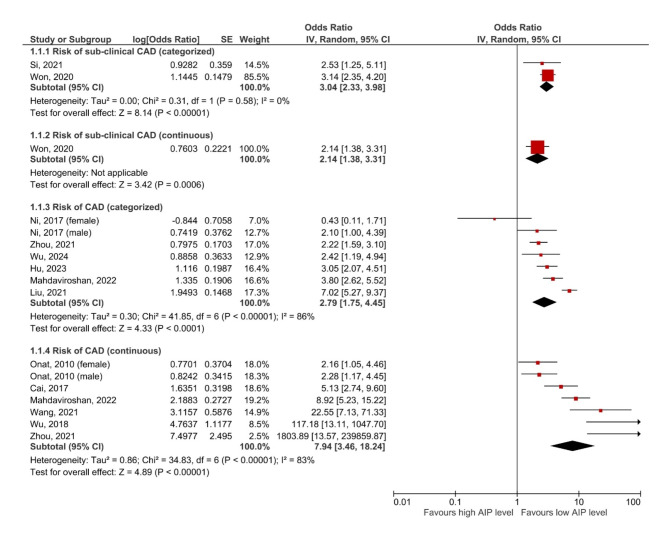
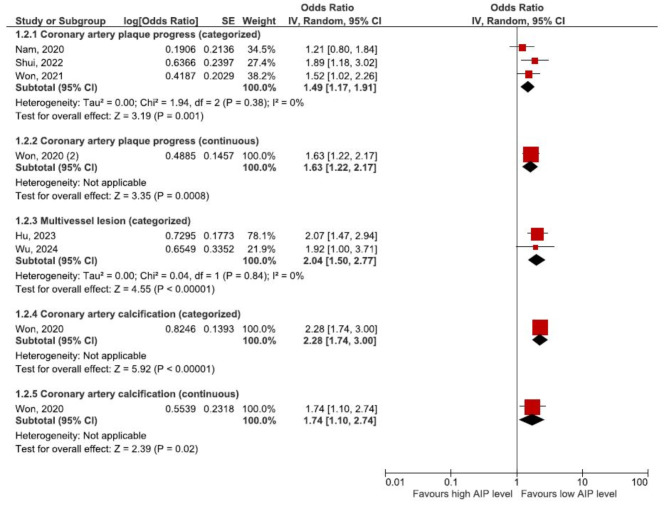
Results: Fifty-one observational studies were included in this study. Patients with higher AIP were more likely to have CAD (odds ratio (OR): 2.79, 95% CI 1.75-4.45, P < 0.00001). Furthermore, these patients were more likely to have coronary artery calcification (OR: 2.28, 95% CI 1.74-3.00, P < 0.00001), multivessel CAD (OR: 2.04, 95% CI 1.50-2.77, P < 0.00001), and an increased risk of plaque progression (OR: 1.49, 95% CI 1.17-1.91, P = 0.001). In populations without established CAD, higher AIP levels were associated with an increased risk of Major adverse cardiovascular events (MACE) (hazard ratio (HR): 1.28, 95% CI 1.22-1.35, P < 0.00001). Interestingly, this finding was consistent in patients presenting with acute coronary syndrome (HR: 1.59, 95% CI 1.33-1.89, P < 0.00001) and patients with chronic coronary syndrome or stable CAD (HR: 1.65, 95% CI 1.15-2.37, P = 0.007).
Conclusions: This meta-analysis demonstrates that elevated AIP is strongly associated with increased CAD risk, greater severity, and poorer prognosis in populations with and without established CAD. However, more studies are needed to evaluate the predictive performance and determine the optimal cut-off for AIP in different populations.
Keywords: Atherogenic index of plasma; Coronary artery disease; Outcomes; Prognosis; Risk; Severity.
© 2025. The Author(s).
Conflict of interest statement
Declarations. Ethics approval and consent to participate: Not applicable. Consent for publication: Not applicable. Competing interests: The authors declare no competing interests.
Figures


References
Publication types
MeSH terms
Substances
LinkOut - more resources
Full Text Sources
Medical
Miscellaneous
