


Survey response in colorectal surgery. A systematic review
- PMID: 39845079
- PMCID: PMC11749908
- DOI: 10.1016/j.sipas.2022.100068
Survey response in colorectal surgery. A systematic review
Abstract
Background: Survey research is widely used for developing value-based management strategies in colorectal surgery. However, declining response rates threaten the validity of results. Our aim is to identify factors that influence response rate in colorectal surgical surveys and provide recommendations for future survey design.
Methods: We performed a (MEDLINE) search between 2007 and 2020 for survey studies in colorectal surgery providing response rates.
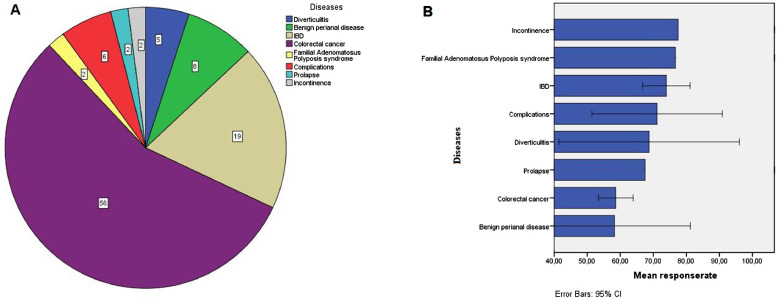
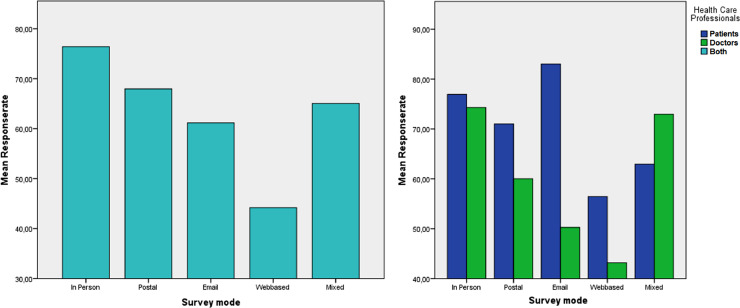
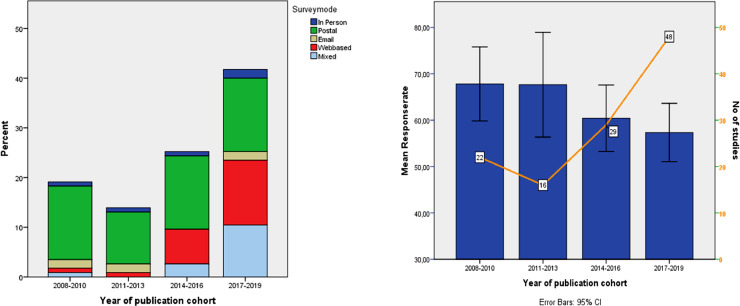
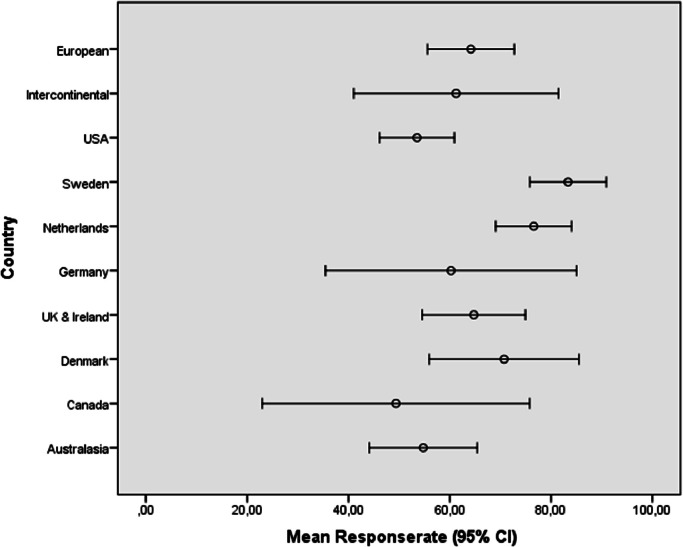
Results: Our search revealed 5693 studies, of which 128 studies were included. Patients with colorectal cancer have a lower mean response rate than patients with benign pathology (62.8% vs 75.5%, p < 0.001). Response rate depends on the mode of survey; conducted in person (76%), postal (68%), email (61%) and web-based (44%). Patients participate more often than doctors (P < 0.001). Reminders can positively influence response rates in postal patient surveys (p = 0.03). The proportion of web-based doctor surveys has grown over time (p < 0.01) and overall survey response is declining over time (p = < 0.01).
Conclusion: In-person surveying should be explored first in colorectal surgery, especially when addressing colorectal cancer patients and doctors. Reminders are useful to boost response rate in postal surveys directed at patients. Web-based doctor surveys generate the lowest response rate. As response rate is declining, it is important to address these factors when designing and reviewing colorectal surgical survey studies.
Keywords: Colorectal cancer; Colorectal surgery; Postal; Response rate; Survey.
© 2022 The Author(s). Published by Elsevier Ltd.
Conflict of interest statement
All authors report no competing interests or conflicts of interest
Figures
Similar articles
-
Global Overview of Response Rates in Patient and Health Care Professional Surveys in Surgery: A Systematic Review.Ann Surg. 2022 Jan 1;275(1):e75-e81. doi: 10.1097/SLA.0000000000004078. Ann Surg. 2022. PMID: 32649458 Free PMC article.
-
Response rates in postal surveys of healthcare professionals between 1996 and 2005: an observational study.BMC Health Serv Res. 2009 Sep 14;9:160. doi: 10.1186/1472-6963-9-160. BMC Health Serv Res. 2009. PMID: 19751504 Free PMC article.
-
Strategies to improve response rates to web surveys: A literature review.Int J Nurs Stud. 2021 Nov;123:104058. doi: 10.1016/j.ijnurstu.2021.104058. Epub 2021 Aug 3. Int J Nurs Stud. 2021. PMID: 34454334 Review.
-
Surveys in Surgical Education: A Systematic Review and Reporting Guideline.Eur Surg Res. 2021;62(2):61-67. doi: 10.1159/000516125. Epub 2021 May 5. Eur Surg Res. 2021. PMID: 33951638
-
A comparison of a postal survey and mixed-mode survey using a questionnaire on patients' experiences with breast care.J Med Internet Res. 2011 Sep 27;13(3):e68. doi: 10.2196/jmir.1241. J Med Internet Res. 2011. PMID: 21946048 Free PMC article.
References
Publication types
LinkOut - more resources
Full Text Sources
Research Materials
