


Synergistic interaction between wheat streak mosaic virus and Triticum mosaic virus modulates wheat transcriptome to favor disease severity
- PMID: 39845488
- PMCID: PMC11750876
- DOI: 10.3389/fpls.2024.1504482
Synergistic interaction between wheat streak mosaic virus and Triticum mosaic virus modulates wheat transcriptome to favor disease severity
Abstract
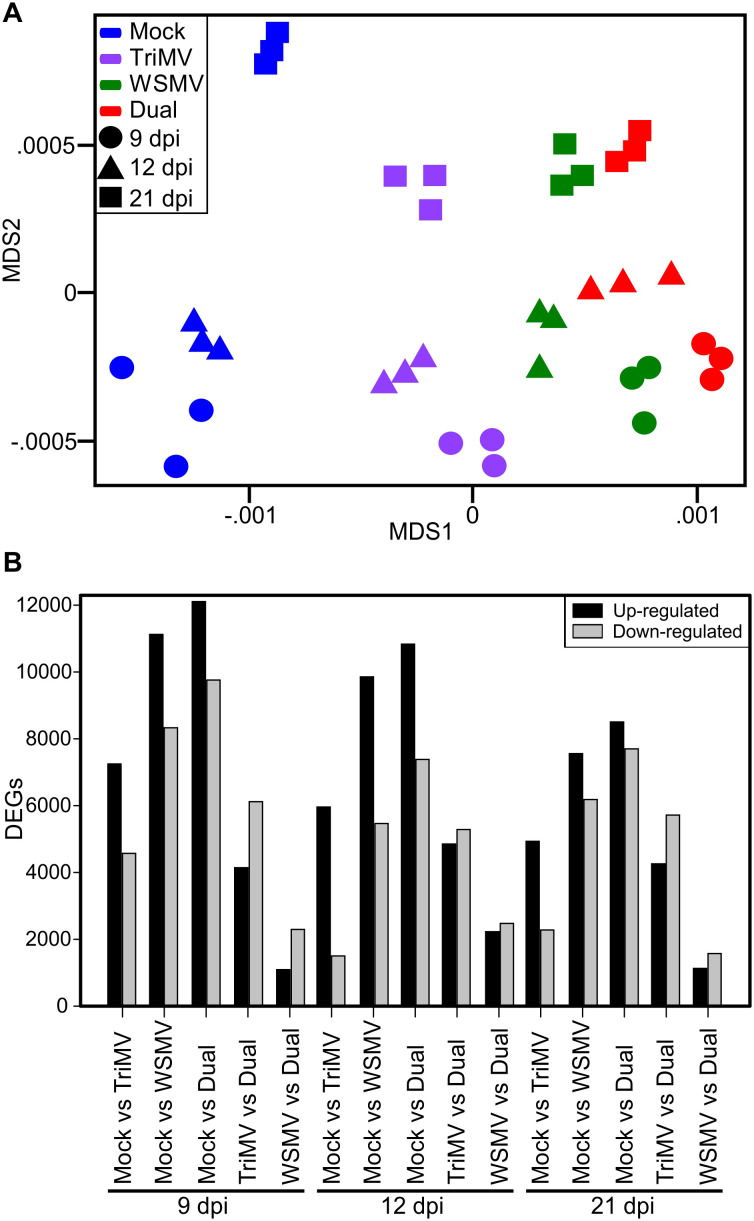
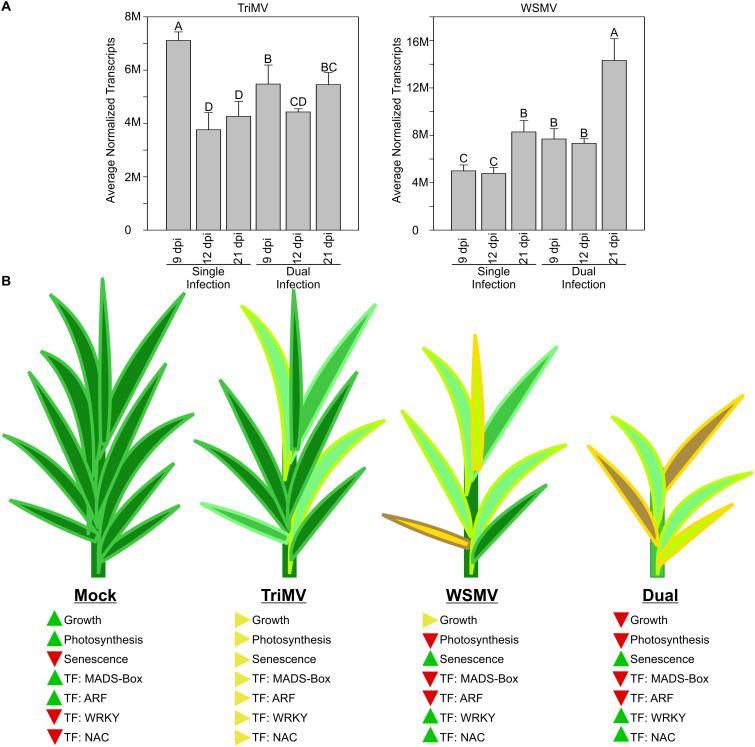
Wheat streak mosaic virus (WSMV; Tritimovirus tritici) and Triticum mosaic virus (TriMV; Poacevirus tritici), the type members of the genera Tritimovirus and Poacevirus, respectively, in the family Potyviridae, are economically important wheat viruses in the Great Plains region of the USA. Co-infection of wheat by WSMV and TriMV results in disease synergism. Wheat transcriptome from singly (WSMV or TriMV) and doubly (WSMV+TriMV) infected upper uninoculated leaves were analyzed by RNA-Seq at 9, 12, and 21 days postinoculation. A total of 31,754 differentially expressed wheat genes were identified among all comparisons. Weighted gene co-expression network analysis resulted in 11 co-expression modules that broadly indicated gene expression profiles attributable to control, single, and double infections. Gene ontology, protein domain and KEGG (Kyoto Encyclopedia of Genes and Genomes) pathway enrichment analysis revealed that genes specifically related to photosynthesis, growth, stress, senescence, and defense were differentially enriched. Analyses of transcription factor families indicated that genes encoding MADS-Box and ARFs were strongly enriched in control plants, moderately repressed in TriMV-infected plants, and more strongly repressed in WSMV- and doubly-infected plants, whereas genes encoding WRKYs and NACs were more enriched in WSMV or doubly infected plants. Synergistic interactions between WSMV and TriMV drastically enhanced disease phenotype compared to individual virus infections. The progression of disease phenotype was correlated to transcriptomic changes, indicating the strong disruption to plant metabolism and likely channeling of energy and metabolites for viral replication. There also appeared to be a connection between viral replication and plastid health, with stronger downregulation of genes needed for chloroplast functions and integrity and increased synergism between TriMV and WSMV. This study provides an overview of transcriptomic changes distinctly influenced by TriMV and WSMV either singly or in combination and provides a good correlation between specific transcription factors and genes associated with metabolism to observed phenotypic changes in plant growth and disease synergism.
Keywords: Triticum mosaic virus; disease synergism; synergistic interaction; transcription factors; transcriptome; wheat; wheat streak mosaic virus.
Copyright © 2025 Nunna, Palmer, Sarath, Wegulo and Tatineni.
Conflict of interest statement
The authors declare that the research was conducted in the absence of any commercial or financial relationships that could be construed as a potential conflict of interest. The author(s) declared that they were an editorial board member of Frontiers, at the time of submission. This had no impact on the peer review process and the final decision.
Figures



References
-
- Brakke M. K. (1987). “Virus disease in wheat,” in Wheat and wheat improvement, 2nd ed. Ed. Heyne E. G. (American Society of Agronomy, Crop Science Society of America, Soil Science Society of America, Madison, WI, U.S.A: ), 585–603.
-
- Burrows M., Franc G., Rush C., Blunt T., Ito D., Kinzer K., et al. (2009). Occurrence of viruses in wheat in the Great Plains regio. Plant Health Prog. 10, 14. doi: 10.1094/PHP-2009-0706-01-RS - DOI
LinkOut - more resources
Full Text Sources
