


Predicting Factors Affecting Survival Rate in Patients Undergoing On-Pump Coronary Artery Bypass Graft Surgery Using Machine Learning Methods: A Systematic Review
- PMID: 39846048
- PMCID: PMC11751876
- DOI: 10.1002/hsr2.70336
Predicting Factors Affecting Survival Rate in Patients Undergoing On-Pump Coronary Artery Bypass Graft Surgery Using Machine Learning Methods: A Systematic Review
Abstract
Background and aim: Coronary artery bypass grafting (CABG) is a key treatment for coronary artery disease, but accurately predicting patient survival after the procedure presents significant challenges. This study aimed to systematically review articles using machine learning techniques to predict patient survival rates and identify factors affecting these rates after CABG surgery.
Methods: From January 1, 2015, to January 20, 2024, a comprehensive literature search was conducted across PubMed, Scopus, IEEE Xplore, and Web of Science. The review adhered to the Preferred Reporting Items for Systematic Reviews and Meta-Analyses (PRISMA) guidelines. Inclusion criteria included studies that evaluated survival rates and predictors associated with CABG patients during the specified period.
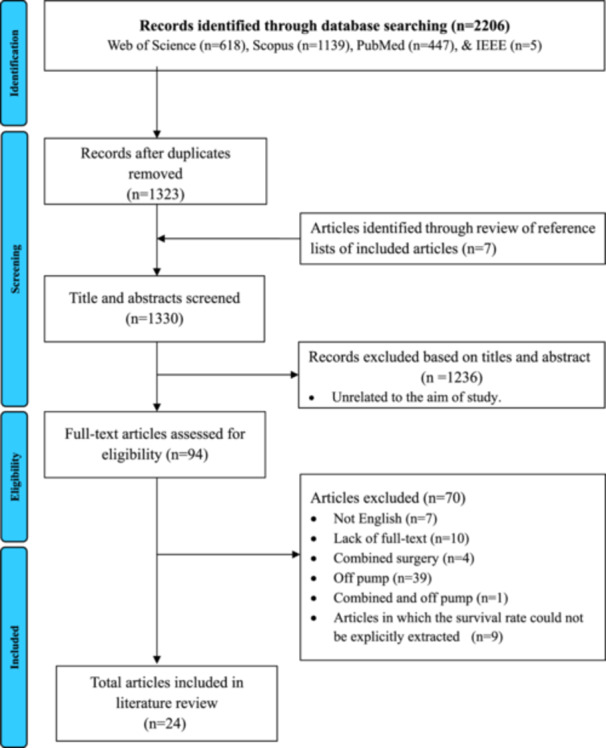
Results: After eliminating duplicates, a total of 1330 articles were identified. Following a systematic screening, 24 studies met the inclusion criteria. Our findings revealed 43 distinct factors influencing survival rates in patients undergoing CABG. Notably, five factors-age, ejection fraction, diabetes mellitus, a history of cerebrovascular disease or accidents, and renal function-were consistently identified across multiple studies as significant predictors of postsurgical survival.
Conclusion: This systematic review identifies key factors influencing survival rates after CABG surgery and highlights the role of machine learning in improving predictive accuracy. By identifying high-risk patients through these key factors, our findings offer practical insights for healthcare providers, enhancing patient management and customizing therapeutic strategies after CABG. This study significantly enhances existing literature by combining machine learning techniques with clinical factors, thereby improving the understanding of patient outcomes in CABG surgery.
Keywords: coronary artery bypass; machine learning; survival rate; systematic review.
© 2025 The Author(s). Health Science Reports published by Wiley Periodicals LLC.
Conflict of interest statement
The authors declare no conflicts of interest.
Figures
References
-
- Benjamin E. J., Muntner P., Alonso A., et al., “Heart Disease and Stroke Statistics—2019 Update: A Report From the American Heart Association,” Circulation 139, no. 10 (2019): e56–e528. - PubMed
-
- Kim A. S. and Johnston S. C., “Global Variation in the Relative Burden of Stroke and Ischemic Heart Disease,” Circulation 124, no. 3 (2011): 314–323. - PubMed
-
- Kannel W. B., McGee D., and Gordon T., “A General Cardiovascular Risk Profile: The Framingham Study,” American Journal of Cardiology 38, no. 1 (1976): 46–51. - PubMed
-
- Benjamin E. J., Virani S. S., Callaway C. W., et al., “Heart Disease and Stroke Statistics—2018 Update: A Report From the American Heart Association,” Circulation 137, no. 12 (2018): e67–e492. - PubMed
Publication types
LinkOut - more resources
Full Text Sources
Miscellaneous
