


Acute Effects of Fast vs. Slow Bench Press Repetitions with Equal Time Under Tension on Velocity, sEMG Activity, and Applied Force in the Bench Press Throw
- PMID: 39846645
- PMCID: PMC11755598
- DOI: 10.3390/jfmk10010004
Acute Effects of Fast vs. Slow Bench Press Repetitions with Equal Time Under Tension on Velocity, sEMG Activity, and Applied Force in the Bench Press Throw
Abstract
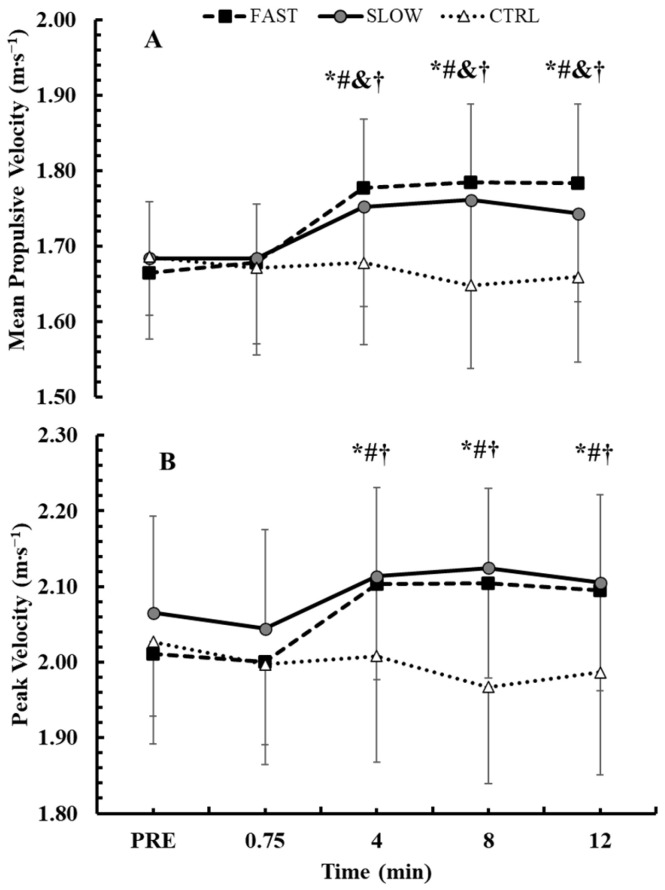
Background: The tempo of resistance exercises is known to influence performance outcomes, yet its specific effects on post-activation performance enhancement (PAPE) remain unclear. This study aimed to investigate the effects of fast versus slow repetitions at a load of 70% of one-repetition maximum (1-RM) in the bench press exercise, focusing on velocity, surface electromyographic (sEMG) activity, and applied force while equating time under tension on bench press throw performance. Methods: Eleven men (age: 23.5 ± 5.4 years, height: 1.79 ± 0.04 m, body mass: 79.1 ± 6.4 kg, maximum strength 1-RM: 91.0 ± 12.0 kg) participated. Two experimental conditions (FAST and SLOW) and one control (CTRL) were randomly assigned. Participants performed two sets of six repetitions as fast as possible (FAST condition) and two sets of three repetitions at a controlled tempo (SLOW condition) at half the concentric velocity of FAST, as determined in a preliminary session. Before and after the bench press participants performed bench press throws tests (Pre, 45 s, 4, 8, and 12 min after). Results: sEMG activity and peak force during the bench press were higher in FAST vs. SLOW conditioning activity (p < 0.001), with time under tension showing no significant differences between conditions (p > 0.05). Mean propulsive velocity (MPV) during the bench press throw improved equally in both FAST and SLOW conditions compared with baseline from the 4th to the 12th min of recovery (FAST: +6.8 ± 2.9% to +7.2 ± 3.3%, p < 0.01, SLOW: +4.0 ± 3.0% to +3.6 ± 4.5%, p < 0.01, respectively). Compared to the CTRL, both conditions exhibited improved MPV values from the 4th to 12th min (p < 0.01). Peak velocity improvements were observed only after the FAST condition compared to the baseline (p < 0.01) with no differences from SLOW. For all muscles involved and time points, sEMG activity during bench press throws was higher than CTRL in both experimental conditions (p < 0.01), with no differences between FAST and SLOW. Peak force increased in both FAST and SLOW conditions at all time points (p < 0.05), compared to CTRL. Conclusions: These findings suggest that post-activation performance enhancement is independent of movement tempo, provided that the resistive load and total time under tension of the conditioning activity are similar. This study provides valuable insights into the complex training method for athletes by demonstrating that varying tempo does not significantly affect post-activation performance enhancement when load and TUT are equated.
Keywords: accelerometer; kinematics; kinetics; linear position transducer; mean propulsive velocity.
Conflict of interest statement
The authors declare no conflicts of interest.
Figures




References
-
- Cormier P., Freitas T.T., Loturco I., Turner A., Virgile A., Haff G.G., Blazevich A.J., Agar-Newman D., Henneberry M., Baker D.G., et al. Within Session Exercise Sequencing During Programming for Complex Training: Historical Perspectives, Terminology, and Training Considerations. Sports Med. 2022;52:2371–2389. doi: 10.1007/s40279-022-01715-x. - DOI - PubMed
LinkOut - more resources
Full Text Sources
