


A thin film optoelectronic photodetector of spherical and linear resonators via one-pot synthesis of Bi(III) oxide/polypyrrole nanocomposite
- PMID: 39848994
- PMCID: PMC11757702
- DOI: 10.1038/s41598-025-86092-x
A thin film optoelectronic photodetector of spherical and linear resonators via one-pot synthesis of Bi(III) oxide/polypyrrole nanocomposite
Abstract
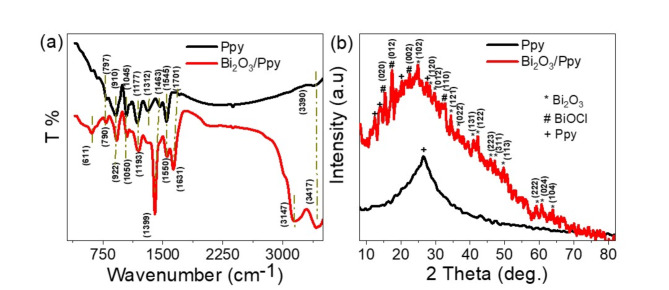
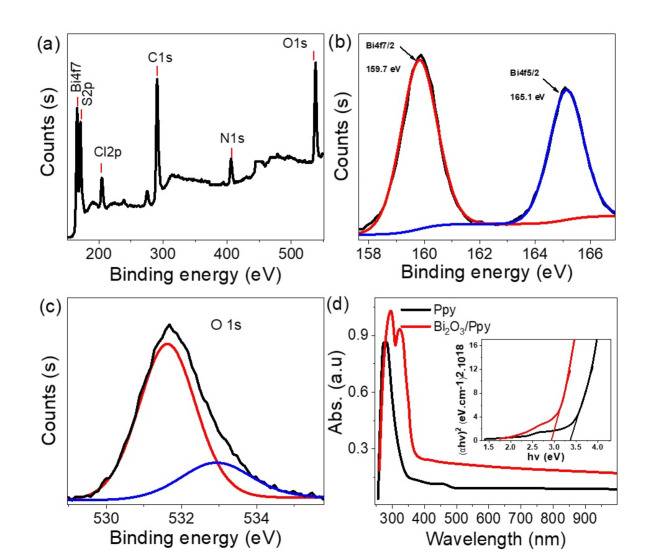
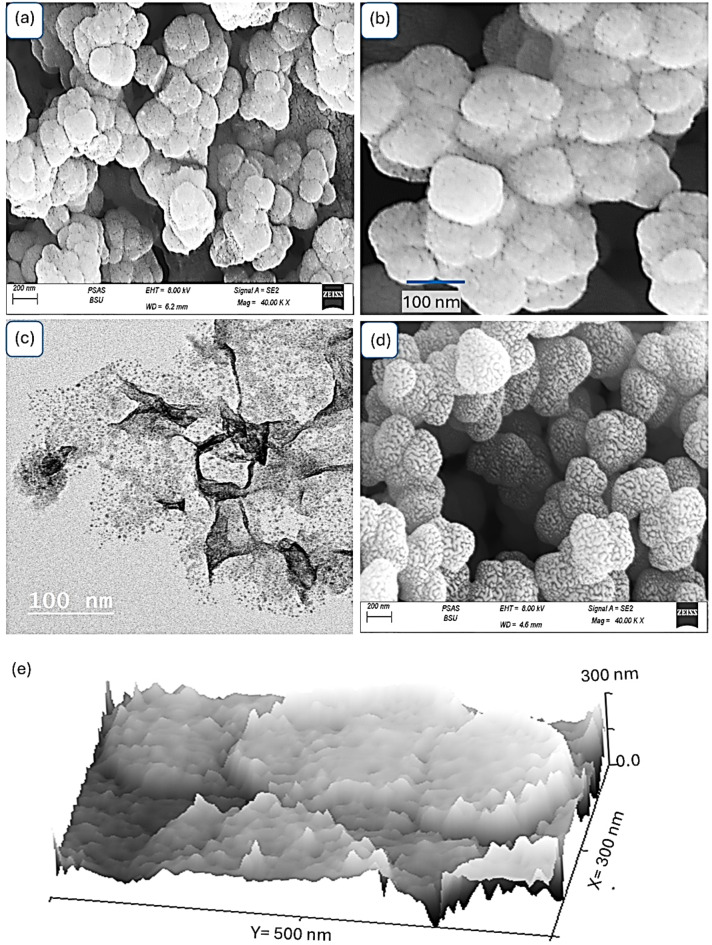
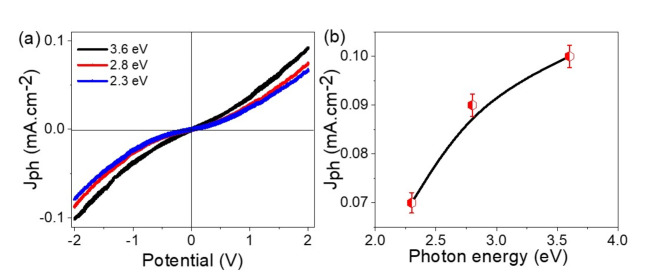
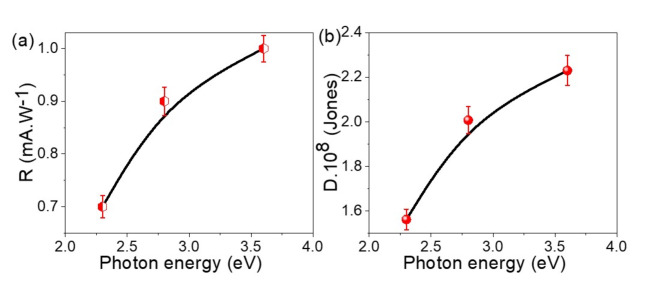
We report the fabrication and characterization of a Bi(III) oxide/polypyrrole (Bi2O3/Ppy) nanocomposite thin film optoelectronic photodetector synthesized by a simple one-pot method. The nanocomposite consists of spherical Bi2O3 nanoparticles embedded in a Ppy matrix, forming a porous structure with a high surface area. The XRD analysis reveals that the Bi2O3 nanoparticles have a poly-crystalline nature with a crystal size of 40 nm and an optical bandgap of 2.86 eV. The SEM images show that the nanoparticles are agglomerated into clusters of about 100 nm in diameter, with pores of about 200 nm in width. The device exhibits a high sensitivity to light, as evidenced by the increase of the photocurrent density (Jph) from - 0.06 mA.cm-2 in the dark to -0.12 mA.cm-2 under illumination at -2.0 V. The device also shows a wavelength-dependent response, with the highest responsivity (R) of 1.0 and 0.9 mA/W and detectivity (D) of 0.221 × 10⁹ and 0.20 × 10⁹ Jones at photon energies of 3.6 eV and 2.8 eV, respectively. The Bi2O3/Ppy nanocomposite is a promising material for low-cost, high-performance optoelectronic applications, making it a superior choice over many contemporary devices reported in recent literature.
Keywords: Bi2O3; High efficiency; Optoelectronic; Photodetector; Polypyrrole.
© 2025. The Author(s).
Conflict of interest statement
Declarations. Competing interests: The authors declare no competing interests.
Figures


References
-
- Sreedhar, A., Ta, Q. T., H & Noh, J-S. Versatile role of 2D Ti3C2 MXenes for advancements in the photodetector performance: A review. J. Ind. Eng. Chem. (2023).
-
- Nawar, A. M. & El-Mahalawy, A. M. Heterostructure device based on brilliant green nanoparticles–PVA/p-Si interface for analog–digital converting dual-functional sensor applications. J. Mater. Sci.: Mater. Electron.31, 3256–3273 (2020).
-
- Wang, X. et al. Q 2022 high performance self-powered UV–visible photodetectors based on TiO2/graphene/ZnIn2S4/electrolyte heterojunctions. Ceram. Int.48, 13090–13099
-
- Zhan, T. et al. J 2023 electrical characteristics and photodetection mechanism of TiO2/AlGaN/GaN heterostructure-based ultraviolet detectors with a Schottky junction. J. Mater. Chem. C11, 1704–1713
Grants and funding
LinkOut - more resources
Full Text Sources
