Review
. 2025 Jan 23;18(1):10.
doi: 10.1186/s13045-024-01654-2.

Helicobacter pylori and gastric cancer: mechanisms and new perspectives

Affiliations
Review

Helicobacter pylori and gastric cancer: mechanisms and new perspectives

Yantao Duan et al. J Hematol Oncol. .

Abstract

Gastric cancer remains a significant global health challenge, with Helicobacter pylori (H. pylori) recognized as a major etiological agent, affecting an estimated 50% of the world's population. There has been a rapidly expanding knowledge of the molecular and pathogenetic mechanisms of H. pylori over the decades. This review summarizes the latest research advances to elucidate the molecular mechanisms underlying the H. pylori infection in gastric carcinogenesis. Our investigation of the molecular mechanisms reveals a complex network involving STAT3, NF-κB, Hippo, and Wnt/β-catenin pathways, which are dysregulated in gastric cancer caused by H. pylori. Furthermore, we highlight the role of H. pylori in inducing oxidative stress, DNA damage, chronic inflammation, and cell apoptosis-key cellular events that pave the way for carcinogenesis. Emerging evidence also suggests the effect of H. pylori on the tumor microenvironment and its possible implications for cancer immunotherapy. This review synthesizes the current knowledge and identifies gaps that warrant further investigation. Despite the progress in our previous knowledge of the development in H. pylori-induced gastric cancer, a comprehensive investigation of H. pylori's role in gastric cancer is crucial for the advancement of prevention and treatment strategies. By elucidating these mechanisms, we aim to provide a more in-depth insights for the study and prevention of H. pylori-related gastric cancer.

Keywords: H. Pylori; Gastric cancer; Mechanism; Signaling pathway.


Conflict of interest statement

Declarations. Ethics approval and consent to participate: Not applicable. Competing interests: The authors declare no competing interests.

Figures

Fig. 1
Fig. 1
Organization of genes within the cagPAI and CagA/VacA variations. (A) Arrangement of cagPAI genes in H. pylori strain 26,695. The cagPAI genes and gene order are relatively well-conserved. Cag3, cagY, cagX, cagT, and cagM encoding proteins localized to the T4SS. H. pylori-specific Cag T4SS components are indicated. (B) Western H. pylori strains possess a form of CagA that contains the EPIYA-A and EPIYA-B regions, followed by 1–3 repeats of EPIYA-C region. East-Asian strains of H. pylori possess a form of CagA that contains EPIYA-D region instead of EPIYA-C region. (C) There are three main regions of diversity within the VacA passenger domain, designated the s, i, and m regions; within each region, sequences can be classified into: s1 or s2, i1, i2 or i3, d1 or d2, and m1 or m2. s1 can be classified into three main types (s1a, s1b, or s1c). Multiple possible combinations can be present in different H. pylori strains as a result of recombination. Figure generated from studies described in references 22, 25, and 33
Fig. 2
Fig. 2
The development of gastric cancer is induced by H. pylori. Key aspects of bacterial pathopoiesis involve flagellar motility, mechanisms of adhesion, disruption of intercellular junctions, and damage to the gastric epithelium via vacuolization. The H. pylori virulence factors activate STAT3, NF-κB, ERK, Akt, and Wnt/β-catenin signaling pathways, and exert key roles in abnormal motogenic signal, hummingbird phenotype, motility and proliferation, cytoskeletal rearrangement, and disruption of cell polarity, leading to gastric carcinogenesis
Fig. 3
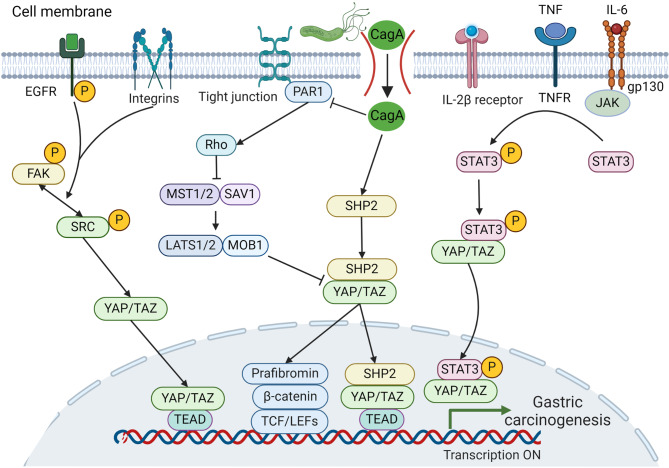
Fig. 3
Aberrant Wnt/β-catenin, STAT3, and Hippo/YAP signaling pathways activation in H. pylori-induced gastric cancer. H. pylori infection and inflammatory cytokines can activate the Wnt/β-catenin, STAT3, and Hippo/YAP signaling pathways, leading to the onset of gastric tumorigenesis. H. pylori infection activates EGFR, leading to FAK/SRC/YAP activation. H. pylori infection can also disturb the tight junction and activate SHP2, leading to Wnt/β-catenin and Hippo/YAP signals activitation. Inflammatory cytokines such as IL-6 and TNF could directly activate STAT3/YAP signaling pathway
Fig. 4
Fig. 4
Signaling pathways regulated by H. pylori. Following H. pylori adherence, signallings by the CagA, VacA, OpiA and TNF lead to the activation of Akt, further leading to the activation of JNK/ERK, Wnt/β-catenin and NF-κB. Meanwhile, CagA can also directly activate Wnt/β-catenin pathway

References

    1. Arnold M, Park JY, Camargo MC, Lunet N, Forman D, Soerjomataram I. Is gastric cancer becoming a rare disease? A global assessment of predicted incidence trends to 2035. Gut. 2020;69(5):823–29. - PMC - PubMed
    1. Sitarz R, Skierucha M, Mielko J, Offerhaus GJA, Maciejewski R, Polkowski WP. Gastric cancer: epidemiology, prevention, classification, and treatment. Cancer Manag Res. 2018;10:239–48. - PMC - PubMed
    1. Bray F, Laversanne M, Sung H, Ferlay J, Siegel RL, Soerjomataram I, et al. Global cancer statistics 2022: GLOBOCAN estimates of incidence and mortality worldwide for 36 cancers in 185 countries. CA Cancer J Clin. 2024;74(3):229–63. - PubMed
    1. Hooi JKY, Lai WY, Ng WK, Suen MMY, Underwood FE, Tanyingoh D, et al. Global prevalence of Helicobacter pylori infection: systematic review and Meta-analysis. Gastroenterology. 2017;153(2):420–29. - PubMed
    1. Gu Y, Xu Y, Wang P, Zhao Y, Wan C. Research progress on molecular mechanism of pyroptosis caused by Helicobacter pylori in gastric cancer. Ann Med Surg (Lond). 2024;86(4):2016–22. - PMC - PubMed

MeSH terms

LinkOut - more resources