Review
. 2024 Dec 31;12(1):26.
doi: 10.3390/bioengineering12010026.

Artificial Intelligence Transforming Post-Translational Modification Research

Affiliations
Review

Artificial Intelligence Transforming Post-Translational Modification Research

Doo Nam Kim et al. Bioengineering (Basel). .

Abstract

Post-Translational Modifications (PTMs) are covalent changes to amino acids that occur after protein synthesis, including covalent modifications on side chains and peptide backbones. Many PTMs profoundly impact cellular and molecular functions and structures, and their significance extends to evolutionary studies as well. In light of these implications, we have explored how artificial intelligence (AI) can be utilized in researching PTMs. Initially, rationales for adopting AI and its advantages in understanding the functions of PTMs are discussed. Then, various deep learning architectures and programs, including recent applications of language models, for predicting PTM sites on proteins and the regulatory functions of these PTMs are compared. Finally, our high-throughput PTM-data-generation pipeline, which formats data suitably for AI training and predictions is described. We hope this review illuminates areas where future AI models on PTMs can be improved, thereby contributing to the field of PTM bioengineering.

Keywords: Post-Translational Modification; artificial intelligence; deep learning; machine learning.


Conflict of interest statement

The authors declare no conflict of interest.

Figures

Figure 1
Figure 1
Various types of Post-Translational Modifications and their effects. This illustration shows several common types of PTMs out of 400 different types. Although these PTMs are often less represented in many computational modeling programs, they control various cellular activities. This figure is generated by BioRender and NIH BIOART [12].
Figure 2
Figure 2
AI Applications in PTM Research. (Left): Various PTM-related datasets serve as the foundation for building AI/ML models. (Right): These models enable diverse applications utilizing accurate PTM information, such as predicting PTM sites and their associated functions [74].
Figure 3
Figure 3
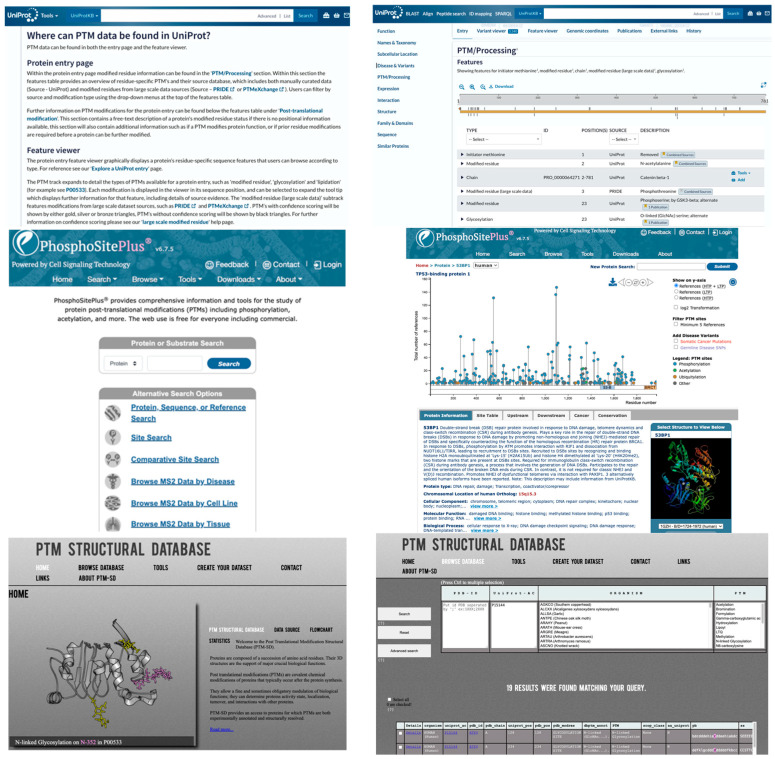
Representative PTM Databases. Upper: UniProt. Middle: PhosphoSitePlus. Lower: PTM-Structural Database. Left: input pages. Right: data retrieval pages.

References

    1. Ramazi S., Zahiri J. Post-translational modifications in proteins: Resources, tools and prediction methods. Database J. Biol. Databases Curation. 2021;2021:baab012. doi: 10.1093/database/baab012. - DOI - PMC - PubMed
    1. Peng Y., Liu J., Inuzuka H., Wei W. Targeted protein posttranslational modifications by chemically induced proximity for cancer therapy. J. Biol. Chem. 2023;299:104572. doi: 10.1016/j.jbc.2023.104572. - DOI - PMC - PubMed
    1. Marx V. Inside the chase after those elusive proteoforms. Nat. Methods. 2024;21:158–163. doi: 10.1038/s41592-024-02170-4. - DOI - PubMed
    1. Leutert M., Entwisle S.W., Villén J. Decoding Post-Translational Modification Crosstalk With Proteomics. Mol. Cell. Proteom. MCP. 2021;20:100129. doi: 10.1016/j.mcpro.2021.100129. - DOI - PMC - PubMed
    1. Bobalova J., Strouhalova D., Bobal P. Common Post-translational Modifications (PTMs) of Proteins: Analysis by Up-to-Date Analytical Techniques with an Emphasis on Barley. J. Agric. Food Chem. 2023;71:14825–14837. doi: 10.1021/acs.jafc.3c00886. - DOI - PMC - PubMed

LinkOut - more resources