. 2025 Jan 2;13(1):7.
doi: 10.3390/diseases13010007.

Advanced Glycation End-Product-Modified Heat Shock Protein 90 May Be Associated with Urinary Stones

Affiliations

Advanced Glycation End-Product-Modified Heat Shock Protein 90 May Be Associated with Urinary Stones

Takanobu Takata et al. Diseases. .

Abstract

Urinary stones (urolithiasis) have been categorized as kidney stones (renal calculus), ureteric stones (ureteral calculus and ureterolith), bladder stones (bladder calculus), and urethral stones (urethral calculus); however, the mechanisms underlying their promotion and related injuries in glomerular and tubular cells remain unclear. Although lifestyle-related diseases (LSRDs) such as hyperglycemia, type 2 diabetic mellitus, non-alcoholic fatty liver disease/non-alcoholic steatohepatitis, and cardiovascular disease are risk factors for urolithiasis, the underlying mechanisms remain unclear. Recently, heat shock protein 90 (HSP90) on the membrane of HK-2 human proximal tubular epithelium cells has been associated with the adhesion of urinary stones and cytotoxicity. Further, HSP90 in human pancreatic and breast cells can be modified by various advanced glycation end-products (AGEs), thus affecting their function. Hypothesis 1: We hypothesized that HSP90s on/in human proximal tubular epithelium cells can be modified by various types of AGEs, and that they may affect their functions and it may be a key to reveal that LSRDs are associated with urolithiasis. Hypothesis 2: We considered the possibility that Japanese traditional medicines for urolithiasis may inhibit AGE generation. Of Choreito and Urocalun (the extract of Quercus salicina Blume/Quercus stenophylla Makino) used in the clinic, Choreito is a Kampo medicine, while Urocalun is a characteristic Japanese traditional medicine. As Urocalun contains quercetin, hesperidin, and p-hydroxy cinnamic acid, which can inhibit AGE generation, we hypothesized that Urocalun may inhibit the generation of AGE-modified HSP90s in human proximal tubular epithelium cells.

Keywords: GLAP; MG-H1; advanced glycation end-products; argpyrimidine; heat shock protein 90; lifestyle-related disease; quercetin; traditional Japanese medicine; ureteric stone; urocalun.


Conflict of interest statement

The authors declare no conflicts of interest.

Figures
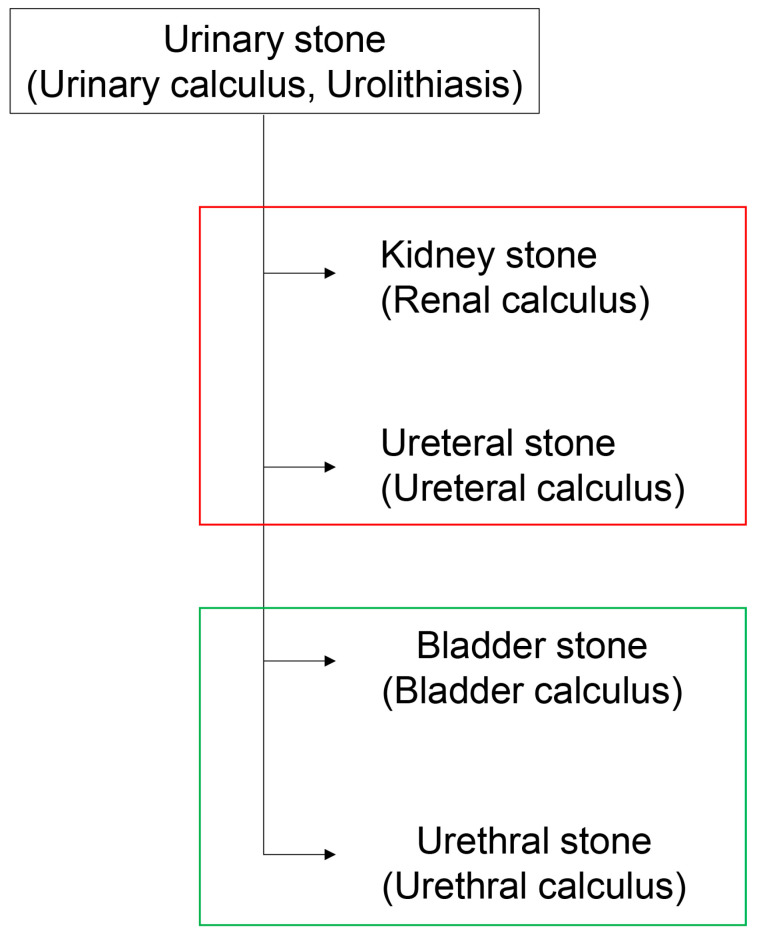
Figure 1
Figure 1
Urinary stones (urolithiasis) include kidney stones, ureteral stones, bladder stones, and urethral stones. The open red box indicates the upper urinary tract. An open green box indicates the lower urinary tract.
Figure 2
Figure 2
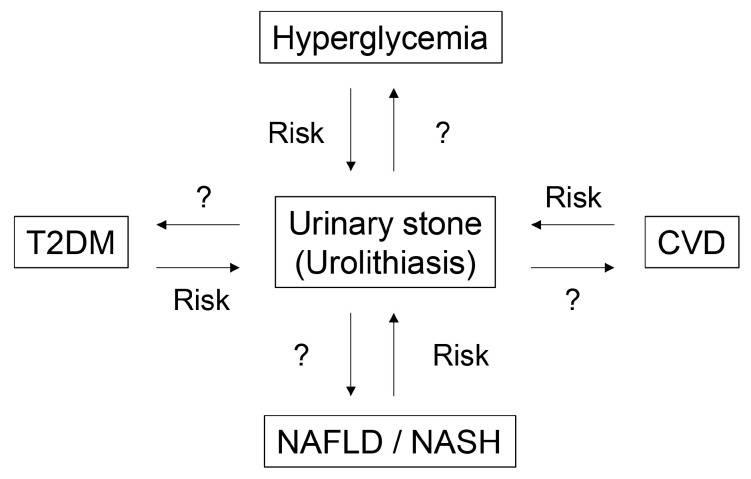
The relationship between urinary stones and lifestyle-related diseases. T2DM, type 2 diabetes mellites; CVD, cardiovascular disease; NAFLD, non-alcoholic fatty liver disease; NASH, non-alcoholic steatohepatitis.
Figure 3
Figure 3
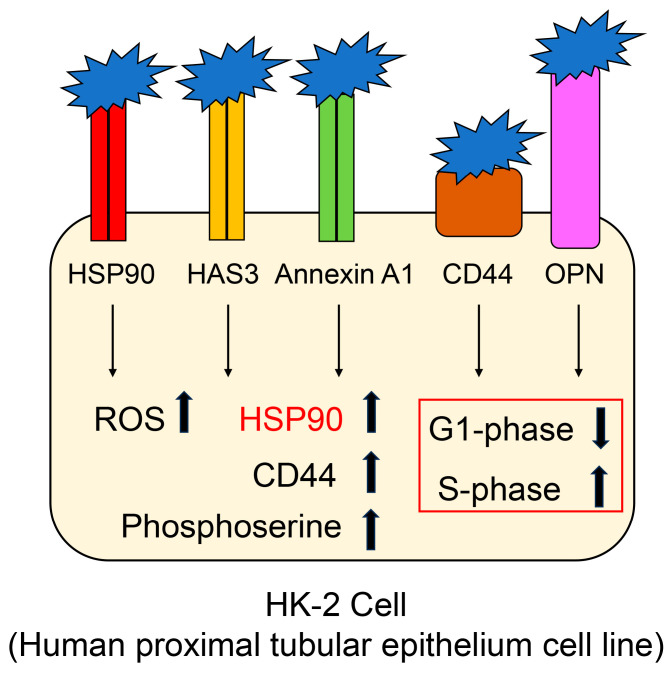
Nano-COM binds to five proteins acting as receptors and induces various processes in HK-2 cells. HSP90, HAS3, annexin A1, CD44, and osteopontin located on the membrane act as its receptors. Closed blue prickly leaves indicate nano-COM. The closed red, orange, green, brown, and pink squares indicate HSP90, HAS3, annexin A1, CD44, and OPN, respectively. The open red square shows the cell cycle effects. COM, calcium oxalate monohydrate; HSP90, heat shock protein 90; HAS3, hyaluronic acid synthase 3; CD44, cluster of differentiation 44; OPN, osteopontin. ROS, reactive oxygen species.
Figure 4
Figure 4
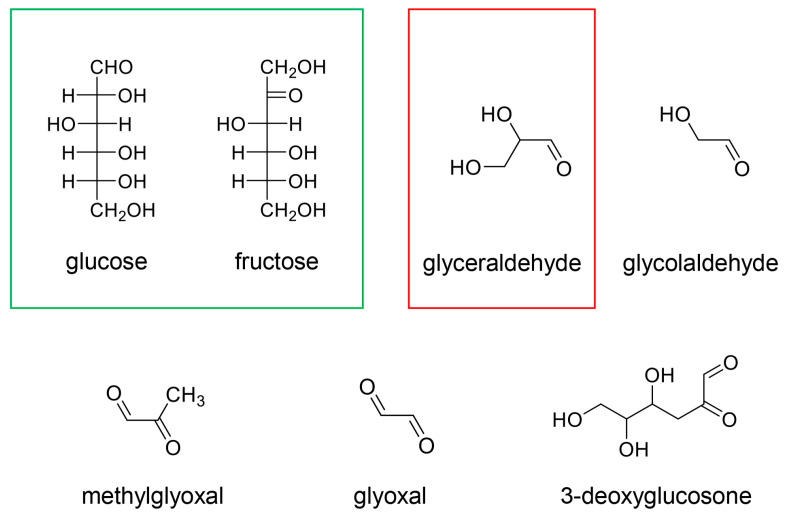
The origin of AGEs. The open green box indicates hexoses. The open red box indicates a triose. Glucose, fructose, and glyceraldehyde are saccharides. In contrast, glyceraldehyde, glycolaldehyde, methylglyoxal, glyoxal, and 3-deoxyglycosone are the metabolic intermediates/non-enzymatic reaction sub-products of glucose and fructose.
Figure 5
Figure 5
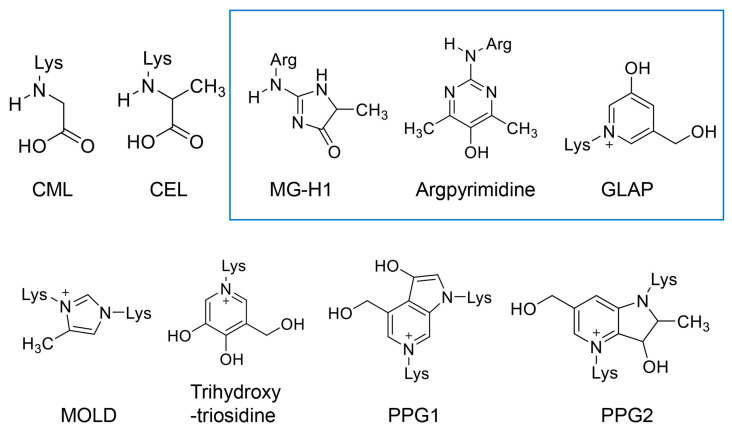
Free-type AGEs containing one or two amino acid residues. The AGEs in the upper tier contain one amino acid residue. The AGEs in the lower tier contain two amino acid residues. Lys, lysine; Arg, arginine [19,80]; CML, Nε-carboxymethyl-lysine [17,18,19,80]; Nε-carboxyethyl-lysine [17,18,19,80]; MG-H1, Nδ-(5-hydrox-5-methyl-4-imidazolone-2-yl)-ornithine (methylglyoxal-derived hydroimidazolone) [17,18,19,79,80]; GLAP, 3-hydroxy-5-hydroxymethyl-1-pyridinium [17,19,79,80]; MOLD, 6-{1-(5S)-5-ammonio-6-oxido-6-oxyohexyl-}-4-methyl-imidazolium-3-yl-L-norleucine (methylglyoxal dimer) [17,19,80]. PPG1 and 2, pyrrolopyridinium-lysine dimer derived from glyceraldehyde 1 and 2 [19,82]. The open blue box indicates free-type AGEs generated from both glyceraldehyde and methylglyoxal [18,19,79].
Figure 6
Figure 6
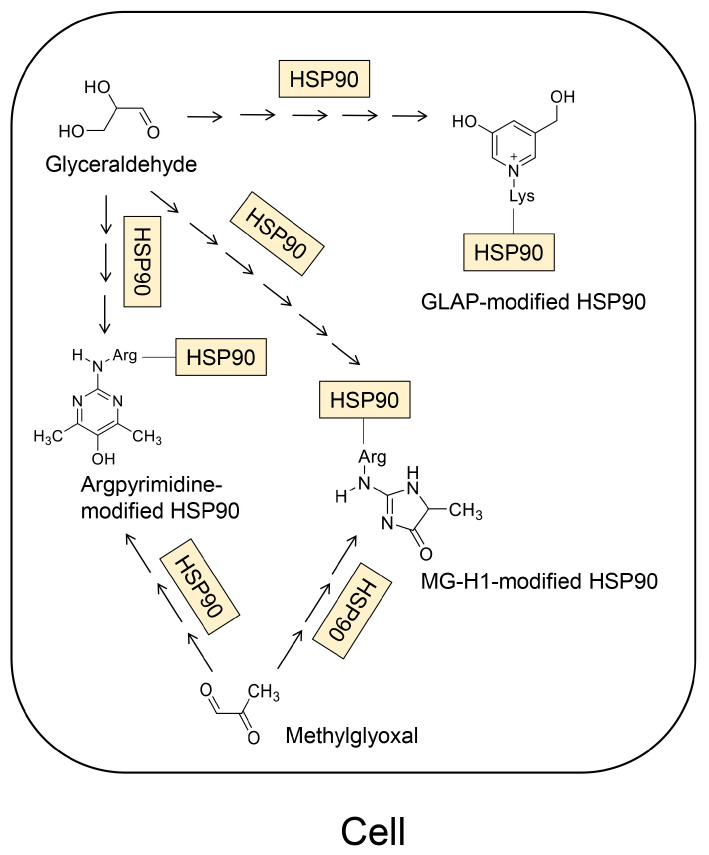
MG-H1-, argpyrimidine-, and GLAP-modified HSP90s can be generated from glyceraldehyde and/or methylglyoxal in the cell [21,22]. Lys, lysine; Arg, arginine; HSP90, heat shock protein 90. The arrows show a step of the Maillard and a non-enzymatic reaction between methylglyoxal and an amino acid residue (lysine or arginine) in HSP90.
Figure 7
Figure 7
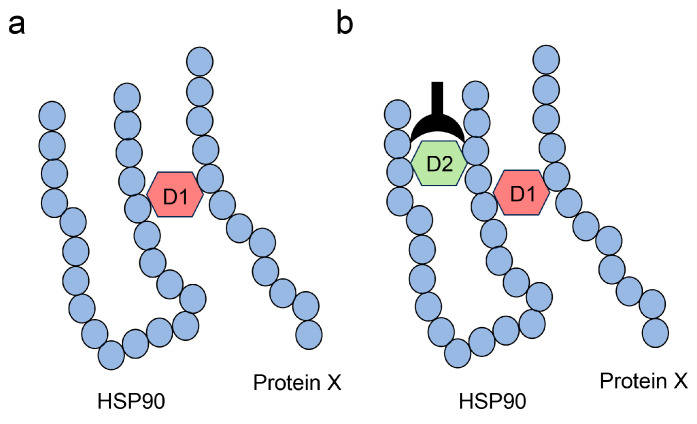
Model of the free-type AGE combined with HSP90 and another protein (protein X) via an intermolecular covalent bond, and with the amino acid in HSP90 via an intramolecular covalent bond. HSP90, heat shock protein 90. D1 and D2 indicate the AGEs capable of binding two amino acid residues simultaneously. (a) D1 combines HSP90 and protein X via an intermolecular covalent bond. (b) D1 combines two amino acids in both HSP90 and protein X via intermolecular covalent bonds, while D2 combines two amino acids in HSP90 via intramolecular covalent bonds. The closed black plow represents an anti-D2-antibody in HSP90.
Figure 8
Figure 8
Natural compounds that inhibit the generation of intracellular AGEs. Quercetin [19,25,98], hesperidin [19,99], p-hydroxy cinnamic acid [19,25,100], resveratrol [19,25,101,102,103], and curcumin [19,103] have the function of the carbonyl trap system. Both resveratrol and curcumin can activate GLO-1.

Similar articles

Cited by

References

    1. Nakazawa Y., Inoue S., Nakamura Y., Iida Y., Ishigaki Y., Miyazawa K. High-salt diet promotes crystal deposition through hypertension in Dahl salt-sensitive rat model. Int. J. Urol. 2019;26:839–846. doi: 10.1111/iju.14035. - DOI - PubMed
    1. Sakamoto S., Miyazawa K., Yasui T., Iguchi T., Fujita M., Nishimatsu H., Masaki T., Hasegawa T., Hibi H., Arakawa T., et al. Chronological changes in epidemiological characteristics of lower urinary tract urolithiasis in Japan. Int. J. Urol. 2019;26:96–101. doi: 10.1111/iju.13817. - DOI - PubMed
    1. Sholan R., Aliyev R., Hashimoto U., Karimov S., Bayramov E. Urinary Stone Composition Analysis of 1465 Patients: The First Series from Azerbaijan. Arch. Iran. Med. 2024;27:618–623. doi: 10.34172/aim.32026. - DOI - PMC - PubMed
    1. Ushimoto C., Sugiki S., Kunii K., Inoue S., Kuroda E., Akai R., Iwawaki T., Miyazawa K. Dynamic change and preventive role of stress response via Keap1-Nrf2 during renal crystal formation. Free Radic. Biol. Med. 2023;207:120–132. doi: 10.1016/j.freeradbiomed.2023.07.013. - DOI - PubMed
    1. Acharya P., Acharya C., Thongprayoon C., Hansrivijit P., Kanduri S.R., Kovvuru K., Medaura J., Vaitla P., Garcia Anton D.F., Mekraksakit P., et al. Incidence and Characteristics of Kidney Stones in Patients on Ketogenic Diet: A Systematic Review and Meta-Analysis. Diseases. 2021;9:39. doi: 10.3390/diseases9020039. - DOI - PMC - PubMed

LinkOut - more resources