


Tuning Wetting Properties Through Surface Geometry in the Cassie-Baxter State
- PMID: 39851736
- PMCID: PMC11762741
- DOI: 10.3390/biomimetics10010020
Tuning Wetting Properties Through Surface Geometry in the Cassie-Baxter State
Abstract
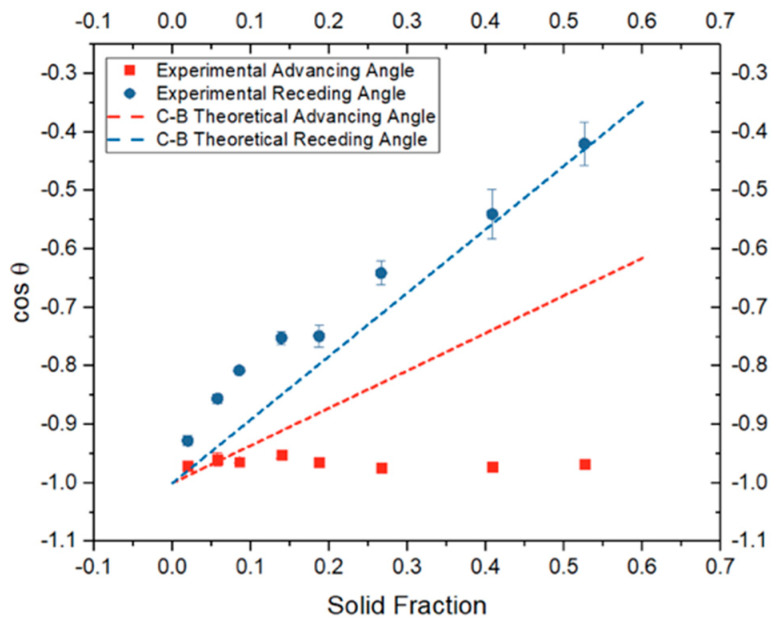
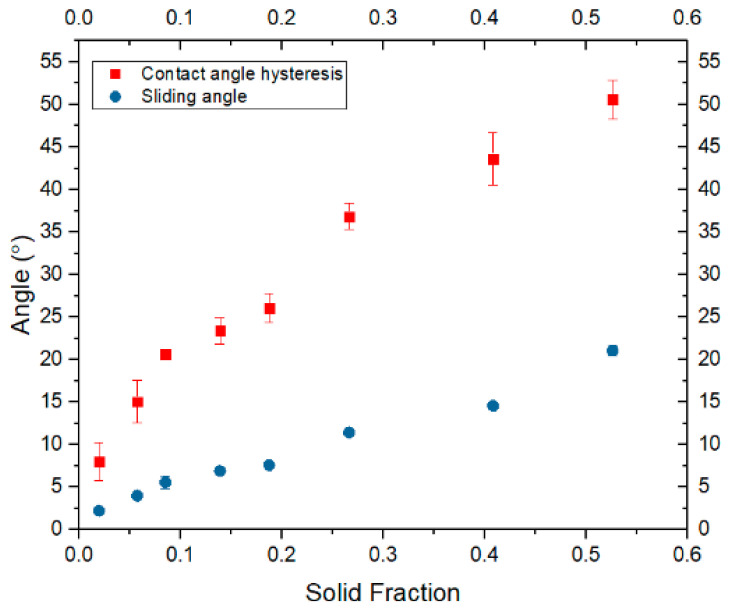
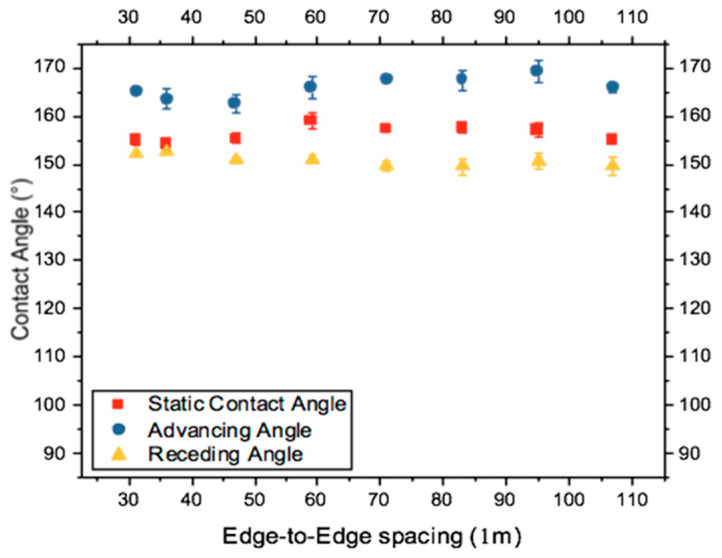
Superhydrophobic coatings are beneficial for applications like self-cleaning, anti-corrosion, and drag reduction. In this study, we investigated the impact of surface geometry on the static, dynamic, and sliding contact angles in the Cassie-Baxter state. We used fluoro-silane-treated silicon micro-post patterns fabricated via lithography as model surfaces. By varying the solid fraction (ϕs), edge-to-edge spacing (L), and the shape and arrangement of the micro-posts, we examined how these geometric factors influence wetting behavior. Our results show that the solid fraction is the key factor affecting both dynamic and sliding angles, while changes in shape and arrangement had minimal impact. The Cassie-Baxter model accurately predicted receding angles but struggled to predict advancing angles. These insights can guide the development of coatings with enhanced superhydrophobic properties, tailored to achieve higher contact angles and customized for different environmental conditions.
Keywords: Cassie–Baxter state; contact angle hysteresis (CAH); dynamic wetting; photolithography; silicon micro-posts; superhydrophobicity; surface geometry.
Conflict of interest statement
The authors declare no conflicts of interest.
Figures






References
-
- Jeevahan J., Chandrasekaran M., Joseph G.B., Durairaj R.B., Mageshwaran G. Superhydrophobic surfaces: A review on fundamentals, applications, and challenges. J. Coat. Technol. Res. 2018;15:231–250. doi: 10.1007/s11998-017-0011-x. - DOI
-
- Erbil H.Y. The debate on the dependence of apparent contact angles on drop contact area or three-phase contact line: A review. Surf. Sci. Rep. 2014;69:325–365. doi: 10.1016/j.surfrep.2014.09.001. - DOI
-
- Pierce E., Carmona F.J., Amirfazli A. Understanding of sliding and contact angle results in tilted plate experiments. Colloids Surf. A Physicochem. Eng. Asp. 2008;323:73–82. doi: 10.1016/j.colsurfa.2007.09.032. - DOI
LinkOut - more resources
Full Text Sources
