


Optimal Non-Pharmacological Interventions for Reducing Problematic Internet Use in Youth: A Systematic Review and Bayesian Network Meta-Analysis
- PMID: 39851902
- PMCID: PMC11762159
- DOI: 10.3390/bs15010098
Optimal Non-Pharmacological Interventions for Reducing Problematic Internet Use in Youth: A Systematic Review and Bayesian Network Meta-Analysis
Abstract
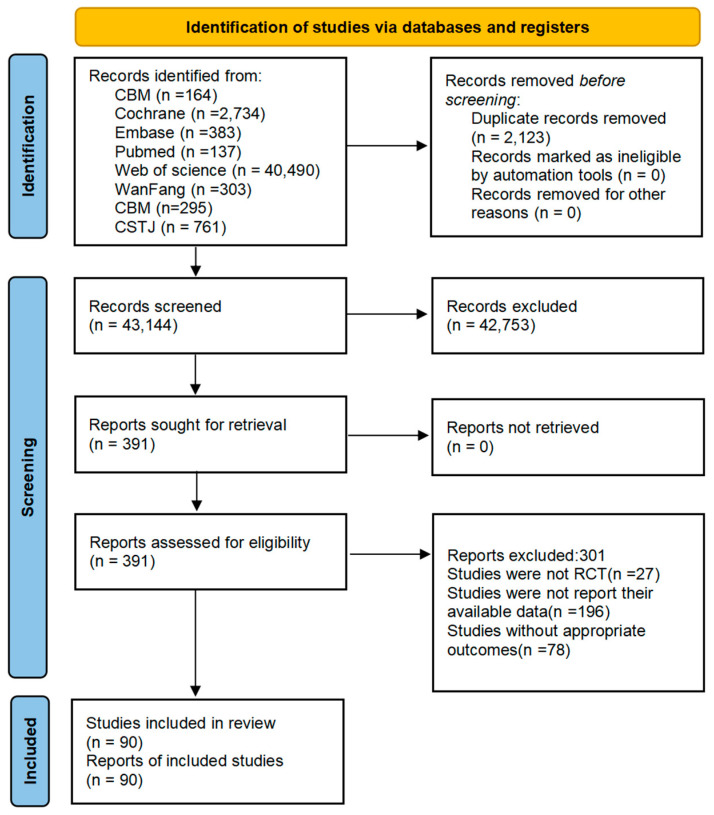
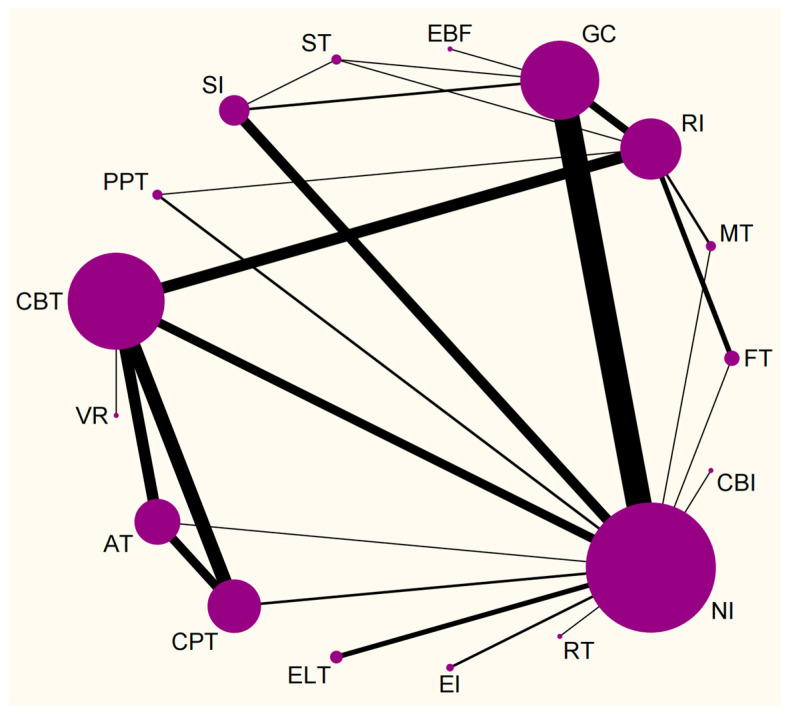
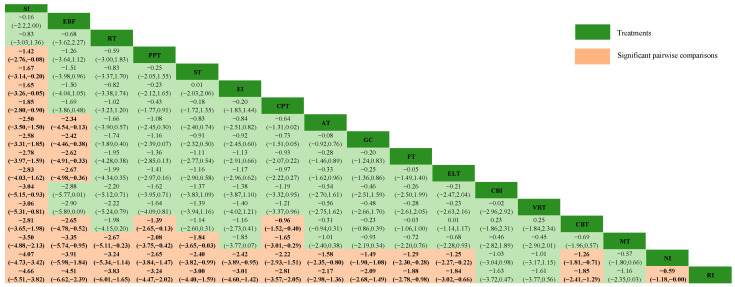
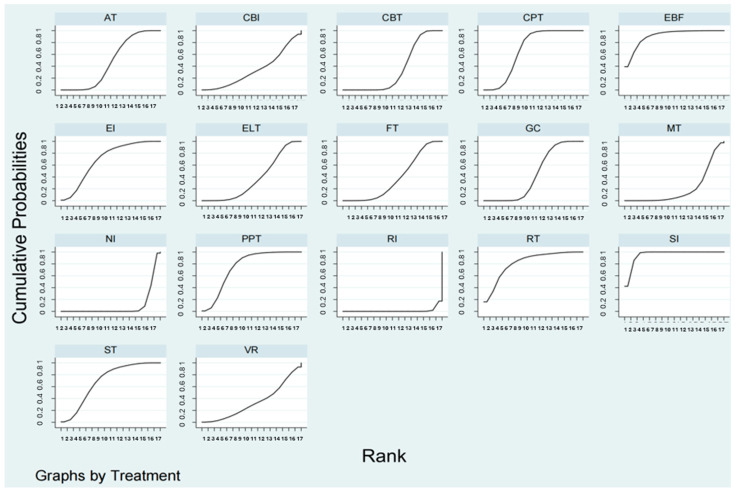
The purpose of this network meta-analysis (NMA) is to compare the effect of different non-pharmacological interventions (NPIs) on Problematic Internet Use (PIU). Randomized controlled trials (RCTs) published from their inception to 22 December 2023 were searched in Cochrane Central Register of Controlled Trials, Embase, Medline, Web of Science, China National Knowledge Infrastructure, China Science and Technology Journal Database, Chinese BioMedical Literature Database, and WanFang Data. We carried out a data analysis to compare the efficacy of various NPIs using Bayesian NMA. A battery of analyses and assessments, such as conventional meta-analysis and risk of bias, were performed concurrently. Two reviewers extracted data and evaluated bias using the Cochrane Risk of Bias tool independently. We identified 90 RCTs including 15 different NPIs (5986 participants), namely sports intervention (SI), electroencephalogram biological feedback (EBF), reality therapy (RT), positive psychology therapy (PPT), sandplay therapy (ST), educational intervention (EI), compound psychotherapy (CPT), electroacupuncture therapy (AT), group counseling (GC), family therapy (FT), electrotherapy (ELT), craving behavior intervention (CBI), virtual reality therapy (VRT), cognitive behavior therapy (CBT), and mindfulness therapy (MT). Our NMA results showed that SI, EBF, RT, PPT, ST, EI, CPT, AT, GC, FT, ELT, CBT, CBI, VRT, and MT were effective in reducing PIU levels. The most effective NPI was SI (SMD = -4.66, CrI: -5.51, -3.82, SUCRA = 95.43%), followed by EBF (SMD = -4.51, CrI: -6.62, -2.39, SUCRA = 90.89%) and RT (SMD = -3.83, CrI: -6.01, -1.62, SUCRA = 81.90%). Our study showed that SI was the best NPI to relieve PIU levels in youth. Medical staff should be aware of the application of SI to the treatment of PIU in youth in future clinical care.
Keywords: internet addiction; network meta-analysis; non-pharmacological interventions; problematic internet use; youth.
Conflict of interest statement
The authors declare no conflicts of interest.
Figures
References
-
- Adalıer A., Balkan E. The relationship between internet addiction and psychological symptoms. International Journal of Global Education (IJGE) 2012;1(2):45–48.
-
- Banerjee S., Hellier J., Dewey M., Romeo R., Ballard C., Baldwin R., Bentham P., Fox C., Holmes C., Katona C., Knapp M., Lawton C., Lindesay J., Livingston G., McCrae N., Moniz-Cook E., Murray J., Nurock S., Orrell M., Burns A. Sertraline or mirtazapine for depression in dementia (HTA-SADD): A randomised, multicentre, double-blind, placebo-controlled trial. Lancet. 2011;378(9789):403–411. doi: 10.1016/S0140-6736(11)60830-1. - DOI - PubMed
-
- Bastioli G., Arnold J. C., Mancini M., Mar A. C., Gamallo-Lana B., Saadipour K., Chao M. V., Rice M. E. Voluntary exercise boosts striatal dopamine release: Evidence for the necessary and sufficient role of BDNF. Journal of Neuroscience. 2022;42(23):4725–4736. doi: 10.1523/JNEUROSCI.2273-21.2022. - DOI - PMC - PubMed
-
- Burton J. K., Craig L. E., Yong S. Q., Siddiqi N., Teale E. A., Woodhouse R., Barugh A. J., Shepherd A. M., Brunton A., Freeman S. C., Sutton A. J., Quinn T. J. Non-pharmacological interventions for preventing delirium in hospitalised non-ICU patients. Cochrane Database of Systematic Reviews. 2021;11(11):CD013307. doi: 10.1002/14651858.CD013307. - DOI - PMC - PubMed
Publication types
LinkOut - more resources
Full Text Sources
Miscellaneous
