Review
. 2025 Jan 10;16(1):20.
doi: 10.3390/jfb16010020.

Natural Protein Films from Textile Waste for Wound Healing and Wound Dressing Applications

Affiliations
Review

Natural Protein Films from Textile Waste for Wound Healing and Wound Dressing Applications

Livia Ottaviano et al. J Funct Biomater. .

Abstract

In recent years, several studies have focused on the development of sustainable, biocompatible, and biodegradable films with potential applications in wound healing and wound dressing systems. Natural macromolecules, particularly proteins, have emerged as attractive alternatives to synthetic polymers due to their biocompatibility, biodegradability, low immunogenicity, and adaptability. Among these proteins, keratin, extracted from waste wool, and fibroin, derived from Bombyx mori cocoons, exhibit exceptional properties such as mechanical strength, cell adhesion capabilities, and suitability for various fabrication methods. These proteins can also be functionalized with antimicrobial, antioxidant, and anti-inflammatory compounds, making them highly versatile for biomedical applications. This review highlights the promising potential of keratin- and fibroin-based films as innovative platforms for wound healing, emphasizing their advantages and the prospects they offer in creating next-generation wound dressing devices.

Keywords: keratin films; silk fibroin films; wound dressing; wound healing.


Conflict of interest statement

Sara Buoso, Roberto Zamboni, Giovanna Sotgiu are employees of Kerline srl. The paper reflects the views of the scientists, and not the company. The other authors declare no conflicts of interest.

Figures

Figure 1
Figure 1
Schematic representation of the methods used for film preparation: (a) solvent casting; (b) salt leaching; (c) spin coating; (d) microfluidic spinning; (e) dip coating.
Figure 2
Figure 2
Antimicrobial activity of SF–PVA and SF–PVA/ZnO composite films against (a) S. aureus, (b) E. coli, (c) P. aeruginosa, (d) P. mirabilis, and (e) S. pyogenes microorganisms. Reprinted and adapted with permission from [57]. Copyright Royal Society of Chemistry 2018.
Figure 3
Figure 3
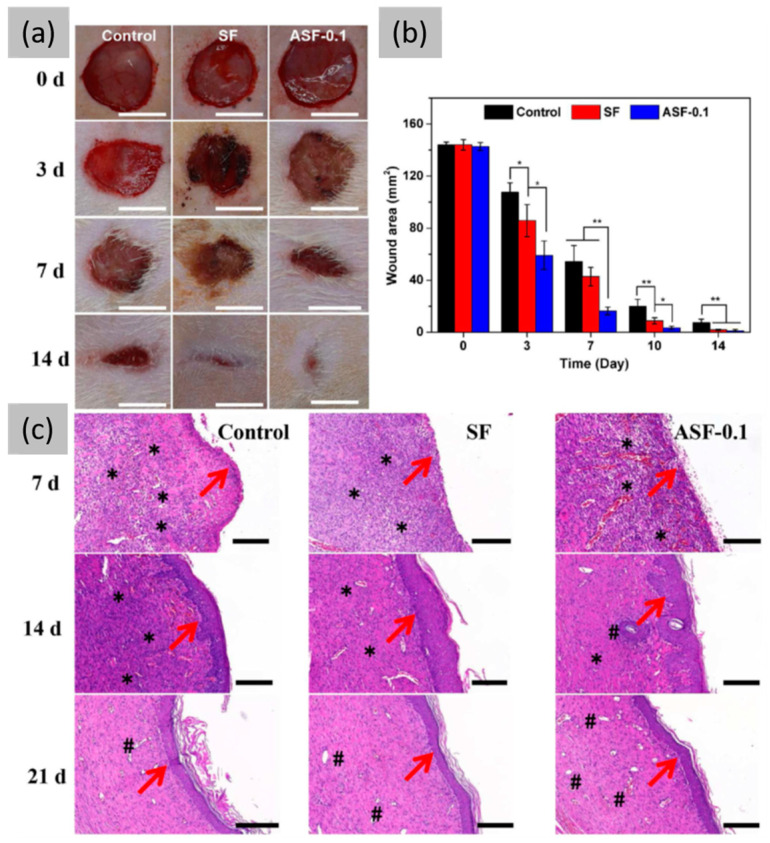
Wound healing ability of different films in a rat full-thickness wound model. (a) Representative photographs of the wound healing process over 2 weeks (scale: 10 mm). (b) Quantification of wound areas at days 0, 3, 7, 10, and 14 after operation. Note: * p < 0.05, ** p < 0.01. (c) Representative HE (hematoxylin and eosin)-stained photographs of the wound tissue regeneration process at 7, 14, and 21 days after surgery (scale: 200 µm). Note: →, new epithelium; *, inflammatory cells; #, hair follicle cells. Reprinted and adapted with permission from [79]. Copyright Elsevier Clearance Center 2023.
Figure 4
Figure 4
Antimicrobial “patch assay”. KFMB400 film placed upon LB agar inoculated with S. aureus was incubated in the dark (a) or irradiated (b) for 75 min. After film removal, bacteria were grown for 24 h at 37 °C. Reprinted and adapted with permission from [80]. Copyright Clearance Center American Chemical Society 2015.
Figure 5
Figure 5
(a) Transparency of curcumin-loaded SF film (scale bar 10 mm), (b) free-standing curcumin-loaded SF film in the dry state, (c) hydrated films follow surface contours (scale bar: 10 mm), (d) SF films can be loaded with a range of curcumin concentrations, (e) inhibition ratio kinetic curves of SF/Gly/GA/Cur composite film against S. aureus and E. coli. Reprinted and adapted with permission from [46].
Figure 6
Figure 6
Effects of IGF-1, hydrocolloid IGF-1, and SF film IGF-1 on BALB/3T3 fibroblast scratch closure, cytotoxicity, and viability. (a) Scratch closure and cytotoxicity of BALB/3T3 monolayer in the presence of hyperglycemic medium at different times. Cells were stained with LIVE/DEAD stain and examined under a fluorescence microscope. (b) Quantification of cell scratch closure after different treatments at 48 h in hyperglycemic medium. (c) Cell viability after different treatments at 72 h. Significant differences between the control (black bar) and treatment groups were determined by Dunnett’s multiple comparison post hoc test. ** p < 0.01; n = 3; mean ± SEM. (Scale bars = 500 μm). Reprinted and adapted with permission from [99].
Figure 7
Figure 7
(a) Preparation and screening of SF films with different surface roughnesses and (b) the potential mechanism of roughness on macrophage polarization. Reprinted and adapted with permission from [104]. Copyright Elsevier Clearance Center 2024.
Figure 8
Figure 8
(a) Preparation of Ker films loaded with HTlc and diclofenac (KF_D and KF_HTlcD, respectively) and (b) comparison of in vitro release profiles of KF_D and KF_HTlcD. Reprinted and adapted with permission from [109]. Copyright Elsevier Clearance Center 2018.

References

    1. Borbolla-Jiménez F.V., Peña-Corona S.I., Farah S.J., Jiménez-Valdés M.T., Pineda-Pérez E., Romero-Montero A., Del Prado-Audelo M.L., Bernal-Chávez S.A., Magaña J.J., Leyva-Gómez G. Films for Wound Healing Fabricated Using a Solvent Casting Technique. Pharmaceutics. 2023;15:1914. doi: 10.3390/pharmaceutics15071914. - DOI - PMC - PubMed
    1. Sheokand B., Vats M., Kumar A., Srivastava C.M., Bahadur I., Pathak S.R. Natural Polymers Used in the Dressing Materials for Wound Healing: Past, Present and Future. J. Polym. Sci. 2023;61:1389–1414. doi: 10.1002/pol.20220734. - DOI
    1. Çalamak S., Erdoǧdu C., Özalp M., Ulubayram K. Silk Fibroin Based Antibacterial Bionanotextiles as Wound Dressing Materials. Mater. Sci. Eng. C. 2014;43:11–20. doi: 10.1016/j.msec.2014.07.001. - DOI - PubMed
    1. Radulescu D.M., Andronescu E., Vasile O.R., Ficai A., Vasile B.S. Silk Fibroin-Based Scaffolds for Wound Healing Applications with Metal Oxide Nanoparticles. J. Drug Deliv. Sci. Technol. 2024;96:105689. doi: 10.1016/j.jddst.2024.105689. - DOI
    1. Pollini M., Paladini F. Bioinspired Materials for Wound Healing Application: The Potential of Silk Fibroin. Materials. 2020;13:3361. doi: 10.3390/ma13153361. - DOI - PMC - PubMed

LinkOut - more resources