


Is cranial anatomy indicative of fossoriality? A case study of the mammaliaform Hadrocodium wui
- PMID: 39853864
- PMCID: PMC12329393
- DOI: 10.1002/ar.25630
Is cranial anatomy indicative of fossoriality? A case study of the mammaliaform Hadrocodium wui
Abstract
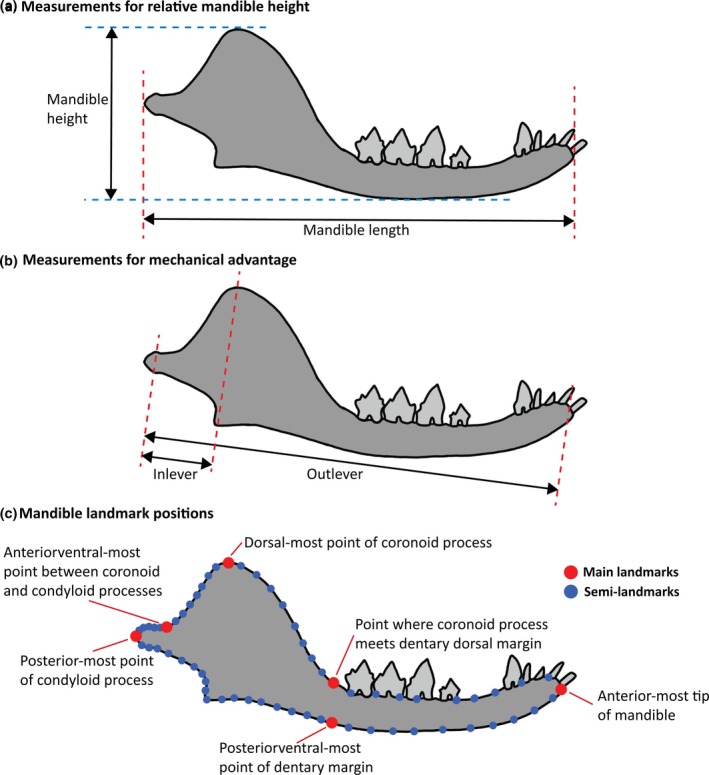
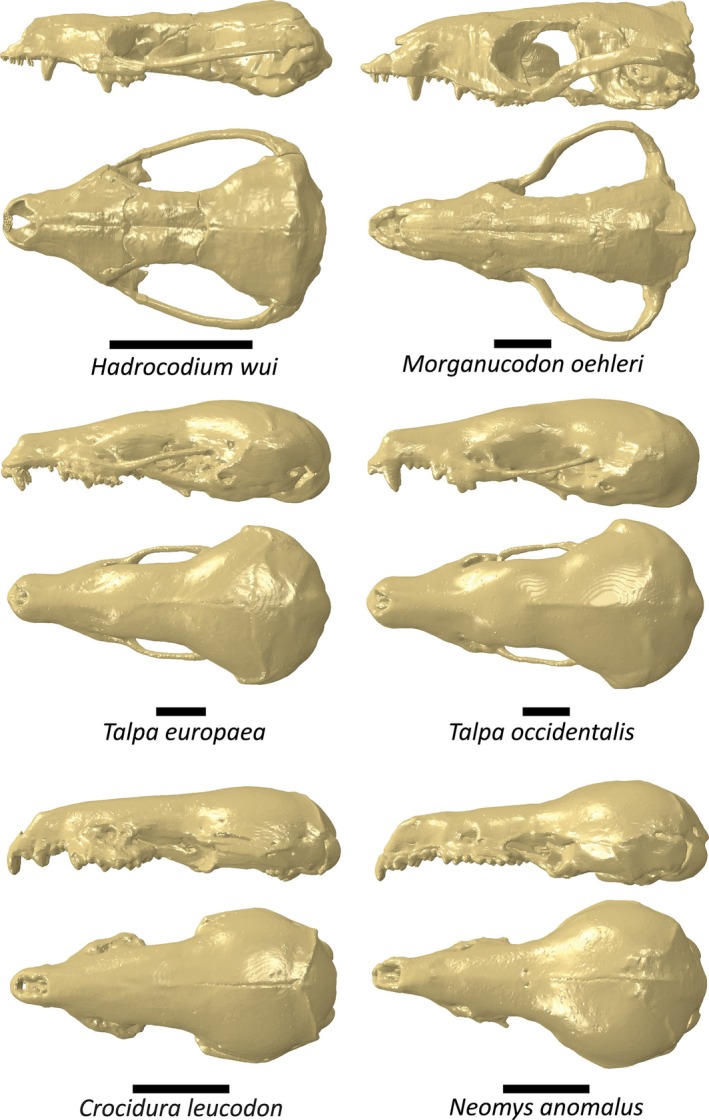
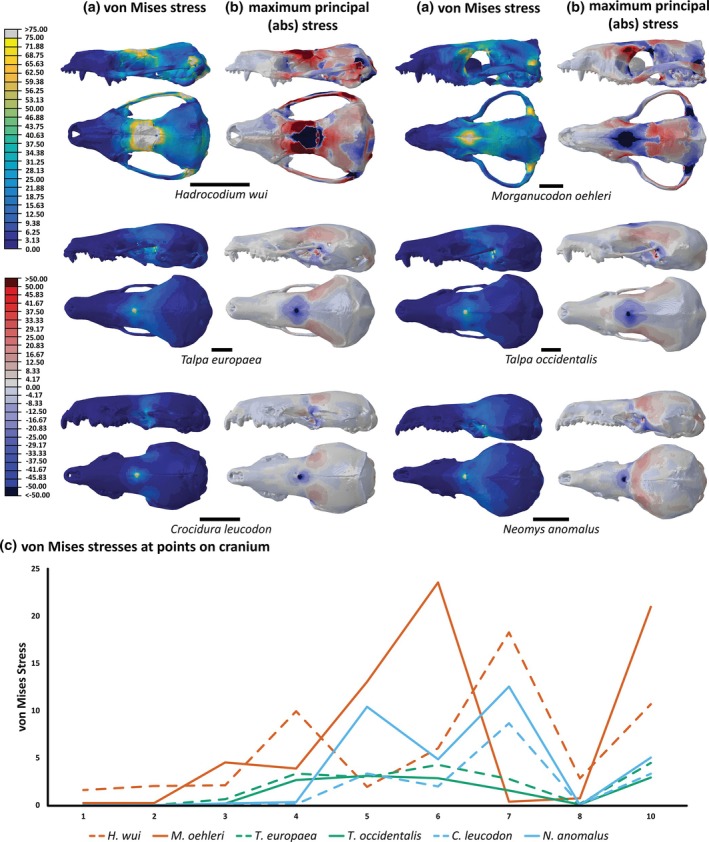
Determining the ecology of fossil species presents considerable challenges due to the often fragmentary preservation of specimens. The mammaliaform Hadrocodium wui from the Jurassic of China is known only from the cranium and mandible but may have had a fossorial lifestyle. It shares morphological similarities with talpid moles and soricid shrews and is closely related to other fossorial mammaliaforms. However, the lack of postcranial elements has so far precluded a definitive assessment regarding its fossorial behavior. Using a combination of geometric morphometric analysis of the lower mandible and finite element analyses of the cranium, comparisons between H. wui and extant groups are made. H. wui resembles talpid moles more closely than shrews in mandible shape. However, there are more similarities between H. wui and semi-fossorial/semi-aquatic moles than fully fossorial moles. The skull of H. wui is particularly weak in every tested biomechanical scenario when compared to the related mammaliaform Morganucodon oehleri and talpid moles. This weakness is potentially a result of the reduction in thickness of the zygomatic arch. In contrast, the shrew crania show similar stress magnitudes and distribution. These results imply that H. wui was not fully fossorial and fed on a diet of softer invertebrates. Skull morphology may therefore not be sufficient to infer fossoriality in forelimb-digging species.
Keywords: finite element analysis; geometric morphometrics; mammaliaformes; mammalian evolution.
© 2025 The Author(s). The Anatomical Record published by Wiley Periodicals LLC on behalf of American Association for Anatomy.
Figures





References
-
- Agrawal, V. C. (1967). Skull adaptations in fossorial rodents. Mammalia, 31(2), 300– 312.
-
- Arlton, A. V. (1936). An ecological study of the mole. Journal of Mammalogy, 17(4), 349.
-
- Becerra, F. , Casinos, A. , & Vassallo, A. I. (2012). Biting performance and skull biomechanics of a chisel tooth digging rodent (Ctenomys tuconax; Caviomorpha; Octodontoidea). Journal of Experimental Zoology Part A: Ecological Genetics and Physiology, 319(2), 74–85. - PubMed
MeSH terms
LinkOut - more resources
Full Text Sources
