


Undergraduates' lifestyle and Suboptimal Health Status (SHS): A cross-sectional study in the Ha'il region of Saudi Arabia
- PMID: 39854535
- PMCID: PMC11761099
- DOI: 10.1371/journal.pone.0317127
Undergraduates' lifestyle and Suboptimal Health Status (SHS): A cross-sectional study in the Ha'il region of Saudi Arabia
Abstract
Background: University students in Saudi Arabia are embracing some of the negative traits of the fast-paced modern lifestyle, typified by unhealthy eating, low physical activity, and poor sleep habits that may increase their risk for poor health. Health and holistic well-being at the population level are among the priorities of the 2030 vision of a vibrant society in the Kingdom of Saudi Arabia. The current study thus aims at determining the prevalence and predictive factors of Suboptimal Health Status (SHS) among university students.
Methods: A cross-sectional study was conducted among 9,026 undergraduate students between 31st May and 15th June 2023. The data was collected through an online questionnaire using the Arabic translation of the SHS (ASHSQ-25) and the Simple Lifestyle Indicator Questionnaire (SLIQ). The chi-square test, Canonical Correlation Analysis (CCA), hierarchical multiple regression, and Receiver Operating Characteristic (ROC) were performed to analyze the data using IBM SPSS software (version 25.0) at a significance level of p<0.05.
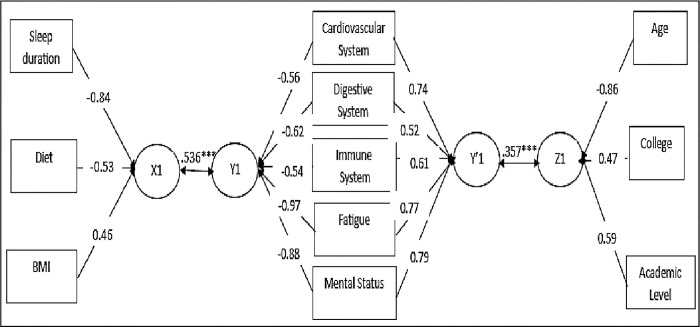
Results: The findings showed that 33.7% (3038) of the students were classified as having SHS. The prevalence of SHS was statistically higher among younger and those studying social science discipline, overweight, had poor diets, engaged in low physical activity, and slept <6 hours (p<0.001). Canonical loadings of these factors were significant in predicting the five SHS dimensions range (0.52-0.97). Furthermore, the extracted significant variables from the multiple regression analysis indicated the final model (Model 3) was statistically significant, R2 = 0.646, F (6,9019), p <0.0001, suggesting that 64.6% of the variance in the SHS can be explained by the predictor variables in the model. These variables included age, college, academic level, diet, BMI, and sleeping duration.
Conclusion: Findings show that modifiable predictors such as poor sleep quality, higher BMI scores, and poor dietary habits increase SHS risk among university students in Saudi Arabia. Therefore, the findings of this study emphasize the necessity of early interventions that promote healthy lifestyles.
Copyright: © 2025 Alsaif et al. This is an open access article distributed under the terms of the Creative Commons Attribution License, which permits unrestricted use, distribution, and reproduction in any medium, provided the original author and source are credited.
Conflict of interest statement
The authors have declared that no competing interests exist.
Figures

References
-
- UNESCO, I. for S. Higher Education _gures at a Glance.; UNESCO World Higher Education Conference: Quebec, Canada, 2022.
-
- Ahlstrand I.; Larsson I.; Larsson M.; Ekman A.; Hedén L.; Laakso K.; et al.. Health-Promoting Factors among Students in Higher Education within Health Care and Social Work: A Cross-Sectional Analysis of Baseline Data in a Multicentre Longitudinal Study. BMC Public Health 2022, 22, 1–15. - PMC - PubMed
-
- Wang W.; Yan Y.; Guo Z.; Hou H.; Garcia M.; Tan X.; et al.. All around Suboptimal Health—a Joint Position Paper of the Suboptimal Health Study Consortium and European Association for Predictive, Preventive and Personalised Medicine. EPMA J. 2021, 12, 403–433. doi: 10.1007/s13167-021-00253-2 - DOI - PMC - PubMed
MeSH terms
LinkOut - more resources
Full Text Sources
