


Impact of COVID-19 vaccination on hospitalization, hospital utilization and expenditure for COVID-19: A retrospective cohort analysis of a South African private health insured population
- PMID: 39854537
- PMCID: PMC11760578
- DOI: 10.1371/journal.pone.0317686
Impact of COVID-19 vaccination on hospitalization, hospital utilization and expenditure for COVID-19: A retrospective cohort analysis of a South African private health insured population
Abstract
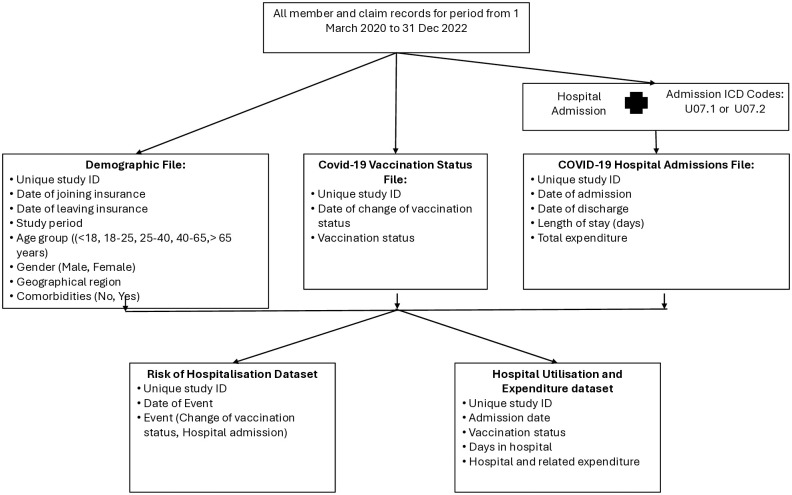
This study quantifies the impact of COVID-19 vaccination on hospitalization for COVID-19 infection in a South African private health insurance population. This retrospective cohort study is based on the analysis of demographic and claims records for 550,332 individuals belonging to two health insurance funds between 1 March 2020 and 31 December 2022. A Cox Proportional Hazards model was used to estimate the impact of vaccination (non-vaccinated, partly vaccinated, fully vaccinated) on COVID-19 hospitalization risk; and zero-inflated negative binomial models were used to estimate the impact of vaccination on hospital utilization and hospital expenditure for COVID-19 infection, with adjustments for age, sex, comorbidities and province of residence. In comparison to the non-vaccinated, the hospitalization rate for COVID-19 was 94.51% (aHR 0.06, 95%CI 0.06, 0.07) and 93.49% (aHR 0.07, 95%CI 0.06, 0.07) lower for the partly and fully vaccinated respectively; hospital utilization was 17.70% (95% CI 24.78%, 9.95%) and 20.04% (95% CI 28.26%, 10.88%) lower; the relative risk of zero hospital days was 4.34 (95% CI 4.02, 4.68) and 18.55 (95% CI 17.12, 20.11) higher; hospital expenditure was 32.83% (95% CI 41.06%, 23.44%) and 55.29% (95% CI 61.13%, 48.57%) lower; and the relative risk of zero hospital expenditure was 4.38 (95% CI 4.06, 4.73) and 18.61 (95% CI 17.18, 20.16) higher for the partly and fully vaccinated respectively. Taken together, findings indicate that all measures of hospitalization for COVID-19 infection were significantly lower in the partly or fully vaccinated in comparison to the non-vaccinated. The use of real-world data and an aggregated level of analysis resulted in the study having several limitations. While the overall results may not be generalizable to other populations, the findings add to the evidence based on the impact of COVID-19 vaccination during the period of the pandemic.
Copyright: © 2025 Solanki et al. This is an open access article distributed under the terms of the Creative Commons Attribution License, which permits unrestricted use, distribution, and reproduction in any medium, provided the original author and source are credited.
Conflict of interest statement
Geetesh Solanki is employed on a contractual basis by the South African Medical Research Council and NMG Consultants and Actuaries, an independent consulting firm providing consulting and actuarial services to South African private health insurance funds. NMG provided access to the data used for the study but did not have any other role or involvement in the study design, data collection and analysis, decision to publish, or preparation of the manuscript and Geetesh Solanki’s commercial affiliation to NMG therefore played no role in influencing the study. Geetesh Solanki’s association with NMG does not alter our adherence to PLOS One policies on sharing data and materials.
References
-
- Statement on the second meeting of the International Health Regulations (2005) Emergency Committee regarding the outbreak of novel coronavirus (2019-nCoV) [Internet]. Geneva WHO; 2020
-
- WHO Director-General’s opening remarks at the media briefing on COVID-19–11 March 2020 [Internet]. Geneva WHO; 2020
-
- World Health Organisation. WHO Coronavirus (COVID-19) Dashboard. https://covid19.who.int/table.
MeSH terms
Substances
LinkOut - more resources
Full Text Sources
Medical
