


The association of activity patterns on female reproductive diseases: a prospective cohort study of UK biobank
- PMID: 39856643
- PMCID: PMC11762564
- DOI: 10.1186/s12889-025-21576-z
The association of activity patterns on female reproductive diseases: a prospective cohort study of UK biobank
Abstract
Objective: Little is known about the role of timing of physical activity in female reproductive disorders. These disorders include polycystic ovary syndrome (PCOS), heavy menstrual bleeding (HMB), endometriosis, infertility, and pregnancy-related disorders. This study aims to investigate the associations of activity patterns with female reproductive diseases.
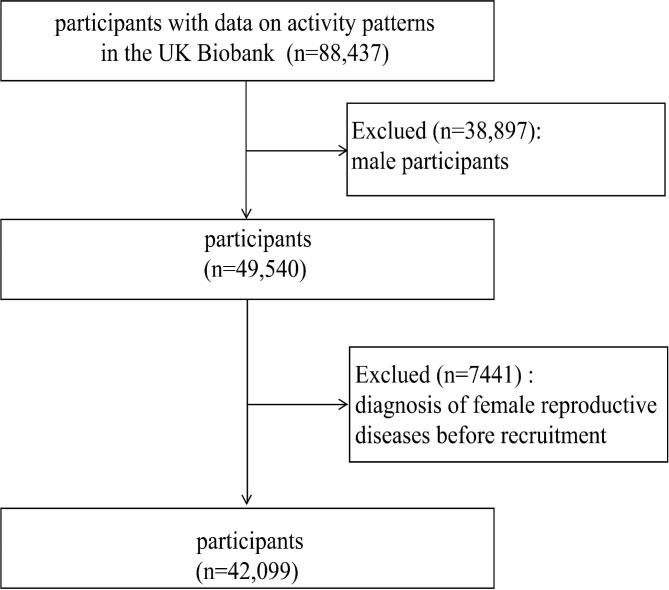
Methods: A total of 49,540 female participants from the UK Biobank with valid accelerometer data were enrolled at baseline. Activity patterns were defined based on the timing of moderate-to-vigorous intensity physical activity (MVPA) throughout the day. Participants were categorized into four groups according to the timing of their MVPA: "morning, evening, mixed, midday-afternoon", with the midday-afternoon group serving as the reference. Cox proportional hazards models were utilized to evaluate the association between activity patterns and female reproductive diseases.
Results: During a median follow-up of 12.6 years, a total of 1044 cases of female reproductive diseases were documented. After adjustment for potential confounders, compared to women with midday-afternoon exercise, women with morning exercise and mixed-timing exercise were associated with lower risks for female reproductive diseases (HRmorning=0.81, 95% CI: 0.67-0.98; HRmixed=0.79, 95% CI: 0.69-0.91, P-trend < 0.05). Moreover, morning exercise and mixed-timing exercise had lower risks of PCOS (HRmorning=0.38, 95% CI: 0.15-0.97; HRmixed=0.27, 95% CI: 0.13-0.57, P-trend<0.001), and mixed-timing exercise was associated with a lower risk for HMB (HRmixed=0.81, 95% CI: 0.70-0.95, P-trend < 0.05), compared with the reference group.
Conclusions: Compared with midday-afternoon group, morning and mixed MVPA timing groups, but not evening group, were associated with decreased risks for female reproductive diseases and PCOS. In addition, we found that women with mixed MVPA timing exercise had a lower risk of HMB, compared with the reference group.
Keywords: Activity patterns; Female reproductive diseases; Heavy menstrual bleeding; Polycystic ovary syndrome; Valid accelerometer.
© 2025. The Author(s).
Conflict of interest statement
Declarations. Ethics approval and consent to participate: All procedures followed were in accordance with the ethical standards of the responsible committee on human experimentation (institutional and national) and with the Helsinki Declaration of 1975, as revised in 2008 (5). This research has been conducted using the UK Biobank Resource. The UK biobank has approval from the North West Multi-centre Research Ethics Committee (MREC) as a Research Tissue Bank (RTB) approval (application ID:103547), and all participants agreed and provided written informed consent. Consent for publication: Not applicable. Competing interests: The authors declare no competing interests.
Figures
References
-
- Venkatesh SS, Ferreira T, Benonisdottir S, Rahmioglu N, Becker CM, Granne I, Zondervan KT, Holmes MV, Lindgren CM, Wittemans LBL. Obesity and risk of female reproductive conditions: A Mendelian randomisation study. PLoS Med. 2022;19(2):e1003679. 10.1371/journal.pmed.1003679. Erratum in: PLoS Med. 2022;19(9):e1004095. PMID: 35104295; PMCID: PMC8806071. - PMC - PubMed
MeSH terms
Grants and funding
LinkOut - more resources
Full Text Sources
Medical
