


Physicians' Intentions to Recommend Influenza Vaccine: A Multi-Centered Hospital-Based Study Using the Theory of Planned Behavior in Bangladesh
- PMID: 39857537
- PMCID: PMC11765029
- DOI: 10.3390/ijerph22010084
Physicians' Intentions to Recommend Influenza Vaccine: A Multi-Centered Hospital-Based Study Using the Theory of Planned Behavior in Bangladesh
Abstract
Background: Influenza remains a significant public health challenge in low- and middle-income countries (LMICs) like Bangladesh, where vaccine uptake remains low despite the substantial disease burden. Physicians play a vital role in promoting vaccination, yet their intentions and influencing factors are not well understood.
Methods: We conducted a cross-sectional study from June to October 2022 across four tertiary-level hospitals in Bangladesh using a questionnaire grounded in the Theory of Planned Behavior (TPB). Hierarchical logistic regression was employed to identify factors associated with vaccine recommendation intentions.
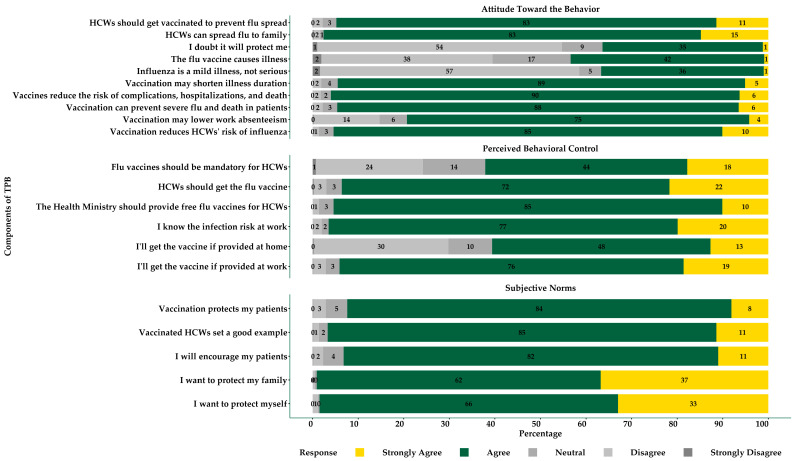
Results: Among 972 physicians with an average age of 32.1 years, 40.1% intended to recommend and administer the influenza vaccine. Most (85.3%) agreed vaccination reduces risk, 65.5% desired vaccination for self-protection, 63.5% would vaccinate if available at work, and 85.3% anticipated Ministry of Health support. Male (OR = 1.9, 95% CI: 1.5-2.3) and married (OR = 1.5, 95% CI: 1.1-1.9) physicians were more likely to recommend vaccination. Each unit increase in attitude score doubled the likelihood of recommending the vaccine (OR = 2.0, 95% CI: 1.4-3.0).
Conclusions: Physicians' influenza vaccine recommendations in Bangladesh are suboptimal, influenced by gender, marital status, and attitudes. Targeted educational interventions addressing attitudinal barriers and leveraging institutional support could improve recommendation practices.
Keywords: Bangladesh; Theory of Planned Behavior (TPB); influenza vaccine; intention to recommend; physician attitudes and behaviors.
Conflict of interest statement
The authors declare no conflicts of interest.
Figures
References
-
- World Health Organization Global Influenza Strategy 2019–2030. [(accessed on 20 October 2024)]. Available online: https://www.who.int/publications/i/item/9789241515320.
-
- World Health Organization Influenza (Seasonal) Fact Sheet. [(accessed on 20 October 2024)]. Available online: https://www.who.int/news-room/fact-sheets/detail/influenza-(seasonal)
-
- Wang X., Li Y., Mei X., Bushe E., Campbell H., Nair H. Global hospital admissions and in-hospital mortality associated with all-cause and virus-specific acute lower respiratory infections in children and adolescents aged 5–19 years between 1995 and 2019: A systematic review and modelling study. BMJ Glob. Health. 2021;6:e006014. doi: 10.1136/bmjgh-2021-006014. - DOI - PMC - PubMed
MeSH terms
Substances
Grants and funding
LinkOut - more resources
Full Text Sources
Medical
